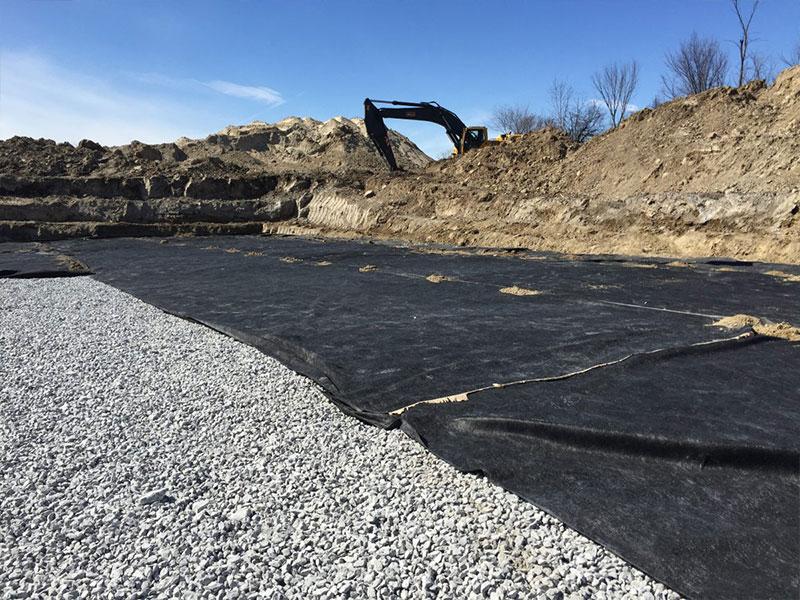
Successful road, utility, commercial, and site-development projects depend on more than simply delivering “rock” to a jobsite.
Contractors, engineers, aggregate producers, inspectors, and material suppliers may all use slightly different terminology when describing the materials beneath a pavement, parking lot, building pad, haul road, or utility trench. Some names come from formal Iowa DOT or SUDAS specifications, while others develop through years of local construction practice.
Terms such as Special Backfill, Class A stone, Macadam, recycled concrete, road stone, clean stone, and modified subbase may sound interchangeable. They are not.
Understanding the differences—and knowing how each material interacts with the underlying soil—is an important part of building a stable, economical pavement section.
In construction, aggregate generally refers to processed stone, gravel, sand, recycled pavement, or a blend of granular materials.
Aggregate may be used to:
- Create a working surface over soft soils
- Distribute vehicle and equipment loads
- Provide drainage
- Support pavement
- Backfill utility trenches
- Improve compaction
- Reduce frost-related movement
- Separate the finished pavement from the natural subgrade
The right material depends on what the aggregate is expected to accomplish.
A dense-graded road base, for example, performs differently than an open-graded drainage stone. Likewise, recycled asphalt behaves differently from crushed limestone when placed over wet or weak subgrade.
Recycled Crushed Concrete
Recycled crushed concrete, commonly called recycled concrete aggregate or RCA, is produced by crushing and processing concrete removed from roads, parking lots, buildings, and other structures.
Steel reinforcement and unsuitable debris are removed, and the remaining concrete is processed to the required particle-size distribution.
In Iowa, crushed Portland cement concrete may be permitted in several applications, including granular subbase, Special Backfill, pipe bedding, stabilization material, and other approved uses. Acceptance depends on the application, required gradation, material source, and approval of the engineer or governing agency.
Potential advantages include:
- Reuse of existing construction materials
- Reduced demand for virgin aggregate
- Potentially lower hauling and disposal costs
- Good angularity and interlock
- Availability near pavement-reconstruction projects
However, recycled concrete is not automatically suitable simply because it has been crushed. Gradation, contamination, durability, particle breakdown, and consistency still matter.
Reclaimed Asphalt Pavement
Reclaimed Asphalt Pavement, or RAP, is asphalt pavement that has been milled, removed, crushed, or otherwise processed for reuse.
RAP is widely used as a component in new hot-mix asphalt, but it may also be approved for certain granular applications.
Current Iowa DOT Special Backfill specifications allow reclaimed hot-mix asphalt as an approved source when it complies with the applicable material requirements. The specification identifies a nominal maximum particle size of 2 inches and states that reclaimed HMA should not be placed below the high-water table.
RAP can offer several advantages:
- Reuse of aggregate and asphalt binder
- Reduced disposal requirements
- Good compaction under appropriate conditions
- Potential cost savings
- Reduced need for virgin materials
RAP may also behave differently from crushed stone as temperatures change. The residual asphalt binder can influence stiffness, compaction, drainage, and long-term performance. That makes the location and intended use especially important.
Special Backfill
In everyday conversation, “Special Backfill” is sometimes treated as a generic name for road base. Under Iowa DOT terminology, however, it is a defined material category.
Iowa DOT Special Backfill may consist of:
- Crushed stone
- Crushed concrete pavement
- Crushed composite pavement
- Reclaimed hot-mix asphalt
- Mixtures of gravel, sand, and soil
- Uniformly blended combinations of approved materials
Crushed stone, crushed PCC, and crushed composite pavement are generally required to meet Iowa DOT Gradation No. 30. Gravel-based blends are generally associated with Gradation No. 31.
Special Backfill is frequently encountered beneath pavement, around structures, in over-excavated areas, and in other locations where a compactable granular material is needed.
The word special does not mean that the material is automatically stronger than every other aggregate. It means that it must meet the applicable specification for that named material.
Class A Crushed Stone
The term Class A road stone is commonly heard in Iowa, although the formal Iowa DOT terminology is generally Class A Crushed Stone.
Class A refers to material quality requirements—not merely the rock’s nominal particle size. Iowa DOT quality requirements address characteristics such as freeze-thaw durability, abrasion resistance, and clay or friable-particle content.
This distinction is important.
Two piles of crushed limestone may look nearly identical, but they may not meet the same quality requirements. The source geology, durability testing, processing, and final gradation determine whether the material complies with a particular specification.
Class A crushed stone is commonly associated with granular surfacing and road-building applications where durability under traffic and Iowa weather conditions is important.
Macadam Stone Base
Macadam is one of the oldest terms still regularly used in road construction.
The system takes its name from John Loudon McAdam, who promoted building roads with controlled layers of angular, compacted stone. Modern Macadam construction has evolved considerably, but the basic principle of using interlocked stone remains.
Under current Iowa DOT specifications, a Macadam stone base includes:
- Preparation of the subgrade
- A filter course
- Placement and compaction of a Macadam base course
- Placement of choke stone
- Application of a prime before the surface course
The larger Macadam stone creates a load-supporting stone structure. The smaller choke stone fills and locks the upper voids, helping create a tighter, more stable surface.
Macadam should not be confused with a conventional dense-graded aggregate base. The particle-size distribution and construction method are different.
Granular Subbase
A granular subbase is a compacted layer placed between the natural or improved subgrade and the overlying pavement or base.
Its functions may include:
- Providing a stable construction platform
- Improving load distribution
- Limiting contamination from the subgrade
- Providing drainage
- Reducing frost-related problems
- Supporting pavement construction equipment
Iowa DOT specifications permit qualifying granular materials and, under defined conditions, recycled PCC for granular subbase construction.
Typically, one cannot drive too much construction equipment on Granular Subbase as it does not lock up well and will roll around. Modified Subbase performs better under construction traffic loads (IE concrete trucks, etc.).
The subbase is not expected to correct every soil problem by itself. When the underlying soil is extremely wet, pumping, unstable, or weak, simply adding more aggregate may not be the most efficient solution.
Modified Subbase
Modified Subbase is a specific Iowa DOT material and construction method used to create a stable pavement foundation over prepared subgrade.
Despite the name, “modified” does not mean the soil is chemically treated. It refers to a compacted aggregate subbase made from approved materials such as:
- Crushed stone
- Crushed gravel
- Recycled concrete pavement
- Reclaimed asphalt pavement
- Uniform blends of approved materials
The material must meet the applicable Iowa DOT gradation and quality requirements. Reclaimed asphalt may be limited as a percentage of the total blend and is not permitted below the high-water table.
Modified Subbase construction also includes more than simply placing aggregate. The Iowa DOT procedure requires preparation and proof rolling of the subgrade, correction of unstable areas, uniform moisture conditioning of the aggregate, placement in controlled lifts, and thorough compaction.
The completed layer helps:
- Create a stable working platform
- Distribute pavement loads
- Provide uniform support beneath the pavement
- Reduce localized yielding and rutting
- Improve the performance of the overall pavement section
Modified Subbase differs from Special Backfill because each has its own material requirements, gradation, intended applications, and construction specifications.
As with other aggregate sections, Modified Subbase still depends on the condition of the underlying soil. When the subgrade is weak, wet, or prone to pumping, a stabilization geogrid or separation geotextile may be needed to help keep the aggregate confined and prevent contamination.
Well-Graded Aggregate
A well-graded aggregate contains a continuous range of particle sizes—from larger stone down through smaller particles and fines.
The smaller particles fit into spaces between the larger particles, allowing the material to compact into a dense mass.
Well-graded aggregate is commonly selected when the goal is to create:
- A firm working surface
- A dense road base
- A compacted building pad
- A stable shoulder
- A durable granular driving surface
The fines help fill voids, but excessive fines can also hold water and contribute to rutting or pumping when the material is placed over weak, saturated soil.
Open-Graded Aggregate
An open-graded aggregate contains relatively few fine particles.
Because the voids between the larger particles remain open, water can move through the aggregate more freely. Open-graded materials are often used for drainage, pipe bedding, permeable pavement systems, wall drainage, and foundation stabilization.
SUDAS specifications, for example, recognize clean, open-graded crushed stone for certain pipe bedding and stabilization applications.
Open-graded stone can provide excellent drainage and strong stone-to-stone contact, but it presents another concern: weak subgrade soil may migrate upward into the open voids.
That is where separation becomes important.
Choke Stone
Choke stone is smaller aggregate placed over larger, open-textured stone to fill or partially fill the surface voids.
It is commonly associated with Macadam base construction.
The choke stone helps:
- Lock the larger aggregate together
- Create a smoother finished surface
- Improve equipment travel
- Prepare the base for the next pavement layer
Choke stone should not be confused with soil fines pumping upward from the subgrade. One is an intentionally placed construction material; the other is contamination that can weaken the aggregate layer.
Crusher Run, Road Stone, and Road Base
Terms such as crusher run, road stone, road base, road bond, and crushed aggregate base are often used informally.
Their meanings can vary by quarry, contractor, county, or region. One producer’s “road stone” may not have the same gradation or quality as another producer’s material with the same nickname.
For that reason, project decisions should be based on more than the informal product name.
Before ordering, it is worth confirming:
- The governing specification
- Required gradation
- Maximum particle size
- Percentage of fines
- Material source
- Durability requirements
- Whether recycled materials are permitted
- Whether the aggregate is intended for drainage or compaction
- Whether a geotextile or geogrid is required beneath it
Where Geogrid Fits into the Aggregate Section
Aggregate is often treated as the material that provides all the strength in an unpaved road or pavement foundation.
That is only part of the story.
The performance of an aggregate layer depends on its interaction with the soil beneath it. When the subgrade is weak, aggregate particles can move laterally under traffic. The stone can rut downward while soft soil pumps upward into the aggregate.
As contamination and lateral movement increase, the effective aggregate thickness decreases.
A properly selected stabilization geogrid is placed at or near the interface between the aggregate and the subgrade. Aggregate particles partially enter and engage with the geogrid apertures. This interaction helps confine the aggregate and limit lateral particle movement.
The stabilized aggregate layer can then distribute wheel loads over a broader area.
Depending on the project conditions and design, geogrid stabilization may help:
- Improve construction access
- Reduce rutting
- Reduce aggregate movement
- Increase the effectiveness of the aggregate layer
- Improve proof-roll performance
- Reduce undercutting
- Reduce the required aggregate thickness
- Extend pavement or haul-road service life
Geogrid does not turn unsuitable material into good aggregate, and it does not eliminate the need for proper drainage or compaction. It makes the aggregate layer work more efficiently by improving confinement and load distribution.
Geogrid and Geotextile Are Not the Same
A geogrid and a geotextile may both be placed beneath aggregate, but they do not necessarily perform the same primary function.
A separation geotextile helps prevent fine-grained subgrade soil from migrating upward into the aggregate while allowing water to move through the system.
A stabilization geogrid mechanically interacts with the aggregate to improve confinement and load distribution.
Some projects need separation. Some need stabilization. Some benefit from both functions.
Selecting the product based only on the phrase “fabric under the rock” can lead to a material that does not address the actual failure mechanism.
More Aggregate Is Not Always the Best Answer
When a loaded truck begins rutting through a newly placed aggregate section, the immediate response is often to bring in more stone.
Sometimes that is necessary.
But when the underlying problem is lateral aggregate movement, subgrade pumping, or contamination, additional stone alone may not solve the problem efficiently. New aggregate can continue disappearing into the weak subgrade.
Before increasing aggregate thickness, the project team should consider:
- Subgrade strength
- Soil moisture
- Expected traffic
- Vehicle axle loads
- Number of passes
- Drainage
- Aggregate gradation
- Aggregate quality
- Separation requirements
- Stabilization requirements
A thinner, properly designed aggregate section with geogrid may outperform a thicker, unstabilized section—particularly over weak Iowa soils.
The Name Is Only the Starting Point
Terms such as Special Backfill, Class A stone, Macadam, RAP, recycled concrete, road stone, and clean stone provide useful shorthand.
But the name alone does not tell the whole story.
The successful use of aggregate depends on:
- What the specification requires
- How the material is graded
- How durable the particles are
- How much moisture is present
- What lies beneath the aggregate
- How the section will be loaded
- Whether drainage, separation, or stabilization is needed
The objective is not simply to place rock.
The objective is to build an aggregate layer that remains confined, supported, drainable, and capable of carrying the expected loads throughout the life of the project.
At Coleman Moore Company, we help contractors and engineers evaluate subgrade conditions, anticipated traffic, aggregate thickness, geotextile separation, and geogrid stabilization. When site conditions are uncertain, field testing and project-specific design can help determine whether the proposed aggregate section is likely to perform before the trucks begin hauling stone.