
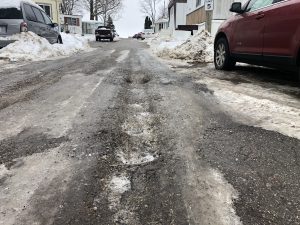
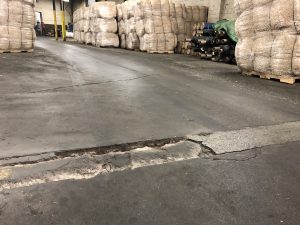
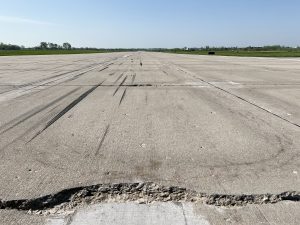
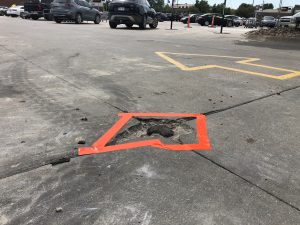
Across the country, pothole season seems to last longer every year.
Freeze-thaw cycles, snowplows, moisture intrusion, and heavy traffic continue to damage asphalt and concrete surfaces faster than many maintenance crews can keep up. Municipal streets, industrial yards, bridge approaches, parking lots, utility cuts, and loading areas all tend to experience the same issue — temporary repairs that fail long before crews expected them to.
For many contractors and facility owners, the bigger frustration is not just the pothole itself. It is repairing the same area repeatedly.
That has led more municipalities, contractors, and property owners to ask a different question:
Is there a repair material that can actually handle Midwest winters, install in cold weather, and stay in place under traffic?
In many cases, that conversation is leading toward high-performance repair materials like FastPatch.
________________________________________
Why Traditional Cold Patch Often Struggles in Midwest Conditions
Most crews have used traditional bagged cold patch products at some point. They are convenient, widely available, and useful for emergency repairs. The problem is that many of them were never designed to function as a long-term structural repair.
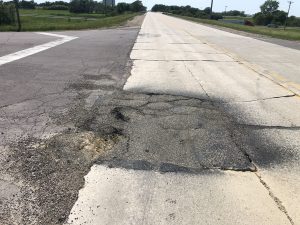
Common issues include:• Material pulling out under traffic
• Water infiltration around repair edges
• Soft spots during freeze-thaw cycles
• Snowplow damage• Repeated repairs in the same location
• Loss of compaction over time
The northern half of the country is especially hard on pavement repairs because moisture and temperature swings continuously stress the repaired area. Once water penetrates below the patch, failure often accelerates quickly.
That becomes expensive when crews are repeatedly mobilizing labor, equipment, traffic control, and materials to repair the same locations.
________________________________________
Looking Beyond Initial Material Cost
One of the biggest misconceptions in pavement maintenance is that the lowest-cost repair material is automatically the most economical option.
In reality, labor and repeat repairs are often the largest expense.
For example, a low-cost patch that fails multiple times through winter may ultimately cost more than a higher-performance repair that lasts significantly longer.
When evaluating pothole repair solutions, it is important to factor in:
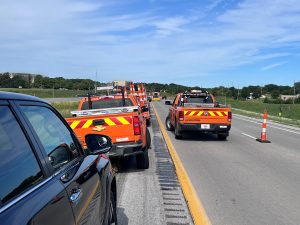
• Crew labor
• Equipment and mobilization
• Traffic disruption
• Repeat maintenance cycles
• Public complaints
• Liability concerns
• Downtime for facilities or businesses
This is where permanent or semi-permanent repair materials can become much more cost effective over time.
________________________________________
This is where FastPatch Different?
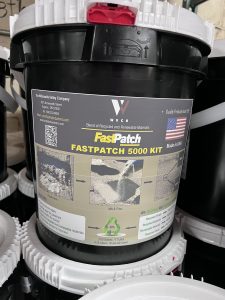
FastPatch is designed differently than many traditional cold patch products. Instead of functioning primarily as a temporary filler material, it is engineered to create a durable bonded repair capable of handling traffic quickly after installation.
For many Midwest maintenance crews, several characteristics stand out.
Year-Round Installation Capability
One of the largest advantages is the ability to perform repairs during colder weather conditions when hot mix asphalt may not be readily available.
This is especially valuable during:
• Winter emergency repairs
• Early spring pothole season
• Freeze-thaw damage events
• Off-hour maintenance operations
Immediate Traffic Return
Many repair areas cannot remain closed for extended periods.
Industrial facilities, distribution centers, municipalities, schools, and commercial properties often need repairs completed quickly with minimal disruption. FastPatch allows traffic to return rapidly after installation, which can significantly reduce downtime and traffic control concerns.
Reduced Repeat Repairs
Long-term durability is where many owners begin seeing the true value.
By reducing failures caused by:
• Moisture infiltration
• Edge separation
• Traffic displacement
• Freeze-thaw movement
maintenance crews can often reduce the frequency of repeated patching operations throughout the year.
________________________________________
Common Applications
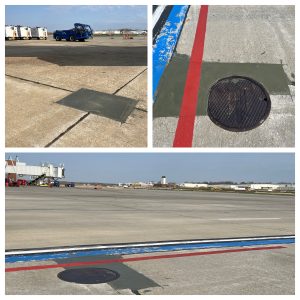
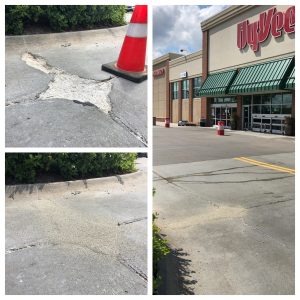
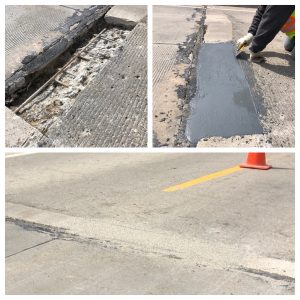
Across Iowa and surrounding Midwest states, FastPatch is commonly used for:
• Pothole repairs
• Bridge approach repairs
• Concrete spalls
• Utility cuts
• Warehouse and industrial pavement
• Loading docks
• Parking lots
• Municipal streets
• Heavy traffic intersections
It is particularly useful in areas where shutting down traffic for extended repairs is not practical.
________________________________________
Why Winter Repairs Continue to Fail
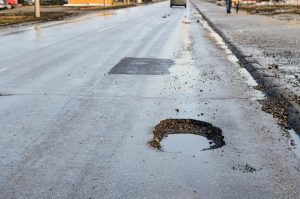
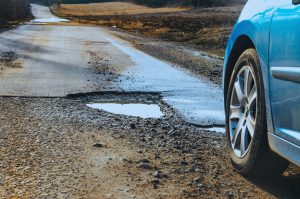
In many cases, failed repairs are less about the pothole itself and more about the underlying conditions.
Water infiltration remains one of the biggest contributors to pavement deterioration. Once moisture enters cracks or failed repair edges, freeze-thaw expansion begins breaking apart surrounding pavement.
This is similar to what is often seen in roadway stabilization applications involving weak subgrades. Just as geogrids and geotextiles are used to stabilize and separate roadway sections beneath aggregate, long-term pavement repairs also depend heavily on controlling moisture movement and maintaining structural integrity under loading.
Temporary repairs may address the visible pothole, but they often do little to stop the ongoing deterioration process beneath the surface.
________________________________________
Choosing the Right Repair Strategy
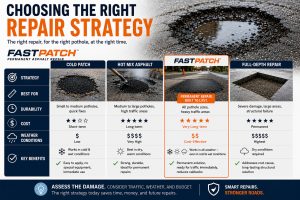
There is no single repair material that fits every application. Temporary cold patch products still have a place for emergency situations and very short-term maintenance needs.
However, when projects involve:
• High traffic volumes
• Frequent repeat failures
• Winter installation requirements
• Labor shortages
• Expensive mobilizations
• Industrial traffic loading
higher-performance repair materials often provide significantly better long-term value.
For many property management companies, contractors and municipalities, that is why products like FastPatch continue gaining attention.
________________________________________
Final Thoughts
Potholes and pavement spalls are not going away anytime soon, especially locations with many freeze-thaw cycles. The combination of freeze-thaw cycles, moisture, and traffic loading will continue creating challenges for maintenance crews every year.
The question many owners are now asking is not simply:
“What is the cheapest repair?”
Instead, they are asking:
“What repair will actually last and reduce repeat maintenance?”
That shift in thinking is why more contractors, municipalities, and facility managers are evaluating permanent repair solutions capable of performing in weather changing conditions.
At Coleman Moore Company, we work with contractors, engineers, municipalities, and facility owners to help identify practical repair solutions for demanding field conditions. Whether the challenge involves roadway stabilization, erosion control, geosynthetics, or permanent pavement repair materials, the goal remains the same — reducing long-term maintenance costs while improving field performance.