
When a roadway, parking lot, construction entrance, or working platform begins to rut or pump, the problem is not always insufficient aggregate. In many cases, the real issue is that the aggregate and the subgrade are no longer functioning as two separate layers.
A recent Geosynthetics editorial highlighted the importance of properly designed and installed geosynthetics in maintaining separation between aggregate and weak or saturated subgrade soils.
That separation may seem simple, but it can have a major effect on the performance and service life of an aggregate section.
What happens without separation?
Aggregate is intended to distribute loads and provide a stable, drainable surface. The subgrade beneath it provides support, but weak or saturated soils can deform when subjected to construction traffic.
As vehicles repeatedly pass over the surface, the aggregate can be pushed downward into the subgrade. At the same time, fine soil particles may migrate upward into the aggregate layer.
This mixing is often called contamination or intermixing.
Once contamination occurs, the aggregate layer begins to lose several of the properties it was installed to provide:
- Drainage becomes restricted.
- Aggregate particles cannot interlock as effectively.
- The section holds more moisture.
- Rutting and pumping increase.
- Additional aggregate may be required to restore the surface.
- Long-term maintenance costs rise.
Simply adding more stone may temporarily improve the surface, but it does not necessarily correct the underlying problem. If aggregate continues to disappear into the subgrade, the owner may end up paying for the same stone more than once.
The role of a separation geotextile
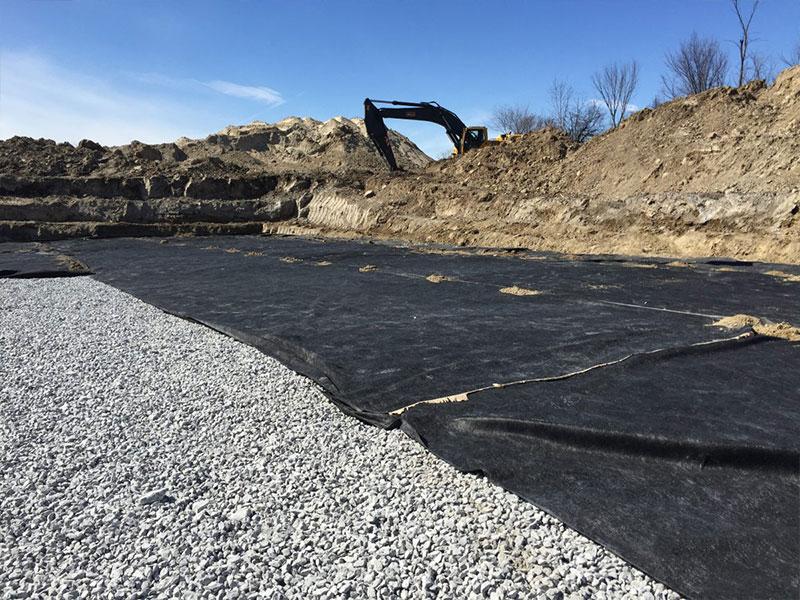
A properly selected geotextile creates a defined boundary between the aggregate and the underlying soil.
The geotextile allows the aggregate layer and subgrade to perform their intended functions without becoming mixed together. Depending on the product and application, it may also provide filtration, drainage, confinement, or stabilization benefits.
The primary purpose of separation is straightforward:
Keep the aggregate above and the soil below.
By limiting contamination, the geotextile helps preserve the effective thickness and quality of the aggregate section.
That can be especially important in areas with:
- Soft or highly compressible soils
- Wet subgrades
- High groundwater
- Fine-grained soils
- Heavy construction traffic
- Frequent freeze-thaw cycles
- Limited access for future repairs
Proper installation is just as important as product selection
Even the correct geotextile cannot perform as intended if it is damaged or installed improperly.
Several details can determine whether the separation layer remains intact during construction.
Prepare the subgrade
Sharp objects, large debris, deep ruts, and abrupt changes in grade can damage the fabric or prevent it from lying flat. The surface should be reasonably smooth before placement.
In extremely soft conditions, excessive grading may do more harm than good. The goal is to prepare the surface without unnecessarily disturbing or remolding the soil.
Maintain adequate overlaps
Adjacent rolls must overlap enough to prevent the subgrade from pushing through the seams during aggregate placement and trafficking.
The required overlap may increase when the soil is especially weak. In some applications, sewing or another connection method may be appropriate.
Avoid trafficking directly on the geotextile
Construction equipment should generally not operate directly on an exposed separation fabric. Turning, braking, or accelerating on the material can cause tearing, displacement, or wrinkling.
Aggregate should be placed ahead of the equipment so that traffic remains on the covered surface.
Use an appropriate initial lift
The first aggregate lift must be thick enough to protect the geotextile and distribute construction loads. Placing too little aggregate over a weak subgrade can cause excessive deformation and damage before the section is fully constructed.
Do not push aggregate aggressively across the fabric
Aggregate should be placed and spread in a controlled manner. Aggressive dozer operations can create wrinkles, shift the fabric, or force aggregate beneath it.
Repair damage before covering it
Tears, punctures, or exposed areas should be repaired before additional aggregate is placed. Covering visible damage may allow soil and aggregate to mix at that location, creating a weak point in the section.
Separation and stabilization are related—but not identical
A geotextile used for separation helps prevent aggregate and soil from mixing.
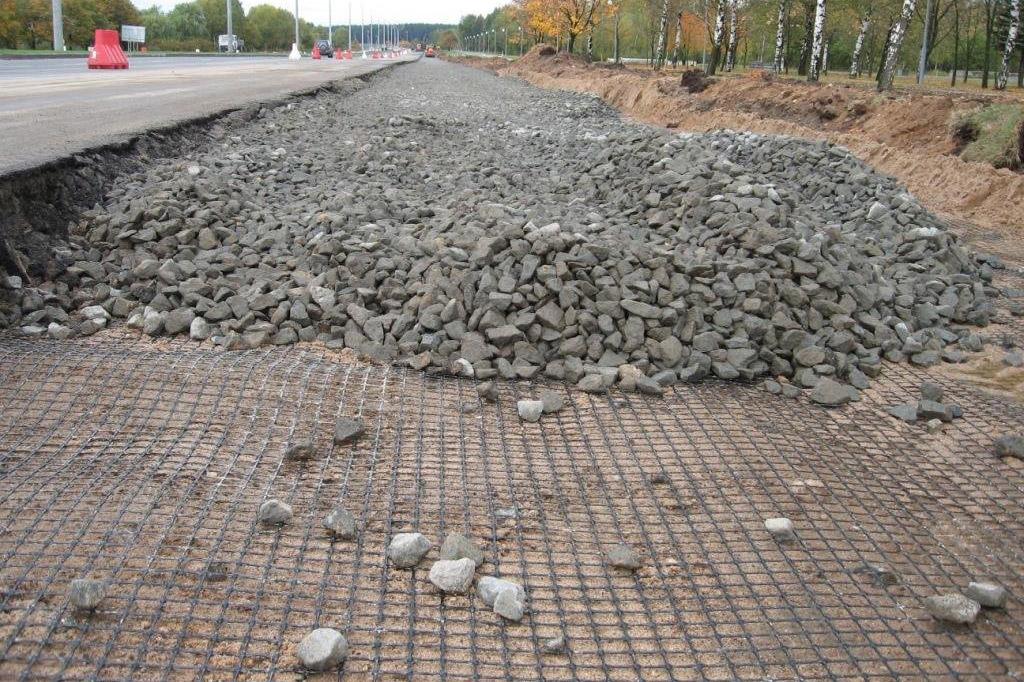
A geogrid used for stabilization helps improve the behavior of the aggregate layer by restricting lateral movement and promoting confinement and interlock.
In many weak-subgrade applications, these functions can complement one another. The geotextile maintains separation and filtration, while the geogrid helps stabilize the aggregate.
However, every project does not automatically require both products. Soil conditions, groundwater, aggregate type, traffic, design life, and construction methods should all be considered when selecting the system.
The key is to identify the problem the geosynthetic is expected to solve.
A relatively small component can protect a much larger investment
The aggregate is often one of the most visible and costly parts of an unpaved section. Yet its performance can depend heavily on the thin layer placed beneath it.
A separation geotextile represents only a small portion of the total section thickness, but it can help protect the aggregate from contamination and premature loss.
When properly selected and installed, geosynthetics can help:
- Preserve aggregate quality
- Reduce rutting and pumping
- Improve constructability
- Limit the amount of replacement stone required
- Extend maintenance intervals
- Improve the reliability of the finished section
The benefit is not simply the presence of fabric beneath the stone. The benefit comes from keeping the designed section intact.
Final thought
Many aggregate failures begin below the surface.
When weak soil migrates into the aggregate—or aggregate is pushed into the subgrade—the section gradually loses the structure it was designed to have.
Proper separation helps prevent that process before it starts.
At Coleman Moore Company, we help contractors, engineers, and owners evaluate subgrade conditions and select geosynthetic systems that address the actual field problem. The right material, installed correctly, can protect the aggregate investment and improve long-term performance.