
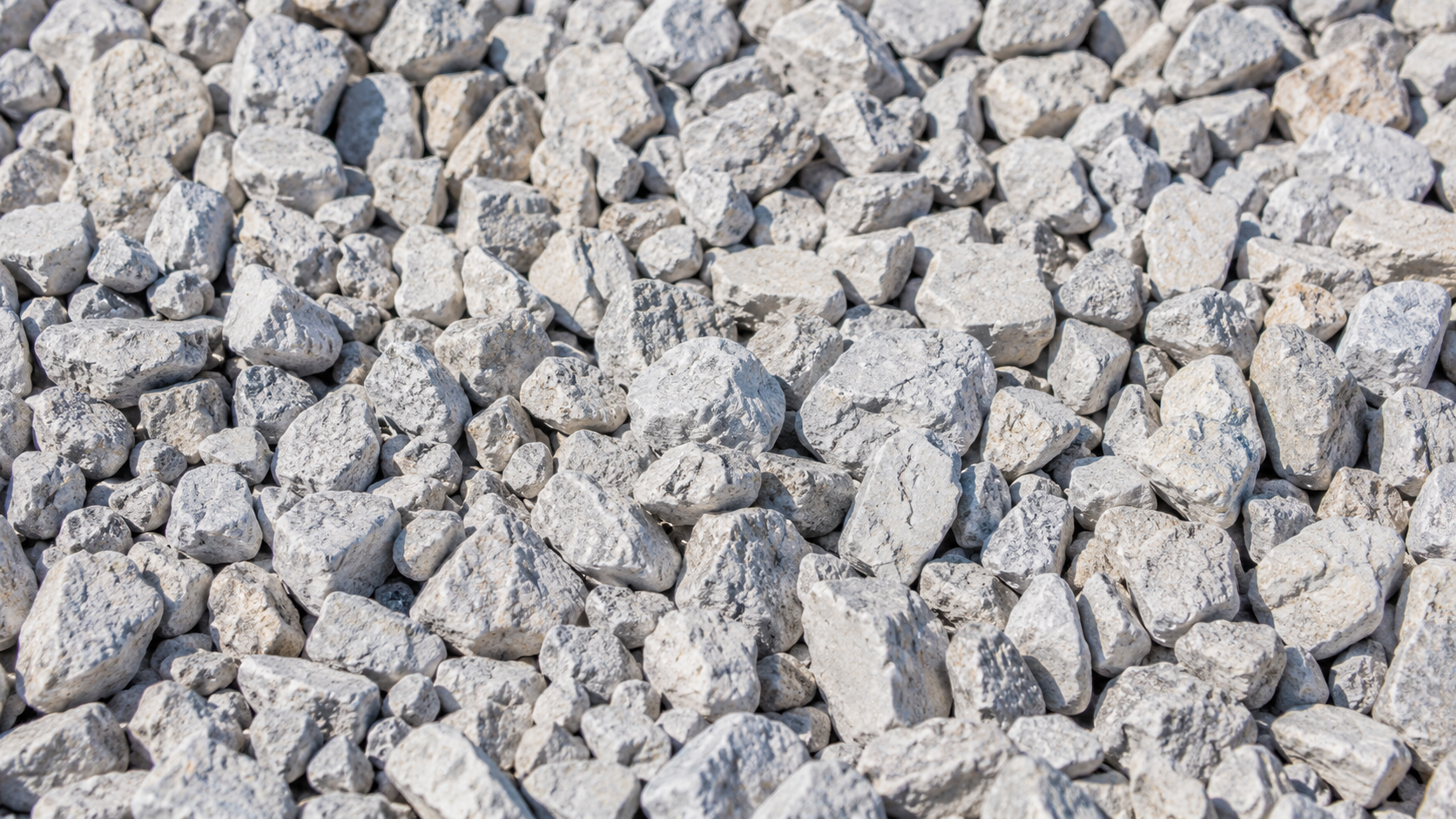

Anyone responsible for a gravel road, driveway, parking lot, farm entrance, or equipment yard knows the frustration: fresh aggregate is placed, graded, and compacted, and the surface looks great. Then traffic, weather, and time begin working against it.
Before long, the larger stones become smaller. Dust increases. Ruts and potholes appear. Eventually, another load of aggregate is needed—and the cycle begins again.
Most discussions about geogrid focus on stabilizing weak subgrade soils, reducing rutting, or decreasing the amount of aggregate needed during construction. Those are important benefits, but they can overshadow another potential advantage:
By reducing aggregate movement, geogrid may also help protect the aggregate from the repeated rubbing, chipping, and abrasion that shorten its useful life.
Aggregate Does Not Last Forever
Aggregate may look permanent, but it is a collection of individual particles that are continually subjected to vehicle loads.
As tires pass over an unpaved surface, the aggregate particles are pushed downward and sideways. When the underlying soil is soft or wet, the aggregate has even less support and can move more freely.
This movement causes particles to shift and rub against one another. Edges chip off, weaker stones fracture, and larger particles gradually become smaller.
Researchers studying unpaved roads describe this process as traffic-induced crushing. Under heavy loading, the shifting of particles against one another causes chipping and abrasion. The amount of degradation depends partly on the quality of the aggregate and the frequency and type of traffic.
Over time, the road’s original gradation changes. A surface that once contained a strong mixture of coarse and fine particles may begin to contain excessive fines.
Those fines can become dust during dry conditions and mud when wet. They may also be carried away by wind, water, and passing vehicles. The result is not simply a rougher surface—it is an actual loss of usable road material.
Research on aggregate degradation has found that materials with higher abrasion losses generally produce more fines as particles fracture and wear. Iowa State University research has similarly noted that lower-quality coarse aggregates can crush under traffic, increasing the amount of fines in an unpaved road.
Why Aggregate Movement Matters
Think about a rack of billiard balls before a game of pool.
When the balls are loose, they can easily roll and shift. When they are packed tightly inside the triangle, each ball helps restrain the others.
Geogrid creates a similar effect within an aggregate layer.
When aggregate is placed and compacted over geogrid, some of the particles partially enter the grid’s openings, called apertures. The particles interact with the grid’s ribs and with the surrounding aggregate, creating what engineers call interlock.
This interlock helps restrain sideways movement.
The Federal Highway Administration explains that geogrid can provide resistance to lateral aggregate movement. This is especially important over soft subgrades, which provide little natural restraint and allow aggregate to move outward under wheel loads.
Modern research describes the same mechanism: aggregate particles are laterally restrained under loading, forming a less-deformable geogrid-and-aggregate composite layer.
Put more simply:
Less movement means less rubbing. Less rubbing means less chipping and abrasion. And less breakdown can mean more of the original aggregate remains useful for longer.
Protecting the Rock, Not Just Supporting the Road
Geogrid is widely recognized for helping stabilize roads and working surfaces. It can distribute loads, reduce permanent deformation, limit lateral spreading, and improve performance over weak soils.
Those benefits can also create a better environment for the aggregate itself.
When aggregate is allowed to move excessively, wheel traffic repeatedly rearranges the particles. Each load can produce additional grinding, fracture, displacement, and rutting.
When the aggregate is restrained, the layer behaves more like a stable system and less like a loose collection of individual stones.
Studies have shown that geogrid-stabilized aggregate layers can experience less permanent deformation and rutting under repeated loading. A five-year evaluation of geogrid in low-volume unpaved roads also documented the long-term performance of the stabilization system under field conditions.
Research directly measuring exactly how many additional years geogrid adds to the life of every type of aggregate is still limited. Aggregate source, strength, gradation, moisture, drainage, traffic, installation, and maintenance all affect performance.
However, the underlying relationship is straightforward and supported by established research:
- Traffic-induced particle movement contributes to aggregate abrasion and breakdown.
- Geogrid interlock restrains lateral aggregate movement.
- Reduced movement and deformation can reduce the conditions that accelerate particle wear.
This does not mean geogrid makes weak aggregate indestructible. It means the aggregate has a better opportunity to remain in place and continue performing its intended job.
The Cost of Replacing Aggregate
The price of aggregate is only part of its true cost.
Replacing lost or degraded aggregate may also require:
- Trucking and fuel
- Grading and compaction
- Labor and equipment
- Traffic interruptions
- Repeated maintenance
- Cleanup of dust and displaced material
For a homeowner, that might mean paying for another load of rock every few years. For a farm, municipality, contractor, industrial property, or commercial facility, it can mean a much larger recurring expense.
Unpaved roads naturally generate dust and lose surface material over time, and repeated deterioration can lead to significant maintenance demands.
Extending the useful life of the aggregate already purchased can therefore be just as valuable as reducing the initial aggregate thickness.
A Different Kind of Stabilization
There are several ways to improve an unpaved road or parking area. Additional aggregate, chemical treatments, cementitious stabilization, drainage improvements, geotextiles, geocells, and geogrids can all have appropriate applications.
Geogrid is different because it stabilizes the aggregate mechanically.
It does not need to glue the stones together or chemically alter the aggregate. Instead, it works through particle interlock and confinement. It helps the individual pieces act together as a more stable layer while maintaining the drainage characteristics of an unbound aggregate system.
In some conditions, a geotextile may also be needed beneath the geogrid to prevent soft subgrade soil from pumping upward and contaminating the aggregate. Geogrid and geotextile perform different functions, and the correct solution depends on the soil, water conditions, traffic, and aggregate being used.
Good drainage, proper aggregate gradation, adequate compaction, and routine surface maintenance remain essential. Geogrid should be viewed as part of a complete road or working-platform design—not as a substitute for those fundamentals.
Getting More Life From a Limited Resource
Aggregate is a natural resource. It must be quarried, processed, transported, placed, and compacted. Every time a road or parking area must be rebuilt, more material, fuel, labor, and money are consumed.
That makes aggregate preservation more than a maintenance issue. It is also an economic and environmental consideration.
Geogrid is usually installed because someone wants to stabilize a soft subgrade, reduce rutting, pass a proof roll, or build a stronger road. But its effect on aggregate movement deserves equal attention.
The rock you place is an investment.
By interlocking with the aggregate and helping restrain its movement, geogrid can do more than strengthen the ground beneath a road. It can help protect the aggregate above it—reducing the movement, rubbing, and breakdown that cause valuable rock to disappear one particle at a time.
A more stable aggregate layer does not just perform better today. It may continue performing longer.