
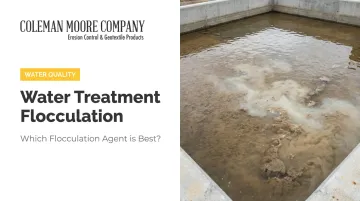
Flocculation is the process of aggregating fine suspended particles into larger masses — called flocs — that can be removed through sedimentation or filtration. It's the second step in the coagulation-flocculation sequence, and agent selection is the single variable that most determines whether the process works.
This guide covers the most widely used inorganic and organic flocculation agents, what each is best suited for, and the factors that should drive your final selection — including regulatory requirements for Iowa construction stormwater projects.
Key Takeaways
- Flocculation agents aggregate fine particles into settleable flocs; inorganic and organic agents work through different mechanisms
- Alum and ferric salts dominate municipal treatment; PAM and chitosan lead in construction stormwater applications
- Water chemistry (pH, alkalinity, solids type) determines which agent performs — not general reputation
- Jar testing with your actual water sample is the only reliable way to identify the right flocculant and dosage
- In Iowa construction stormwater applications, chitosan-based products like Biostar-CH offer a non-toxic, biodegradable alternative to PAM
What Is Flocculation in Water Treatment?
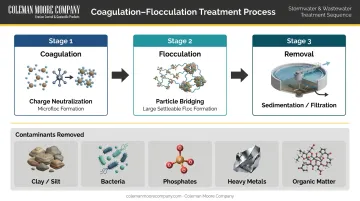
Flocculation is the second step in the coagulation-flocculation sequence. Coagulants go first — they neutralize the electrical charges on suspended particles and form tiny microflocs. Flocculants then bridge those microflocs into larger, heavier masses that can settle or be filtered out. The two steps are distinct: skipping or conflating them is one of the most common mistakes in field applications.
The contaminants flocculation targets span a wide range:
- Suspended clay, silt, and sediment
- Colloidal particles and bacteria
- Phosphates and nutrients
- Heavy metals, including arsenic
- Natural organic matter that can form disinfection by-products (DBPs)
That breadth explains why flocculation appears across municipal drinking water, industrial wastewater, pulp and paper, mining, and stormwater management on active construction sites. Each application uses the same underlying process — but the right agent, dosage, and regulatory requirements differ significantly from one context to the next.
Top Inorganic Flocculation Agents
Inorganic flocculants are carbon-free compounds and the most widely deployed category in water treatment globally. Low unit cost, broad availability, and established regulatory acceptance make them the default starting point for most municipal and industrial applications.
Aluminum Sulfate (Alum)
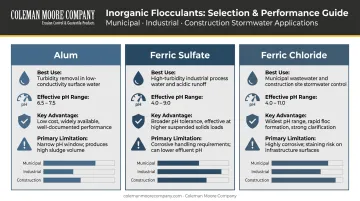
Aluminum sulfate (Al₂(SO₄)₃) reacts with water to form aluminum hydroxide — a gelatinous substance that entraps suspended impurities. It's one of the most widely used flocculants in drinking water treatment, valued for its availability and low per-unit cost.
The catch: alum performance is strongly pH-dependent. EPA enhanced coagulation guidance notes that aluminum solubility rises significantly above pH 8.0, and the EPA's Secondary Maximum Contaminant Level for aluminum sits at 0.05 to 0.2 mg/L — meaning residual aluminum in treated water is a genuine compliance concern, not just an aesthetic one. Under- or over-dosing at the wrong pH can either leave turbidity unresolved or leave excess aluminum in the effluent.
| Factor | Detail |
|---|---|
| Best For | Drinking water turbidity reduction, municipal treatment, moderate-turbidity surface water |
| Key Advantage | Low cost, widely available, effective pH range of 5.5–7.5 |
| Notable Limitation | Produces aluminum-rich sludge; residual aluminum is pH-sensitive and requires careful jar testing |
Ferric Sulfate
Ferric sulfate (Fe₂(SO₄)₃) is an iron-based flocculant that works across a wider pH range than alum — Australian Drinking Water Guidelines cite effectiveness from pH 4 to 11 — which means it holds performance even as influent chemistry fluctuates in industrial applications. It also supports simultaneous pH adjustment during treatment.
Its lower corrosivity relative to ferric chloride makes it preferable when equipment or infrastructure has corrosion sensitivity. For applications involving high organic loads, color removal, or phosphorus reduction, EPA phosphorus removal guidance confirms ferric sulfate as an effective iron-salt option for these conditions.
| Factor | Detail |
|---|---|
| Best For | Industrial effluent with high organic content, phosphorus removal, corrosion-sensitive systems |
| Key Advantage | Wider effective pH range than alum; less corrosive than ferric chloride; removes color and NOM |
| Notable Limitation | Can impart color to treated water; higher unit cost than alum in many markets |
Ferric Chloride
Ferric chloride (FeCl₃) functions as both a coagulation enhancer and a flocculant, and carries strong municipal and drinking-water precedent. EPA's phosphorus removal manual identifies ferric chloride addition for precipitation-flocculation processes targeting suspended solids and phosphorus. It's also one of the few agents with documented performance for arsenic adsorption onto ferric hydroxides.
Handling is the major constraint. Ferric chloride is corrosive, produces acidic fumes, and requires storage in FRP, rubber-lined steel, or plastic-lined steel tanks. Verifying tank material compatibility before procurement determines whether a facility can safely store and dose this agent at all — it shapes equipment selection from the start.
| Factor | Detail |
|---|---|
| Best For | Municipal wastewater, arsenic and phosphorus removal, DBP precursor reduction |
| Key Advantage | High efficacy across multiple contaminant types; effective at low temperatures |
| Notable Limitation | Highly corrosive; requires specialized storage; fumes can damage surrounding infrastructure |
Top Organic Flocculation Agents
Organic flocculants are carbon-based polymeric agents that typically achieve effective treatment at far lower doses than inorganic alternatives. They generate less sludge and are increasingly preferred in applications with stringent discharge standards or where chemical residuals in the effluent are a concern.
Polyacrylamide (PAM)
Polyacrylamide is one of the most widely used synthetic polymer flocculants. Available in anionic, cationic, and nonionic forms, PAM bridges suspended particles through long polymer chains, forming large, dense flocs suited to both sedimentation and filtration.
Effectiveness depends heavily on matching the right ionic form to the water chemistry and solids type. For construction stormwater applications, the EPA Construction General Permit FAQ flags cationic treatment chemicals as requiring site-specific authorization; anionic and nonionic PAM are the forms used in field stormwater applications.
A Maryland State Highway Administration study found 2 mg/L was likely the optimum dose for one anionic PAM and sediment combination — higher doses actually increased turbidity and total solids. That result is site-specific, not universal. It does underscore why jar testing matters before committing to a dose.
| Factor | Detail |
|---|---|
| Best For | Construction stormwater sediment control, municipal wastewater sludge dewatering, industrial effluent clarification |
| Key Advantage | Very low effective dose; available in powder, emulsion, and solution form |
| Notable Limitation | Requires precise dosage control; cationic forms need site-specific authorization for stormwater; overdosing can blind filtration media |
Chitosan
Chitosan is a bio-derived flocculant produced by partial deacetylation of chitin from crustacean shells. It works through charge neutralization and polymer bridging, and peer-reviewed literature documents its effectiveness for removing algae, bacteria, organic matter, heavy metals, and suspended solids.
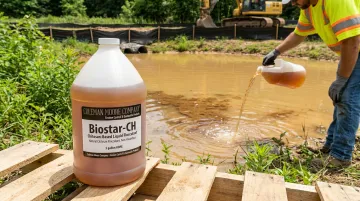
Chitosan suits environmentally sensitive projects for a practical reason: it's biodegradable, low toxicity, and leaves no harmful residuals. Coleman Moore Company supplies Biostar-CH, a proprietary chitosan-based liquid flocculant designed specifically for Iowa water treatment and stormwater applications. Biostar-CH is formulated as a non-toxic, non-hazardous, all-natural solution that breaks down quickly in the environment — making it a practical option for Iowa construction sites where ecological impact and permit compliance both factor into product selection.
| Factor | Detail |
|---|---|
| Best For | Environmentally sensitive discharge, passive water treatment, algal and microorganism removal, construction stormwater |
| Key Advantage | Biodegradable, low toxicity, no harmful residuals; effective across a range of contaminants |
| Notable Limitation | Higher cost than inorganic agents; confirm product-specific regulatory approvals before use in permit-regulated applications |
How to Choose the Best Flocculation Agent
Selecting a flocculant based on general reputation — that alum is the standard or PAM works everywhere — is where most treatment decisions go wrong. Water chemistry varies enough between sites that a product performing well in one application can fail badly in another. Start with jar testing on your actual water sample before committing to any agent.
Key Variables to Evaluate First
Before selecting an agent, assess:
- pH — determines whether cationic or anionic flocculants will bond effectively with particles
- Alkalinity — low-alkalinity water may need lime or caustic soda addition before floc formation is stable; EPA guidance recommends pH correction if it drops below 5.5 during testing
- Turbidity level — high-turbidity streams may require higher doses or a two-stage coagulant-flocculant approach
- Competing ions and organics — certain dissolved compounds interfere with specific agents and should be identified upfront
Matching Agent to Solids Type
The type of suspended solids in your water is often the most decisive factor:
- Inorganic solids (clay, silt, sand) → anionic PAM or inorganic agents
- Organic solids (algae, bacteria, proteins) → cationic flocculants or chitosan
- Mixed streams → combined coagulant-flocculant approach or nonionic polymer
Calculate Total Treatment Cost, Not Unit Price
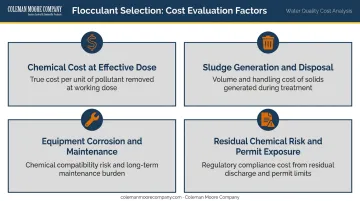
Unit price alone gives an incomplete picture. A higher-cost polymer dosed at a fraction of the rate of alum can come out cheaper overall once you factor in sludge volume, disposal expense, and equipment wear. Evaluate all four cost drivers:
- Chemical cost at effective dose
- Sludge generation and disposal
- Equipment corrosion and maintenance
- Residual chemical risk and permit exposure
Regulatory Compliance for Iowa Construction Sites
For construction site stormwater in Iowa, compliance should drive agent selection from the start. Two key requirements shape that decision:
- Iowa DNR General Permit No. 2 (effective March 1, 2023 through February 29, 2028) governs stormwater discharge from construction activities statewide
- EPA's CGP requires site-specific authorization for cationic treatment chemicals — making anionic or nonionic forms the practical default for most construction stormwater applications
Coleman Moore Company supplies compliant flocculant options for active Iowa sites, including Biostar-CH chitosan-based products, with product consultation available to match the right agent to site-specific conditions.
Conclusion
No single flocculation agent is universally best. Alum and ferric salts are well-suited to municipal treatment where pH can be controlled and sludge handling is routine. PAM in anionic or nonionic form is appropriate for construction stormwater and industrial effluent clarification. Chitosan-based products offer a genuine alternative for applications where biodegradability, low toxicity, and minimal chemical residuals are priorities.
The best choice is always the one verified against your actual water sample through jar testing — accounting for your water chemistry, solids profile, regulatory requirements, and total treatment cost.
Coleman Moore Company has supplied erosion and sediment control solutions — including chitosan-based Biostar-CH flocculants for stormwater treatment — to civil infrastructure and construction projects across Iowa since 2004. They offer product consultation and site evaluations to help contractors and engineers find the right fit for their conditions. Reach them at 515-309-5577 or info@colemanmoorecompany.com.
Frequently Asked Questions
Is flocculation used in wastewater treatment?
Yes — flocculation is a standard step in both municipal and industrial wastewater treatment. It aggregates suspended solids to improve sedimentation efficiency and reduce the load on downstream filtration and biological treatment systems.
What are common flocculating agents used in wastewater treatment?
The most widely used agents are aluminum sulfate (alum), ferric sulfate, and ferric chloride on the inorganic side, and polyacrylamide (PAM) and chitosan on the organic side. The right choice depends on the wastewater's chemistry, solids composition, and discharge requirements.
What is the most commonly used flocculant in wastewater treatment?
Aluminum sulfate has historically been the most widely used due to its low cost and availability. Polyacrylamide has become equally prevalent in industrial and construction applications because of its lower effective dosage and versatility across water types.
What is the difference between a coagulant and a flocculant?
Coagulants neutralize the electrical charges on suspended particles to form small microflocs, which is the destabilization step. Flocculants then bridge those microflocs into larger, settleable masses. Both are often used together for effective water clarification.
Can flocculation agents be used for construction site runoff control?
Yes. Anionic and nonionic PAM — along with chitosan-based products like Biostar-CH — are widely used in construction stormwater management to reduce turbidity in site runoff. Iowa DNR General Permit No. 2 and EPA's CGP restrict cationic treatment chemicals, so review your NPDES permit requirements before selecting an agent.
How do I test which flocculant works best for my application?
Jar testing is the standard method: treat small samples of your actual water with varying flocculant types and doses, then observe floc size, settling speed, and resulting clarity. For Iowa civil projects, Coleman Moore can assist with product selection at 515-309-5577.