Introduction
The moment a bulldozer breaks ground, the clock starts. Bare soil — stripped of vegetation, root structure, and natural cover — becomes immediately vulnerable to rainfall, runoff, and wind. Without protection, even a moderate rain event can mobilize significant sediment off a construction site and into storm drains, waterways, and adjacent properties.
The consequences go well beyond muddy jobsites. Uncontrolled sediment migration damages aquatic habitat, clogs drainage infrastructure, undermines site access roads, and triggers regulatory enforcement. EPA data shows that construction sites generate sediment runoff at rates 10–20 times greater than agricultural land and up to 2,000 times greater than forested land.
A structured, layered approach to erosion and sediment control is a permit requirement, a cost-control measure, and a site protection strategy all at once. This guide covers what Iowa contractors need to know: regulatory obligations, control plan fundamentals, product selection by site condition, and inspection practices that keep projects compliant.
Key Takeaways
- Erosion control and sediment control are complementary strategies — effective site compliance requires both.
- Most sites disturbing 1 acre or more require an NPDES permit and a written SWPPP.
- An Erosion and Sediment Control Plan (ESCP) must be completed before ground is broken, not after problems appear.
- Product selection depends on slope, soil type, and site drainage patterns.
- Iowa DNR requires inspections at least every 7 calendar days and correction of deficiencies within 7 days.
Understanding Erosion and Sediment Control in Construction
Two Distinct Problems, One Layered Solution
Soil erosion in construction is the detachment and transport of soil particles by water, wind, or surface runoff — processes that accelerate dramatically when vegetation and ground cover are removed during clearing, grading, and excavation.
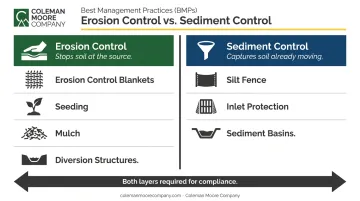
These two controls operate at different points in the same problem:
- Erosion control addresses the source — anchoring soil before it moves using blankets, seeding, mulch, and diversion structures
- Sediment control captures particles already in motion — silt fences, inlet protection devices, and sediment basins intercept disturbed soil before it leaves the site or enters drainage systems
The distinction matters operationally. Sediment controls like silt fence are a backup, not a substitute for erosion prevention. A silt fence on a slope where no erosion blanket was installed will quickly overtop and fail. Both layers are necessary, especially on Iowa sites exposed to spring rainfall and freeze-thaw cycles.
Why Construction Sites Receive Separate Regulation
That operational distinction also drives regulatory requirements. Sedimentation impairs 84,503 river and stream miles in the US, and stormwater flowing over active construction sites is one of the primary transport mechanisms. The USDA's soil erodibility K-factor — which accounts for soil texture, organic matter, structure, and permeability — helps quantify how susceptible a given soil type is to detachment. Sites with high K-factor soils require more aggressive early intervention than those with stable, well-structured soils.
Knowing your site's soil profile before mobilization determines which controls are needed, where they go, and how quickly stabilization must follow ground disturbance.
Regulatory Framework: NPDES Permits and SWPPP Requirements
Federal and Iowa-Specific Requirements
Any construction project disturbing 1 acre or more — or any smaller site that is part of a larger common plan of development exceeding 1 acre — requires a Clean Water Act NPDES Construction Stormwater Permit. In Iowa, this is administered through Iowa DNR General Permit No. 2.
Key Iowa DNR requirements:
- A SWPPP must be developed before the Notice of Intent (NOI) is submitted to the Department — not after permit coverage is obtained.
- The SWPPP identifies pollution sources and describes all Best Management Practices (BMPs) that will control stormwater discharges.
- The SWPPP must be kept at the construction site (in a trailer, shed, or covered structure) from project initiation through final stabilization. If stored off-site, it must be available within 3 hours of a regulatory request.
- Records, including the SWPPP and inspection reports, must be retained for at least 3 years from final stabilization.
The Local Compliance Layer
State permit coverage addresses federal requirements — but local obligations run parallel and are enforced independently. Iowa contractors must also verify:
- File a signed affidavit with the local Soil and Water Conservation District (SWCD) under Iowa Code Section 161A.64 for qualifying land-disturbing activities, unless a local ordinance equivalent applies.
- Meet MS4 permit ESC requirements for sites disturbing 1 acre or more within Iowa DNR-regulated municipal storm sewer jurisdictions.
- Comply with municipal ordinances — cities like Ankeny maintain their own construction site ESC standards that exceed state minimums.
State permit coverage does not satisfy local compliance. Verify city, county, SWCD, and MS4 requirements for every project location before mobilization.
Enforcement Reality
Non-compliance carries real financial exposure. EPA's construction stormwater enforcement actions have resulted in significant penalties — one settlement involving major home builders reached $4.3 million in civil penalties for alleged Clean Water Act violations. Failing to maintain a current, site-accurate SWPPP is among the most common causes of compliance violations and the first thing inspectors look for.
How to Build an Effective Erosion and Sediment Control Plan
A well-built ESCP written before ground is broken prevents compliance failures, reduces remediation costs, and keeps projects on schedule. One written after problems emerge is expensive catch-up. These five steps outline what a complete, enforceable plan requires.
Step 1: Site Assessment
Conduct a pre-construction evaluation covering:
- Soil type and USDA K-factor erodibility rating
- Slope gradients and lengths throughout the disturbed area
- Natural drainage patterns and flow paths
- Proximity to water bodies, wetlands, or regulated areas
- Sensitive natural areas requiring buffer protection
Soil survey data and the USDA's RUSLE2 framework both use the K-factor to estimate erosion potential. Use this information to prioritize where controls are most urgently needed, rather than applying the same BMP uniformly across the entire site.
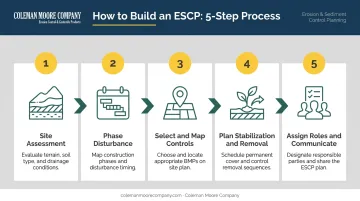
Step 2: Phase and Sequence Disturbance
Minimize the area of exposed soil at any one time. Iowa DNR requires contractors to begin stabilization measures by the 14th day after the last disturbance on any area sitting idle for 21 days or more. Phased grading, scheduled around expected weather patterns, reduces runoff volume and strain on sediment controls.
Step 3: Select and Map Controls
Assign specific erosion and sediment control practices to each area based on its risk profile. Map these on project drawings with product types, installation standards, and dimensional specifications. Vague ESCP language ("install silt fence as needed") does not satisfy permit requirements or protect you during an inspection.
Step 4: Plan for Stabilization and Removal
The ESCP must specify:
- When temporary controls will be removed
- How permanent stabilization will be achieved (seeding, mulching, landscaping, or geotextile reinforcement)
- Target vegetation establishment benchmarks: EPA's 2022 CGP uses 70% perennial vegetative cover relative to undisturbed local areas as the final stabilization standard
Temporary seeding alone does not qualify as erosion protection until vegetation is established. Blankets or mulch must accompany seeding during the establishment period.
Step 5: Assign Roles and Communicate
Specify which team members are responsible for installation, inspection, maintenance, and documentation. Share the plan with all subcontractors and inspectors before work begins. A plan no one has read offers no protection when an inspector arrives on site.
Erosion Control Methods and Products for Construction Sites
Selecting the right erosion control method depends on slope gradient, channel velocity, drainage patterns, and the vegetation establishment timeline. No single product works everywhere.
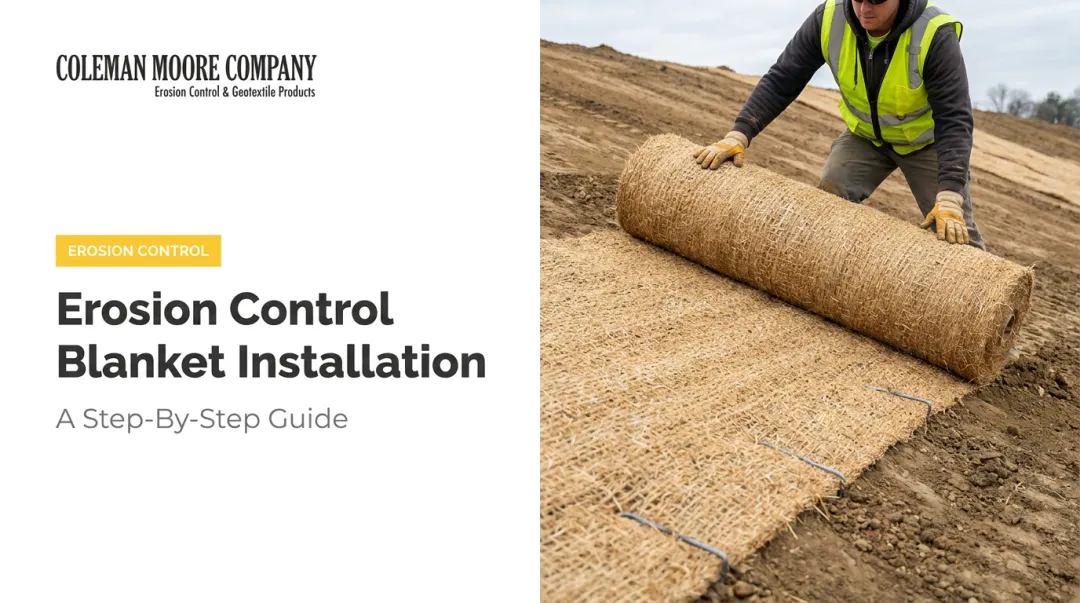
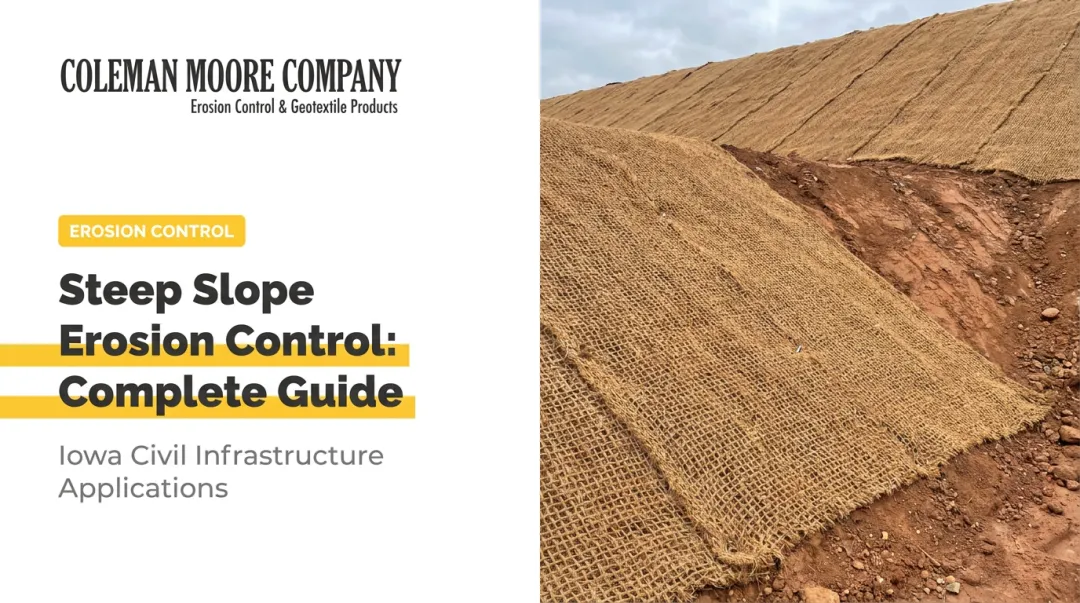
Erosion Control Blankets and Turf Reinforcement Mats
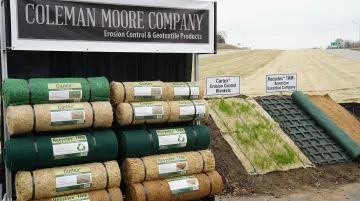
Permeable blankets staked directly over exposed soil absorb rainfall energy, slow surface flow, and retain moisture that supports vegetation germination. Product selection must match site conditions:
- Straw blankets (longevity ~3 months): Cost-effective for short-term protection on slopes up to 3:1 (H:V)
- Wood fiber blankets (longevity 12–24 months): Better suited for sites with adverse conditions, steep topsoil, or variable weather; double-netted versions handle slopes up to 1:1
- Coconut fiber blankets (longevity 2–3 years): Recommended when native grasses require 120+ days to germinate and over two years to fully establish
For permanent, high-velocity channel applications where vegetation alone won't provide sufficient protection, Turf Reinforcement Mats (TRMs) offer long-term structural reinforcement.
Coleman Moore Company carries the Recyclex® TRM from American Excelsior Company, made from 100% post-consumer recycled materials with 92% void space for root development and a non-floating design that maintains position against hydraulic forces.
Matching blanket type to slope length, rainfall intensity, and vegetation timeline is where product selection gets specific. Coleman Moore's team works directly with Iowa contractors and engineers to evaluate these variables and identify the right Curlex® configuration for each application, whether the project calls for a single-netted straw on a gentle grade or a double-netted wood fiber product on a steeper, more exposed slope.
Seeding, Mulch, and Hydraulic Mulch
Temporary seeding (rye grass, winter wheat) provides rapid biological stabilization during construction. It should be paired with mulch or blankets during establishment.
For areas difficult to access with standard equipment, hydraulic mulch (hydromulch) offers an effective alternative:
- Standard wood fiber mulch: Applied via hydroseeding equipment; suitable for moderate slopes and accessible areas
- Mechanically Bonded Fiber Matrix (MBFM): Contains synthetic fibers for increased stability; used on steeper slopes where blanket installation is impractical; typical application rate 3,000–4,500 lbs/acre
- Bonded Fiber Matrix (BFM): Higher erosion control performance for cut and fill slopes; requires less soil preparation than rolled blankets
These three categories cover most slope conditions Iowa contractors encounter. Coleman Moore stocks HH Wood Fiber products across all of them — Wood Fiber, Wood Fiber Flex (MBFM), and Wood Fiber BFM — so hydroseeding options scale from routine revegetation to challenging steep-slope stabilization.
Diversion Structures — Swales, Berms, and Check Dams
Temporary ditches, earthen berms, and check dams redirect or slow concentrated runoff before it reaches vulnerable areas or site boundaries:
- Check dams (rock or compost): Installed in drainage channels to slow flow velocity and promote sediment settling
- Earthen berms: Placed along contour lines to intercept sheet flow before it concentrates
- Temporary diversion swales: Channel runoff away from disturbed areas and toward sediment controls
These structures work best when positioned along drainage flow paths identified during the site assessment — before erosion channels form, not after.
Sediment Control Strategies and Best Practices
Perimeter Sediment Barriers
Silt fences are the most common perimeter control on Iowa construction sites. Geotextile fabric fences installed along downslope site boundaries allow water to pass through while trapping sediment. EPA guidance specifies support post spacing of 3–4 feet where water may run over the fence and 5 feet in most other conditions. SUDAS standards require fabric embedded 12 inches into the ground (minimum 6 inches below the ground line).
A silt fence that isn't properly trenched and staked provides no meaningful sediment control. Common failure modes include undermining from concentrated flow, overtopping from excessive ponding, and fabric tears from construction equipment.
Fiber logs and wattles — including straw wattles, Curlex® Sediment Logs, and coir fiber logs — serve as flexible perimeter controls where silt fence installation is impractical, such as rocky ground, irregular terrain, or tight access.
Coleman Moore supplies coir fiber logs through Nedia Enterprises for shoreline and waterway applications, and Curlex® Sediment Logs from American Excelsior Company for general perimeter and ditch check use.
Inlet and Drainage Protection
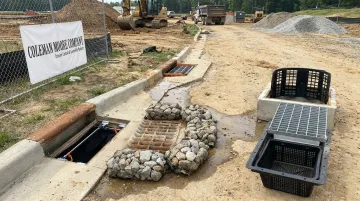
Once runoff moves past the site perimeter, protecting drainage infrastructure becomes the next priority. Inlet protection prevents sediment-laden runoff from entering public storm sewer systems. EPA guidance recommends drainage areas of no more than 1 acre per inlet protection device, with overtopping depth controlled so runoff doesn't bypass the inlet entirely.
Coleman Moore carries multiple inlet protection options for Iowa sites:
- Kyowa Filter Units: Rock-filled bags (2-ton, 4-ton, and 8-ton sizes) using recycled polyester; the flexible design allows close conformance to irregular structures
- Wimco Road Drain: Patented curved-back design that blocks sediment while managing road drainage
- ADS FleXstorm: Fits curb inlets, drop inlets, and round inlets with customizable filter bag configurations
- EZ-Catch by Flo-Water: Below-grate device with 15% greater filtering efficiency than industry standards
Sediment basins are the last line of defense for large graded sites. Iowa DNR requires a temporary or permanent sediment basin wherever more than 10 disturbed acres drain to a common location at one time, with a minimum storage capacity of 3,600 cubic feet per disturbed acre.
Basins must be cleaned regularly — accumulated sediment reduces storage volume and can push the site below permit-required capacity.
For sites adjacent to water bodies, turbidity curtains prevent disturbed sediment from migrating into ponds, lakes, or streams during dredging, bank work, or near-water construction. Coleman Moore supplies Enviro-USA turbidity curtains in 5-foot, 10-foot, and 15-foot depths.
Inspection, Maintenance, and Long-Term Compliance
Inspection Frequency Requirements
Iowa DNR General Permit No. 2 requires inspections at least once every 7 calendar days for all disturbed areas that haven't reached final stabilization. EPA's 2022 Construction General Permit offers an alternative: every 14 calendar days plus within 24 hours of any storm event producing 0.25 inches or more of rain.
For Iowa contractors operating under General Permit No. 2, the 7-day requirement applies regardless of rainfall. Build inspections into the construction schedule as a non-negotiable task — not something that happens when someone remembers.
What to Inspect and Document
Every inspection report must address:
- Condition of all erosion and sediment control practices
- Areas showing active erosion or rill formation
- Status of inlet protection and sediment basin volumes
- Any control measures that are damaged, undermined, or overtopped
- Corrective actions taken or planned
Iowa DNR requires the permit signatory to sign and retain all inspection reports as part of the SWPPP record. Thorough documentation is your first line of defense when deficiencies surface — and your clearest record of corrective action taken.
Common Failure Points and Prompt Repair
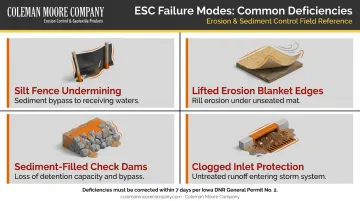
Deficiencies identified during inspection must be corrected immediately and no later than 7 days after the inspection. The most common failures include:
- Silt fences undercut by concentrated flow or torn by equipment
- Erosion blankets with edges lifted by wind or inadequate stapling
- Check dams filled with sediment and no longer effective
- Inlet protection devices clogged and overtopping
Prompt repair is both a permit requirement and a cost-control measure. A single unaddressed silt fence failure during a heavy rain event can discharge sediment loads that trigger enforcement action, remediation costs, and project delays far exceeding what routine maintenance would have cost.
Record Retention
Iowa DNR requires permittees to retain the SWPPP, inspection reports, and all records used to complete the NOI for at least 3 years from final stabilization. A complete, organized inspection log is your primary defense in the event of a regulatory audit or enforcement action — gaps in documentation are treated as gaps in compliance.
Frequently Asked Questions
What is erosion control in construction?
Erosion control in construction refers to the practices and products used to prevent soil from being displaced by water, wind, or runoff on active job sites. This includes erosion control blankets, seeding, mulch, and diversion structures — all applied before erosion occurs to keep soil anchored in place.
What is the difference between erosion control and sediment control?
Erosion control focuses on keeping soil in place (prevention), while sediment control captures soil that has already been displaced and is moving with runoff (containment). Both must be used together. Erosion controls are the primary defense; sediment controls serve as a backup for any soil that gets past them.
What permits are required for erosion and sediment control on a construction site?
Most sites disturbing 1 acre or more require an NPDES Construction Stormwater Permit and a SWPPP. In Iowa, this is covered under Iowa DNR General Permit No. 2. Additional permits or affidavits may be required from municipalities, SWCD districts, and MS4 entities depending on project location and scope.
How much does an erosion control plan cost?
Costs depend on site size, soil conditions, slope complexity, and the number of BMPs required. Smaller disturbed-area projects may involve a few thousand dollars in materials, while large or complex sites can run significantly higher. Getting a supplier or engineer involved during the design phase — before quantities are finalized — helps avoid both gaps in coverage and over-ordering.
How often should erosion and sediment control measures be inspected?
Iowa DNR General Permit No. 2 requires inspections at least every 7 calendar days for all areas with active disturbance. Deficiencies identified during any inspection must be corrected within 7 days, and all findings must be documented in the project's SWPPP inspection log.