Introduction
Steep slopes create some of the most demanding erosion control challenges in civil site development. Once a slope exceeds 33% gradient, water velocity accelerates sharply, infiltration drops, and soil loss compounds quickly. Left unmanaged, that process doesn't stay on-site.
According to a 2022 peer-reviewed study, soil erosion rates on construction-disturbed land run 2 to 40,000 times higher than pre-construction conditions. Sediment-choked waterways, undermined foundations, failed project schedules, and NPDES permit violations are all downstream consequences — and all preventable.
This guide covers what engineers and contractors need to select and sequence the right approach:
- How to classify slope severity by gradient
- Which erosion control methods apply at each level
- What to assess on-site before selecting any product
- How to sequence your strategy from initial grading through long-term stabilization
Key Takeaways
- Slopes above 33% require gradient-matched, layered erosion control — basic seeding won't hold
- Four method categories apply: vegetative, physical/blanket, geosynthetic, and structural
- Site assessment (slope angle, soil type, hydrology, vegetation) must drive every product decision
- Active construction and long-term stabilization phases require different tools, often combined
- Preventive control installed early costs far less than repairing gully failure or facing regulatory fines
Why Steep Slope Erosion Control Matters
The Gradient-Erosion Relationship
Slope angle doesn't increase erosion linearly — it compounds it. As gradient rises, water moves faster, contact time with the soil drops, and the energy available to detach and carry particles multiplies. Three practical tiers guide method selection:
| Gradient | Classification | Typical Requirement |
|---|---|---|
| Up to 33% | Low-moderate | Vegetation + basic mulch |
| 33–50% | Moderate-steep | ECBs or geotextiles + vegetation |
| Above 50% | Steep | Structural solutions required first |
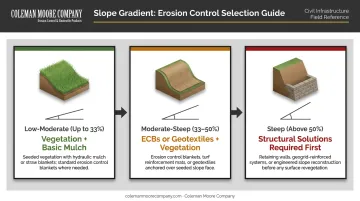
The NRCS RUSLE2 model captures this through its slope steepness factor (S), which quantifies how soil loss changes relative to a 9% reference slope — steeper gradients produce disproportionately higher losses under identical conditions.
The Cost of Doing Nothing
Those compounding losses don't stay on-site. Downstream consequences of uncontrolled steep slope erosion include:
- Sediment loading that degrades streams, raises turbidity, and harms aquatic communities
- Increased flood risk from reduced channel capacity
- Loss of topsoil that permanently reduces site productivity
- Foundation undercutting that threatens structures and retaining systems
The regulatory exposure is real. Clean Water Act violations assessed on or after January 8, 2025 carry civil penalties up to $68,445 per violation under EPA's current penalty schedule. Stop-work orders, remediation costs, and schedule delays compound quickly on top of that — which is why specifying the right erosion control method at the design stage is almost always cheaper than correcting failures after the fact.
Steep Slope Erosion Control Methods
No single product handles all conditions. Method selection depends on slope gradient, soil type, project phase, and budget. Professional-grade solutions almost always combine two or more approaches.
Vegetative Methods
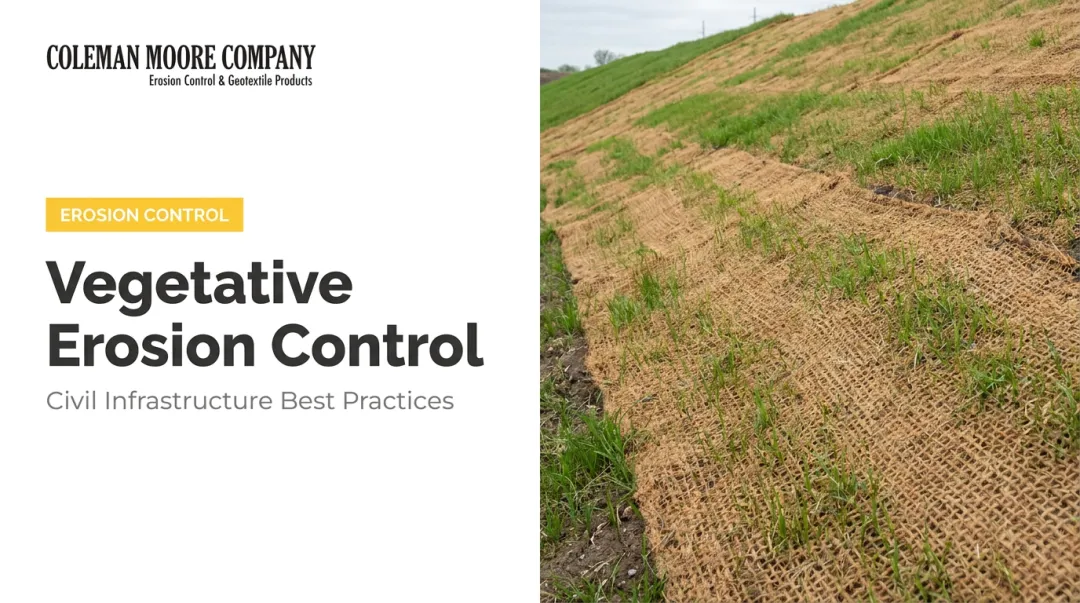
Deep-rooted native grasses, perennial groundcovers, and fibrous-rooted shrubs are the most durable long-term solution for moderate-steep slopes (33–50%). Root systems anchor soil, reduce runoff velocity, and improve infiltration over time. Native plantings are also the most cost-effective option once established.
Hydroseeding is the practical choice for large exposed areas. A slurry of seed, mulch, fertilizer, and tackifier bonds to the slope surface and outperforms dry seeding by maintaining seed-to-soil contact and moisture retention. Iowa DOT's Section 2601 includes native grass seeding as a standard construction erosion control work item — native mixes are generally preferred on civil projects for establishment reliability and long-term root density.
One important limitation: vegetation takes weeks to establish meaningful cover. During active construction, vegetative methods must be paired with physical protection.
Physical Erosion Control Products
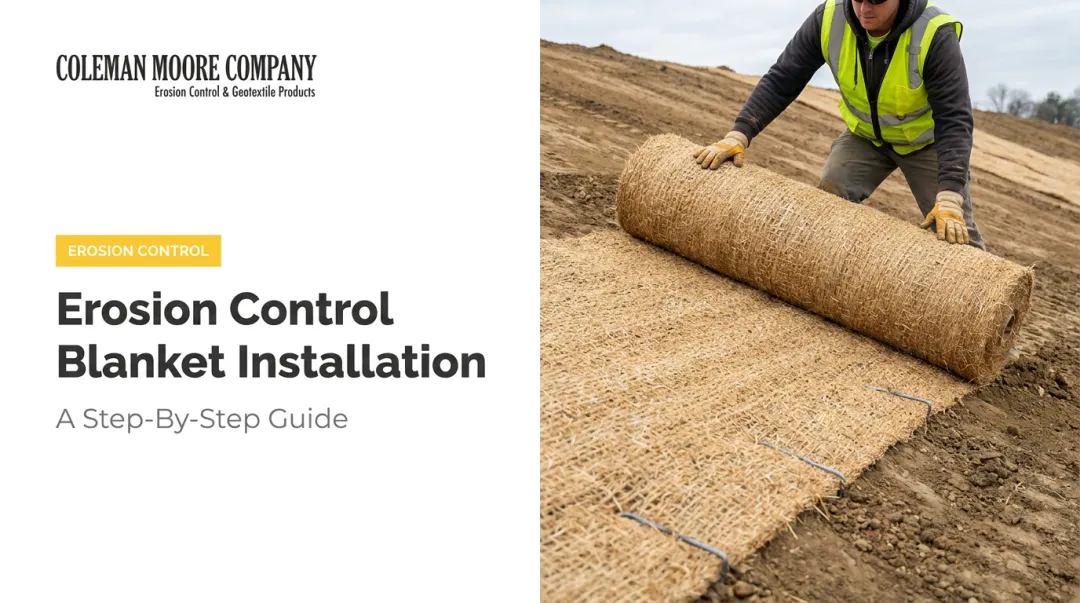
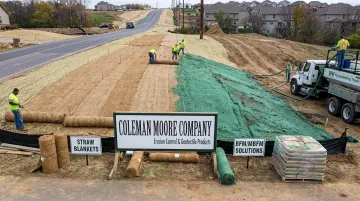
Erosion Control Blankets (ECBs) are the standard solution for protecting bare soil on steep slopes during and after grading. They absorb raindrop impact, slow surface runoff, retain moisture for germination, and biodegrade as vegetation takes over.
Coleman Moore Company stocks the full Curlex® line from American Excelsior Company, including:
- Single-net straw and wood excelsior blankets (rated to 3:1 slopes)
- Double-net straw, wood excelsior, and coconut fiber blankets (rated to 1:1 slopes)
For the 33–50% gradient range, double-net blankets are the appropriate classification. Single-net products are limited to gentler slopes.
Where blanket installation isn't practical — irregular terrain, very steep faces, or large contiguous areas — fiber matrix products take over. Bonded Fiber Matrix (BFM) and Mechanically Bonded Fiber Matrix (MBFM) products are applied by hydroseeder and form a continuous erosion-resistant layer without the ground prep ECBs require. Coleman Moore carries BFM and MBFM products from HH Wood Fiber and LSC (EarthGuard Fiber Matrix), with typical application rates of 3,000–4,500 lbs/acre.
Geosynthetic Solutions
Geosynthetics serve two distinct functions on steep slopes: filtration/separation and reinforcement.
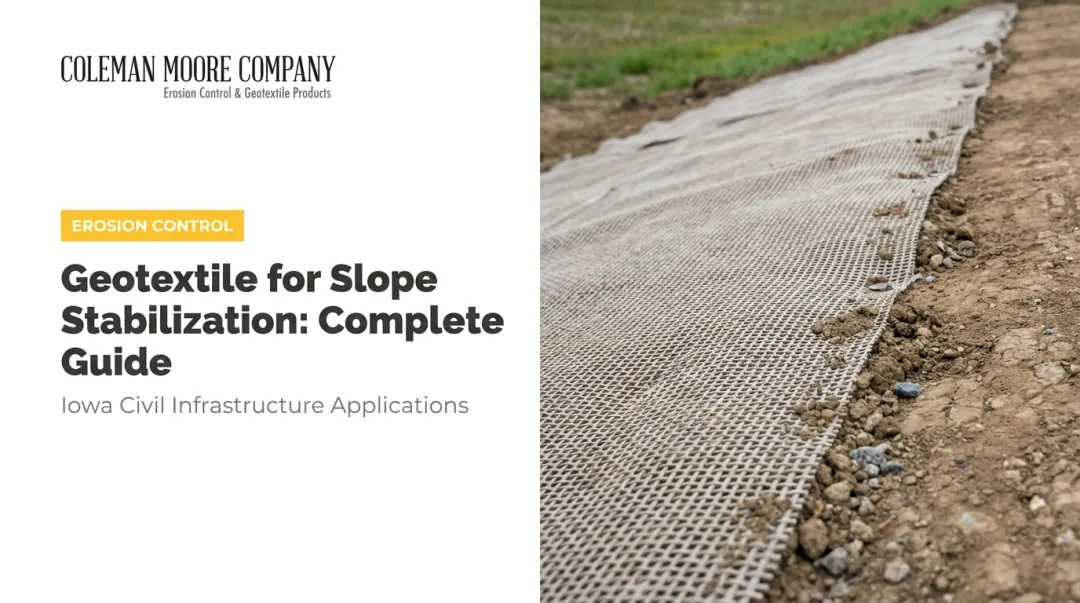
Geotextiles prevent fine particle migration, filter water through soil interfaces, and protect drainage systems from clogging. According to a 2022 review published in PMC, a geotextile filter must retain soil particles while passing water — and both functions must be met simultaneously, which is why AOS and permittivity ratings both factor into product selection. Coleman Moore supplies both nonwoven and woven geotextiles from Mirafi and Huesker for filtration, separation, and shoreline stabilization applications.
Geogrids reinforce soil structure, enabling construction of steeper stable slopes or reinforced earth walls. Tensar's reinforced slope systems address slopes greater than 45 degrees, with their SierraScape system handling slopes steeper than 70 degrees. Coleman Moore carries Tensar InterAx® Geogrid along with Huesker Fortrac® geogrids, which are specified for steepened, settlement-resistant walls and slopes. Design support through Tensar Plus software is also available through Coleman Moore for optimizing geosynthetic specifications to site conditions.
For slopes exceeding 50% where long-term vegetative reinforcement is needed, turf reinforcement mats (TRMs) bridge the gap between geosynthetics and vegetation. Unlike ECBs, TRMs are permanent, non-degradable structures. Their three-dimensional matrix anchors root systems against hydraulic forces even after full vegetation establishes. Coleman Moore stocks TRMs from Propex (LandLok® and Pyramat®), American Excelsior (Recyclex®), and Huesker (Fortrac 3D).
Structural and Engineering Controls
TRMs extend the range of vegetative solutions, but once slopes exceed 50% gradient — or where structural loads are present — physical and vegetative methods alone won't hold. Structural solutions must come first.
Retaining walls (gravity, cantilever, or anchored) halt downslope movement entirely and create stable faces where vegetation can establish. FHWA's mechanically stabilized earth (MSE) wall guidance covers geosynthetic-reinforced soil systems as a preferred approach for reinforced slopes and embankments.
Terracing and grade-control structures break long steep slopes into shorter, flatter segments. Relevant tools include:
- Check dams — EPA defines these as small temporary structures installed in concentrated-flow channels; when installed in series, the crest of the downstream dam should align with the toe of the upstream dam
- Compost filter socks and sediment logs — Coleman Moore carries Curlex Sediment Logs and Straw Wattles from American Excelsior, plus products from Gator Guard and Friendly Environmental
- Bioswales — vegetated channels that slow and filter concentrated runoff before it reaches waterways
Riprap and gabions protect slope toes and high-energy drainage channels where concentrated flow can undercut embankments. They dissipate hydraulic energy and prevent progressive failure at the base of steep fills.
How to Assess Your Slope Before Choosing a Method
Proper site assessment prevents the most costly mistake in erosion control: installing the right product in the wrong place.
Measure and Classify Slope Gradient
Use a clinometer, survey equipment, or topographic map analysis to measure vertical rise over horizontal run, then convert to percentage. The three-tier classification guides method selection:
- Under 33%: Vegetation alone is often sufficient
- 33–50%: ECBs or geotextiles required alongside vegetative methods
- Above 50%: Structural solutions must precede vegetation establishment
Evaluate Soil Type and Stability
Sandy and silty soils are highly erodible. Clay-heavy soils resist erosion better but become unstable when saturated, which is a persistent concern on Iowa construction sites with heavy clay subgrade.
Loose, disturbed construction fill amplifies risk regardless of soil texture. Research confirms erosion rates on disturbed land run 2 to 40,000× higher than on undisturbed ground.
Identify Existing Erosion Indicators
Visual warning signs that a slope has already crossed its threshold:
- Rill and gully formation (small channels carved into the surface)
- Exposed root systems or undercut vegetation
- Soil deposition at the slope toe
- Sediment-stained runoff after rain events
These indicators call for immediate intervention, not a scheduled assessment.
Assess Hydrology and Vegetation Cover
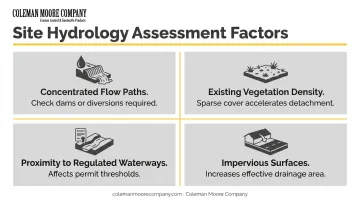
Beyond slope gradient and soil type, the site's hydrology shapes both method selection and your SWPPP requirements. Key factors to document:
- Concentrated flow paths — areas where water converges from upslope require check dams or diversions regardless of overall slope condition
- Existing vegetation density — sparse cover accelerates surface detachment and limits stabilization options
- Proximity to regulated waterways — affects permit thresholds and acceptable sediment loading
- Impervious surfaces — driveways, roads, and rooftops that redirect runoff onto the slope increase effective drainage area
Steep Slope Erosion Control: Implementation Guidelines
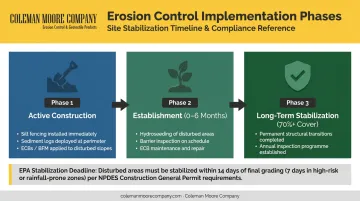
Erosion control on steep slopes is not a one-time installation. It requires a phased approach aligned with project timeline.
Implementation Phases
| Phase | Timing | Primary Actions |
|---|---|---|
| Active Construction | During grading | Install silt fencing, sediment logs, check dams immediately; cover exposed slopes with ECBs or BFM/MBFM |
| Establishment | 0–6 months post-grading | Apply hydroseeding or vegetative plugs; maintain ECBs; inspect barriers after each storm event |
| Long-Term Stabilization | After 70%+ vegetative cover | Transition to permanent structural solutions where needed; schedule annual inspections |
EPA's 2022 Construction General Permit sets the federal timing standard: stabilization must be initiated as soon as practicable — no later than the next business day after construction activity temporarily or permanently ceases. Completion deadlines are 14 calendar days for sites disturbing 5 acres or less, and 7 calendar days for larger sites or those near impaired waterways.
Gradient-Based Method Matching
- Under 33%: Vegetation alone is typically sufficient with standard mulch or light ECB
- 33–50%: Double-net ECBs or geotextiles required; hydroseeding once grading stabilizes
- Above 50%: Retaining walls, geogrids, or terracing must be in place before any vegetative work begins
Regulatory Requirements
Construction sites disturbing one or more acres require NPDES permit coverage and a Stormwater Pollution Prevention Plan (SWPPP). In Iowa, this falls under Iowa DNR General Permit No. 2, effective March 1, 2023 through February 29, 2028.
The SWPPP site map must identify steep slopes and document how disturbance will be minimized or controlled. Approved controls listed in the permit include hydraulic mulch, geotextiles, compost blankets, terraces, and velocity dissipation devices. Failure to install adequate controls exposes a project to stop-work orders and penalties that routinely reach five figures.
Conclusion
Steep slope erosion control protects more than topsoil — it protects site integrity, downstream water quality, structural investments, and your regulatory standing on every project. Effective control means a layered strategy matched to gradient, soil type, project phase, and timeline — not a single product applied once.
Getting the selection right from the start avoids far costlier outcomes: gully failures, lost fill, and compliance violations.
For Iowa contractors, engineers, and municipalities working on steep slope projects, Coleman Moore Company has supplied geotextiles, erosion control blankets, geogrids, BFM products, sediment logs, and turf reinforcement mats across civil infrastructure work throughout the state since 2004. The Coleman Moore team provides technical product guidance and design support — from product selection through Tensar Plus software assistance — to help match the right solution to the specific conditions on your site.
Contact Coleman Moore at 515-309-5577 or info@colemanmoorecompany.com to discuss your project.
Frequently Asked Questions
What is the most effective method of controlling soil erosion on steep slopes?
The most effective approach combines ECBs or geotextiles for immediate soil protection, deep-rooted vegetation for long-term anchoring, and structural measures — retaining walls or terracing — for slopes exceeding 50% gradient. No single method is sufficient on severely steep conditions; layering methods matched to the specific gradient are what hold.
What should I plant on a steep slope to prevent erosion?
Deep-rooted native grasses, fibrous-rooted shrubs, and spreading perennial groundcovers perform best. For large steep areas, hydroseeding with a native seed mix is the preferred application method: it bonds to the slope surface and establishes cover faster than hand-seeding or plugs alone.
What products stop wind erosion on an exposed hillside?
Hydraulic mulch mats (BFM or MBFM), erosion control blankets, and tackified hydroseeding are the most effective products for wind erosion on exposed slopes. Dense, low-growing vegetation with fibrous root systems provides the most durable long-term protection once established, but physical products must hold the surface until cover develops.
What is considered a steep slope for erosion control purposes?
Slopes above 33% gradient are generally classified as moderate-to-steep and require engineered erosion control solutions beyond basic seeding. Slopes exceeding 50% typically require structural stabilization (retaining walls, geogrids, or terracing) before vegetative methods can be relied upon to hold the surface.
How do erosion control blankets work on steep slopes?
ECBs protect bare soil by absorbing raindrop impact, slowing surface runoff, retaining seed moisture, and biodegrading as vegetation establishes. Double-net blankets handle slopes up to 1:1 (100% gradient); single-net products are limited to 3:1 slopes. All ECBs should be anchored with staples per the manufacturer's installation specifications; unanchored blankets fail quickly on steep grades.
Do I need a permit for steep slope erosion control on a construction site?
In Iowa, construction sites disturbing one acre or more require NPDES coverage under Iowa DNR General Permit No. 2 and a SWPPP specifying erosion and sediment control measures. Steep slopes require explicit documentation in your SWPPP site map. Confirm local requirements before breaking ground, as permit conditions vary by jurisdiction.