Geotextiles address multiple failure mechanisms at once: reinforcing soil, controlling drainage, protecting exposed surfaces, and separating dissimilar materials. Engineers, contractors, and municipalities across Iowa use them on everything from highway embankments to riverbank revetments.
This guide covers the main types of geotextile fabric, how they stabilize slopes, how to choose the right product, installation best practices, and common applications.
Key Takeaways:
- Geotextile type depends on slope severity — nonwovens excel at drainage and filtration, wovens at structural reinforcement
- Slope angle, soil type, and project duration all drive product selection
- Proper anchoring, seam overlap, and pre-installation seeding are as important as fabric choice
- Geotextiles serve both temporary (vegetation establishment) and permanent (infrastructure) functions
Why Slopes Fail: Understanding Erosion and Instability
Natural Forces at Work
Four forces drive most slope failures:
- Rainfall impact dislodges surface soil particles directly, initiating erosion before runoff even begins
- Surface runoff accelerates downslope, increasing in velocity and carrying capacity as it goes
- Elevated pore water pressure weakens the soil matrix by reducing effective stress, which is a leading trigger of sudden slope collapse
- Gravity acts continuously on loose or saturated soils, especially on slopes steeper than 3:1 (horizontal to vertical)
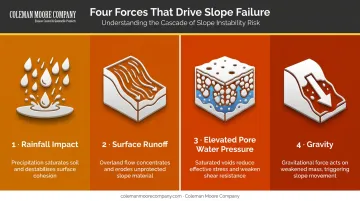
These forces are always present. The difference between a stable slope and a failing one often comes down to how well surface cover and drainage manage them.
How Construction Accelerates the Problem
Land clearing strips the vegetation that absorbs rainfall energy and holds soil in place. Grading and excavation disturb natural soil structure, leaving unconsolidated material exposed. Construction loading shifts stress distribution within slopes in ways the original soil profile wasn't designed to handle.
The result: bare, disturbed slopes with no natural protection during the most vulnerable period of a project.
The Cost of Getting It Wrong
Beyond physical damage, sediment runoff from unprotected slopes creates regulatory exposure. The EPA requires NPDES permit coverage for construction activity disturbing one acre or more, and Clean Water Act civil penalties can reach $68,445 per violation.
EPA enforcement actions in 2022 resulted in settlements ranging from $6,600 to $18,000 for construction companies that failed to install adequate erosion controls. Repair costs for slope failures — including damaged roads, retaining walls, and adjacent structures — consistently run higher than what proper geotextile protection would have cost at the outset.
Types of Geotextile Fabric for Slope Stabilization
Woven Geotextiles
Woven geotextiles are manufactured by interlacing yarns in a grid-like pattern. The result is a fabric with high tensile strength, low elongation, and a relatively tight aperture — properties that make them well-suited for structural reinforcement on steep embankments and retaining wall systems.
When a slope needs to resist significant tensile forces — where the soil mass itself cannot hold without additional support — woven geotextiles are the right tool. They distribute applied loads laterally and improve shear resistance across the slope profile.
One limitation: wovens have lower permeability than nonwovens. They're not used as standalone drainage or filtration layers. Complex slope systems often pair them with nonwoven drainage composites.
Coleman Moore Company supplies woven geotextiles from manufacturers including Mirafi and Huesker for load distribution, separation, and soil reinforcement applications across Iowa infrastructure projects.
Non-Woven Geotextiles
Nonwoven geotextiles are produced by bonding fibers together — through needle-punching, thermal, or chemical processes — rather than weaving them. Key properties include high permeability, flexibility, and excellent filtration capability, which make them the preferred choice for drainage relief, filtration, and surface erosion control.
Weight selection matters on slopes with varied soil conditions:
- Lightweight (139–170 g/m²): general filtration and separation
- Heavy needle-punched (675 g/m²+): puncture resistance and dual filtration-separation roles
Mirafi® nonwoven geotextiles — polypropylene products with UV and chemical resistance — are available through Coleman Moore for drainage, subsurface filtration, and riprap underliner applications.
Biodegradable and Natural Fiber Geotextiles
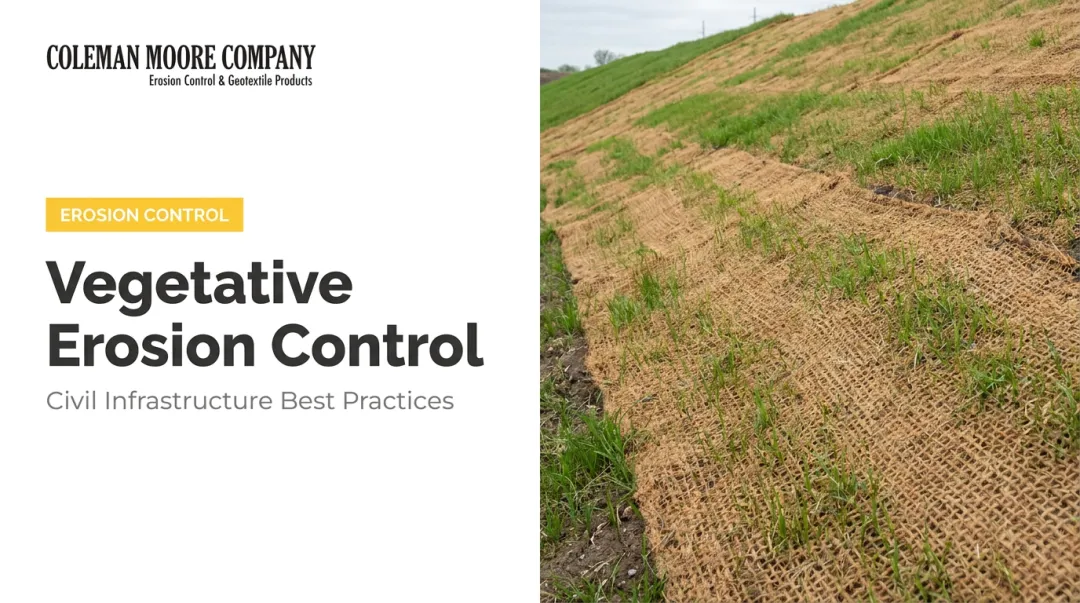
Biodegradable geotextiles — made from coir (coconut fiber), straw, or wood excelsior — are temporary systems designed for one specific job: protecting the slope surface during vegetation establishment.
Typical functional longevity by material:
| Material | Approximate Lifespan |
|---|---|
| Straw blanket | Up to 12 months |
| Wood excelsior blanket | 12–24 months |
| Coir (coconut fiber) blanket | 2–3 years |
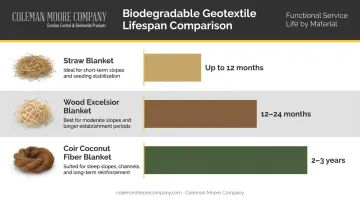
Coleman Moore carries the full Curlex® line from American Excelsior Company — single- and double-netted straw and wood fiber products — along with coir blankets and coir fiber logs from Nedia Enterprises for shoreline and waterway applications.
These products work best when vegetation will establish within the product's lifespan. On slopes where vegetation is unlikely or permanent reinforcement is required, woven or composite geotextile systems are the correct starting point.
How Geotextiles Stabilize Slopes: Key Functions
Geotextiles don't do just one thing on a slope — and identifying the specific function you need is the first step toward selecting the right product. Most slope applications call on one or more of these four core functions:
- Reinforcement — adds tensile strength to resist shear failure
- Filtration — relieves pore water pressure while retaining soil fines
- Surface erosion control — intercepts rainfall energy and slows runoff
- Separation — keeps dissimilar soil and aggregate layers from mixing
Reinforcement
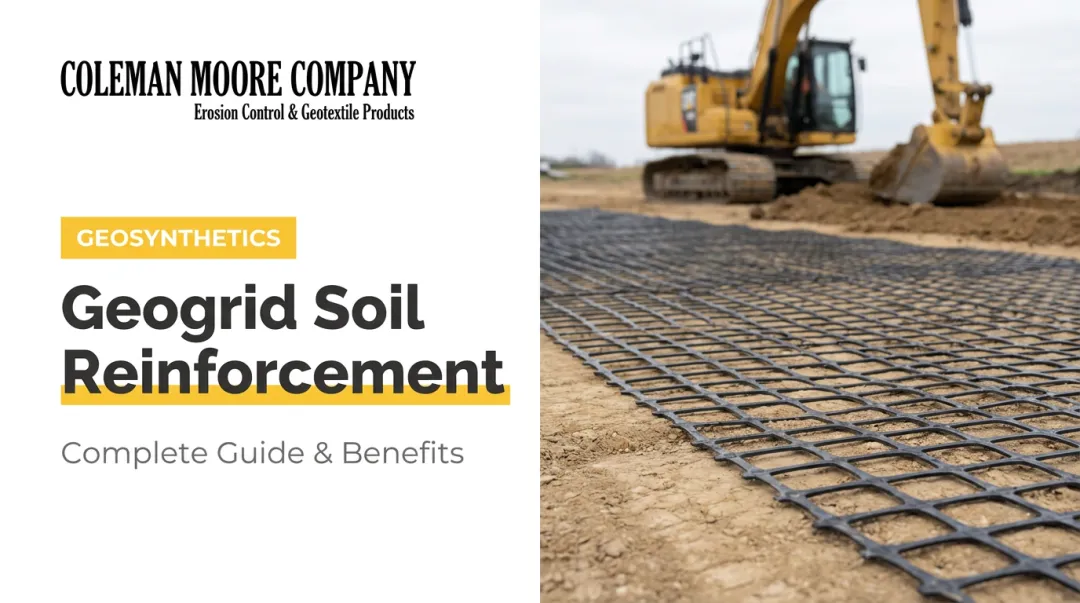
Woven geotextiles and geogrids add tensile strength to the soil mass, distributing applied loads and improving shear resistance. On soft or weak soils where a slope cannot support its own weight, reinforcement is the primary function. High-strength geogrids used in Geosynthetic-Reinforced Soil (GRS) walls and slopes are designed to deliver this tensile capacity with low strain and a high bond coefficient with soil.
Filtration and Pore Pressure Relief
Pore water pressure buildup is one of the most common triggers of slope collapse. Nonwoven geotextiles allow water to pass through freely while retaining soil fines, functioning as a filter that relieves pressure without allowing soil migration. This prevents internal erosion and reduces the risk of sudden failure in saturated conditions.
Surface Erosion Control
When installed on the slope face, geotextiles absorb the kinetic energy of raindrop impact and slow surface runoff velocity. This gives water time to infiltrate rather than carry particles downslope. It's the primary mechanism behind erosion control blankets and biodegradable mats used on graded slopes and disturbed embankments.
Separation
In multi-layer slope systems — such as an aggregate drainage blanket placed over native soil — geotextiles prevent fine soil from migrating into coarser layers over time. Without separation, drainage paths clog and structural integrity degrades. A geotextile at the interface maintains system performance across the project's full design life.
How to Choose the Right Geotextile for Your Slope Project
Match Product to Slope Severity
Slope angle is the primary driver:
- Mild slopes (less than 3:1 H:V (horizontal to vertical): Biodegradable or nonwoven erosion control blankets typically suffice where runoff is manageable and vegetation establishment is the goal
- Moderate slopes (3:1 to 2:1): Nonwoven geotextiles with proper anchoring and adequate weight for soil conditions
- Steep slopes (steeper than 2:1 or greater than 45°): Woven geotextiles or geogrids providing tensile reinforcement become necessary
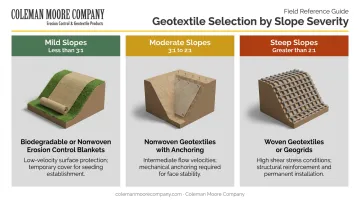
Slope height compounds risk — a taller slope at the same angle demands more robust solutions than a short one.
Account for Soil Type
Cohesive soils (clay-rich) and granular soils (sand or gravel) behave very differently under saturation. Fine-grained soils require geotextiles with an Apparent Opening Size (AOS) calibrated to retain fines while still passing water. Too open and soil migrates through; too tight and drainage backs up.
Temporary vs. Permanent Application
- Construction site protection during vegetation establishment calls for biodegradable blankets — cost-effective and designed to break down once grass takes hold
- Road embankments, retaining structures, and riverbanks require UV-resistant synthetic geotextiles with documented long-term mechanical properties
Key Technical Properties to Specify
| Property | ASTM Standard | What It Tells You |
|---|---|---|
| Apparent Opening Size (AOS/O95) | ASTM D4751 | Whether the fabric retains soil fines without clogging |
| Permittivity | ASTM D4491 | How quickly water passes through the fabric |
| Grab tensile strength | ASTM D4632 | Resistance to point loading during installation and service |
| Wide-width tensile strength | ASTM D4595 | Structural reinforcement capacity across the slope |
| UV resistance | ASTM D4355 | Retained strength after exposure to sunlight and weather |
Specify by function and test value — not by fabric name alone.
Matching the right product to your specific conditions takes more than a spec sheet. Coleman Moore Company works with contractors, engineers, and municipalities across Iowa to evaluate site conditions and select the right geotextile from suppliers like Tensar, Solmax, and American Excelsior Company. Contact them at 515-309-5577 or info@colemanmoorecompany.com.
Geotextile Installation on Slopes: Best Practices
Site Preparation
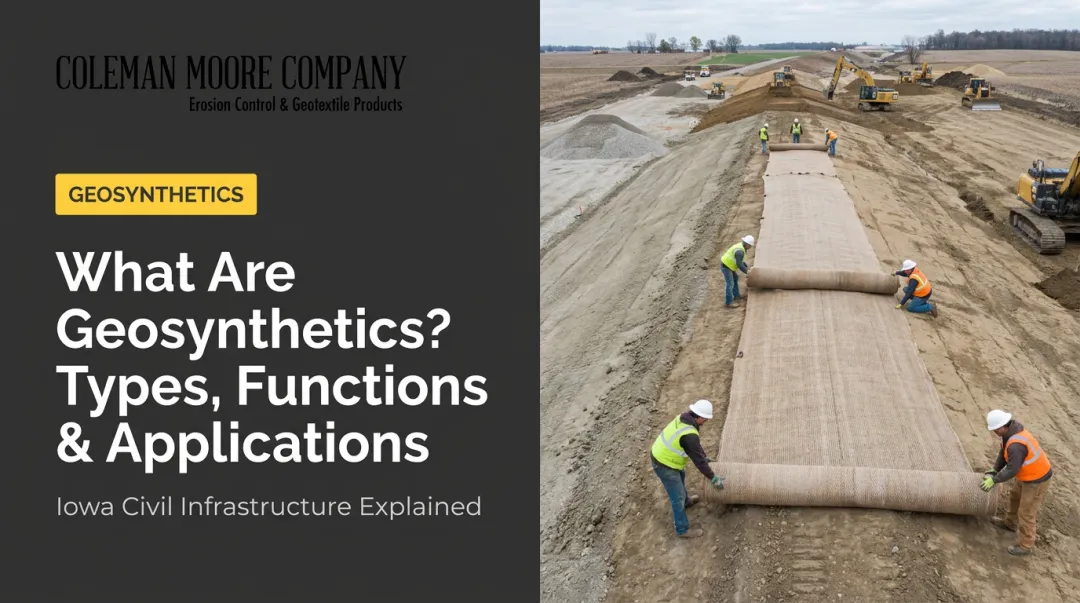
The slope surface must be graded smooth and cleared of debris, rocks, and vegetation clumps before installation. Any gap between the geotextile and soil surface creates a channel for water to flow beneath the fabric — undermining the entire erosion control function.
Seed the area before placing the geotextile. Seeding after installation prevents direct seed-to-soil contact and reduces germination rates. The fabric goes on top; vegetation grows up through or around it.
Anchoring and Overlap Requirements
With site prep complete, anchoring and overlap details determine whether the installation holds under load and runoff. Key requirements:
- Top anchor trench: Bury the upper end of the roll in a trench at least 8 inches deep at the crest of the slope
- Roll orientation: Always install rolls vertically (up and down the slope), never horizontally
- Side overlap: Adjacent roll edges must overlap at least 6 inches across the slope
- Downslope overlap: Upslope rolls must overlap downslope rolls — not the reverse — to prevent water seeping under seams. End overlaps should be at least 3 feet
- Pinning: Use U-staples (minimum 0.09-inch diameter wire, legs at least 6 inches long) spaced approximately 5 feet apart along sides and center. Increase staple density on steeper sections and in sandy soils
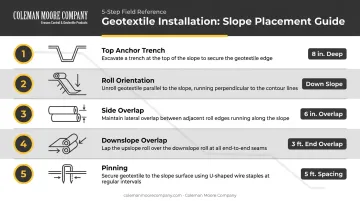
For slope stabilization systems — not just surface erosion control — anchor spacing requirements depend on slope stability class, angle, and height.
Common Mistakes to Avoid
- Installing without seeding first
- Inadequate anchoring on steep or sandy sections
- Seams running upslope over downslope material (creates water channels)
- Skipping the top anchor trench entirely
- Leaving gaps between the fabric and soil surface
Common Applications of Geotextiles in Slope Stabilization
Road, Highway, and Railway Embankments
Geotextiles reinforce embankment slopes, control erosion from stormwater runoff, and maintain drainage around pavement structures. Iowa DOT Section 4196 specifies engineering fabric requirements for revetment and embankment erosion control applications — Coleman Moore carries DOT-compliant products that meet these requirements for Iowa highway and municipal road projects exposed to seasonal precipitation and spring runoff.
Riverbanks, Drainage Channels, and Waterway Slopes
Geotextiles placed beneath riprap or rock armor prevent scour and subsurface erosion from flowing water. Filtration does the heavy lifting here — the fabric must retain fine soil particles while allowing water exchange to prevent hydrostatic pressure buildup. Coleman Moore supplies Mirafi® nonwovens specifically for riprap underliner and shoreline protection applications across Iowa waterways.
Construction Sites, Land Development, and Graded Slopes
Exposed graded slopes need protection the same day grading wraps up. Temporary biodegradable blankets from the Curlex® line go down immediately to prevent sediment runoff during construction.
As vegetation establishes and the project transitions to permanent conditions, synthetic geotextiles take over where longer-term performance is required. This two-stage approach — temporary blanket followed by permanent synthetic, or biodegradable blanket where vegetation is the end goal — is standard practice on Iowa development sites.
Frequently Asked Questions
What is geotextile fabric for slope protection?
Geotextile fabric for slope protection is a permeable synthetic or natural material installed on or within a slope to control erosion, reinforce soil, and manage water movement. Depending on the product, it functions as a filter, reinforcement layer, separator, or surface cover — preventing soil loss from rainfall, runoff, and gravity.
What are the options for slope stabilization?
Main options include geotextiles, erosion control blankets, geogrids, vegetation and hydroseeding, retaining walls, soil nailing, riprap, and geocells. Geotextiles are often combined with these methods — as a filter layer beneath riprap, for example, or as reinforcement within a vegetated embankment.
What type of geotextile fabric is best for slope stabilization and drainage?
Nonwoven geotextiles are generally best when drainage and filtration are the primary needs — they allow water to pass while retaining soil fines. Woven geotextiles are preferred for structural reinforcement on steep slopes. Slope angle, soil type, and whether the application is temporary or permanent drive the final selection.
How do you install geotextile fabric on a slope?
Grade and seed the slope, then anchor the geotextile in a trench at least 8 inches deep at the crest. Unroll downslope without stretching, overlap adjacent rolls by at least 6 inches (upslope over downslope), and pin with staples approximately 5 feet apart — closer on steeper sections or in sandy soils.
How long does geotextile fabric last on a slope?
Biodegradable blankets last from a few months (straw) to 2–3 years (coir), degrading as vegetation establishes. UV-stabilized synthetic geotextiles last far longer — Solmax data indicates properly buried polypropylene nonwovens can reach up to 200 years, though exposed service life varies by product UV resistance rating.