Key Takeaways
- Vegetation controls erosion through three mechanisms: root anchoring, foliage interception of rainfall, and surface runoff reduction
- Method selection depends primarily on slope gradient, project timeline, and soil conditions
- Pairing vegetation with erosion control blankets or geotextiles is critical during the establishment window
- Native grasses like switchgrass develop root systems exceeding 10 feet deep, outperforming most introduced species for long-term slope stabilization
- NPDES/SWPPP compliance sets specific timing and coverage requirements that directly shape your vegetative erosion control plan on permitted sites
What Is Vegetative Erosion Control and Why It Matters
Vegetative erosion control uses living plants — grasses, shrubs, ground covers, and engineered vegetation systems — to stabilize soil, reduce runoff velocity, and prevent sediment displacement on disturbed land surfaces.
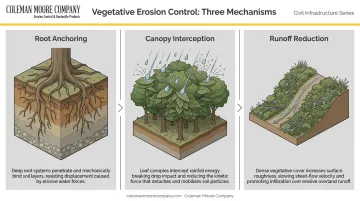
Three mechanisms work together to suppress erosion:
- Root anchoring — plant roots bind and reinforce soil particles at depth, resisting displacement from water or gravity
- Canopy interception — foliage absorbs raindrop impact before it strikes bare soil, preventing splash erosion
- Runoff reduction — dense plant cover slows surface flow, reducing the velocity and volume of water moving across the site
The scale of the problem makes these mechanisms matter. According to EPA, sediment runoff rates from construction sites are typically 10 to 20 times greater than agricultural lands and 1,000 to 2,000 times greater than forest lands. A single active construction site can deposit more sediment to nearby streams in weeks than would accumulate naturally over decades.
For contractors, engineers, and municipalities operating under stormwater permits, that's not an abstract figure — it's a direct compliance target with real liability attached. Choosing the right vegetative strategy, and pairing it with the appropriate erosion control materials, determines whether a site meets permit requirements or faces enforcement action.
Types of Vegetative Erosion Control Methods
Vegetative erosion control spans a wide spectrum — from basic seeding to engineered bioengineering systems. The right approach depends on slope severity, site timeline, and available resources.
Seeding and Hydroseeding
Seeding is the foundational method for large disturbed areas: highway embankments, graded lots, mine reclamation sites. Three approaches are common:
- Broadcast seeding applies seed to the surface; works best on prepared, relatively flat ground
- Drill seeding places seed directly into soil for better seed-to-soil contact on level terrain
- Dormant seeding (applied late fall or winter) targets early spring germination before the erosion window opens
EPA reports that grasses typically emerge within 4 to 28 days after seeding, and legumes within 5 to 28 days. Timing and seedbed preparation are the most critical success factors — poor contact between seed and soil is a leading cause of establishment failure.
Hydroseeding (hydraulic mulch seeding) delivers seed, mulch, fertilizer, and tackifier in a single slurry spray. It's well-suited for large slopes, remote areas, or sites where manual seeding isn't practical. Iowa DOT requires hydroseeding equipment with a pump rated at no less than 100 gallons per minute with continuous agitation to ensure uniform slurry distribution.
Sod Installation
Sod provides immediate erosion protection — no germination period required. It's best reserved for high-visibility areas, stormwater inlet surrounds, and sites where permit timelines don't allow weeks for seeding establishment. The tradeoff is cost: sod is significantly more expensive per square foot than seeding.
Vegetative Barriers and Buffer Strips
NRCS Conservation Practice Standard 601 defines vegetative barriers as permanent strips of stiff, dense vegetation established along the contour of slopes or across concentrated-flow areas. These narrow plantings trap sediment on their upslope side, slow runoff, and gradually build terrace-like benches over time.
Switchgrass and eastern gamagrass are the primary species used. USDA research found that one- and two-row barriers of either species were as effective at resisting sediment-laden overtopping as three- and four-row barriers — making efficient design achievable without excessive planting width.
Bioengineering and Live Staking
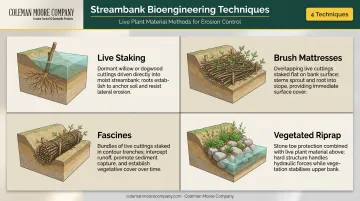
Bioengineering combines live plant material with structural elements for streambank, riverbank, and steep slope stabilization. Common techniques include:
- Live staking drives dormant willow or dogwood cuttings directly into streambanks to root in place
- Brush mattresses lay thick mats of dormant cuttings on eroding banks, staked and wired down to promote rooting
- Vegetated riprap pairs structural stone with live plantings to reinforce slope toes against undercutting
- Fascines (bundled live cuttings) are staked into shallow trenches along the contour to intercept runoff and establish root networks
Unlike purely structural approaches, bioengineering root systems actively reinforce soil after installation. Willow stakes, for example, can develop roots extending 3 to 5 feet deep within a single growing season — increasing slope resistance well beyond what the initial installation provides.
Best Plants for Erosion Control
Plant selection is site-specific. Slope steepness, soil type, moisture, sun exposure, and climate zone all factor in. For Iowa projects, native species adapted to Midwest conditions consistently outperform non-natives in long-term stabilization. The categories below map those conditions to plant types most proven in Iowa civil and infrastructure applications.
Grasses and Native Prairie Species
Native warm-season grasses are top performers for erosion control across a range of conditions:
- Switchgrass (Panicum virgatum) — fibrous roots growing more than 10 feet deep, tolerates both wet and dry conditions, stiff persistent stems make it ideal for vegetative barriers
- Eastern gamagrass (Tripsacum dactyloides) — roots penetrate compact clay pans 3 to 6.5 feet deep, stout brace roots anchor the plant against flow
- Tall fescue — lower-maintenance option for moderate slopes and cooler climates
- Buffalograss — drought-tolerant; suited to drier Iowa sites with minimal irrigation
Shrubs with Suckering or Deep Root Systems
Shrubs with spreading root habits are suited to moderate slopes, streambanks, and rain garden edges:
- Redosier dogwood (Cornus sericea) — suckering habit forms dense colonies; USDA documents its use specifically for streambank protection
- Native willows (Salix spp.) — fast-rooting live cuttings; standard material in bioengineering applications
- Aronia — fibrous root system; tolerates wet and dry cycles
These species bind soil across a wide lateral area rather than a single taproot — valuable on slopes where soil movement is diffuse rather than concentrated.
Ground Covers for Smaller Slopes and Fill Areas
For residential grading, roadway medians, fill slopes, and areas with limited maintenance access, mat-forming ground covers offer practical coverage:
- Creeping juniper
- Catmint
- Stonecrop (Sedum spp.)
- Vinca (use cautiously — check regional invasive status)
A note on invasive species: Before finalizing plant selection for projects near waterways or protected lands, check the Iowa DNR invasive species guide. Reed canary grass, for example, contractors widely use for erosion control, but Iowa classifies it as invasive — it aggressively displaces native riparian vegetation. Iowa State University Extension identifies it as a persistent invader of wetlands and floodplains, making it a poor long-term choice near waterways or protected lands.
Selecting the Right Vegetative Approach for Your Site
No single method fits every site. Slope, timeline, soil quality, and permit requirements each shape which approach will actually work — and which will fail before the first rain.
Slope Gradient
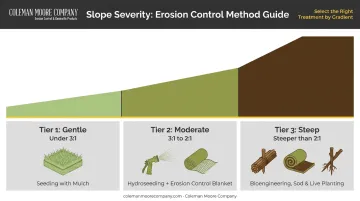
Slope gradient is the primary driver of method selection. Iowa SUDAS notes that seeding on steeper slopes is difficult because runoff can wash away seed, fertilizer, and topsoil before establishment. General guidance:
| Slope Severity | Recommended Approach |
|---|---|
| Gentle (under 3:1) | Seeding alone, with mulch |
| Moderate (3:1 to 2:1) | Hydroseeding + erosion control blankets |
| Steep (steeper than 2:1) | Bioengineering, sod, or live planting; seeding alone insufficient |
Project Timeline
If a site must be stabilized within days — to meet a permit deadline or ahead of a forecasted rain event — sod or erosion control blankets with seed are the practical choice. Bare seeding requires weeks for germination and does not provide immediate protection. EPA is explicit that seeding alone does not provide immediate stabilization and that temporary controls are required during the establishment period.
Soil Conditions
Construction sites frequently expose subsoil that lacks organic matter, biological activity, and structure. Poor soils resist germination and are highly erodible during the establishment window. Soil amendments address this directly. Products like Verdyol Biotic Earth™ and Quantum Growth™ microbial inoculants — both available through Coleman Moore — restore organic matter, improve water retention, and accelerate root establishment on depleted subsoils.
Regulatory Compliance
Soil conditions determine whether vegetation establishes — but permit requirements determine whether you have enough time. Projects under NPDES Construction General Permits face defined stabilization windows with real consequences for missing them:
- Stabilization deadlines: EPA CGP guidance requires stabilization within 7 or 14 calendar days depending on permit conditions
- Final stabilization threshold: 70% or more vegetative cover from native undisturbed vegetation is required
- Iowa-specific permit: General Permit No. 2 (effective March 1, 2023 through February 29, 2028) governs stormwater discharge from construction activity statewide
Vegetative stabilization plans should be coordinated with the project's SWPPP before ground is broken.
Combining Vegetation with Erosion Control Products
Vegetation alone rarely provides adequate protection during the days or weeks between site disturbance and meaningful plant establishment. Structural and manufactured products bridge that gap.
Erosion Control Blankets (ECBs)
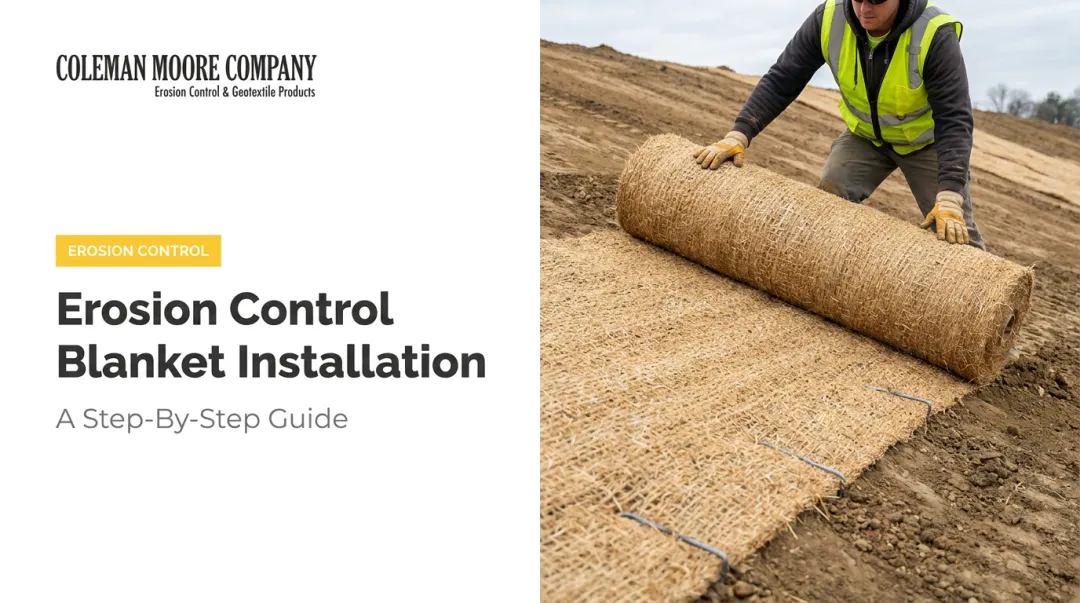
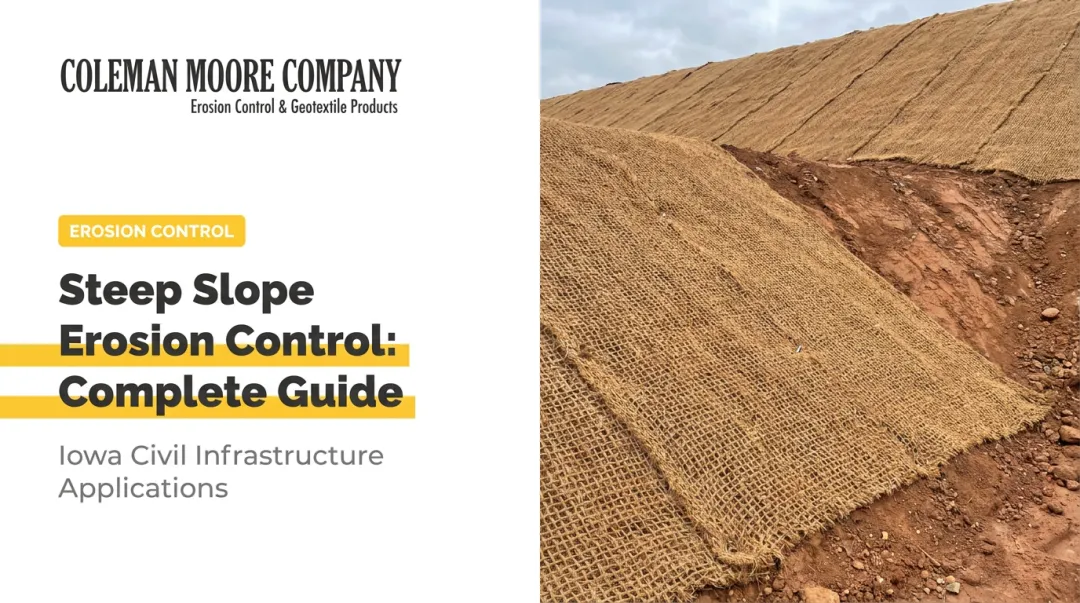
ECBs are the most widely used bridge solution. They hold seed against the soil surface, retain moisture for germination, and absorb raindrop impact on bare slopes. Coleman Moore supplies the Curlex® line from American Excelsior Company, which includes:
| Material | Longevity | Slope Rating |
|---|---|---|
| Straw (single net) | ~3 months | Up to 3:1 |
| Wood excelsior (double net) | 12–24 months | Up to 1:1 |
| Coconut fiber (double net) | 2–3 years | Up to 1:1 |
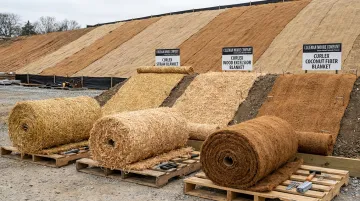
Single-net blankets handle moderate slopes; double-net blankets are specified for steeper conditions. Product selection should match both slope severity and the expected establishment timeline for the chosen vegetation.
For permanent vegetated channel applications or high-stress hydraulic environments where biodegradable blankets would be inadequate, Coleman Moore also carries turf reinforcement mats (TRMs). Options include LandLok®, Pyramat®, and Recyclex® — all providing long-term, non-degradable reinforcement that protects established vegetation under sustained hydraulic stress.
Hydraulic Mulch and Tackifiers
For hydroseeding applications, Coleman Moore supplies three BFM-grade hydraulic mulch products:
- HH Wood Fiber Black Diamond — pelletized BFM with tackifiers and biostimulants; holds seed against slopes until germination
- HH Wood Fiber Double Black Diamond — higher-fiber-density BFM pellets for steeper or more erosion-prone slopes
- LSC EarthGuard® Soil Stabilizing Liquid — liquid tackifier that upgrades standard hydraulic mulch to BFM performance when mixed at application
Sediment Control Companions
During the establishment window, sediment must be contained downslope. Coleman Moore's sediment control product line includes:
- Sediment logs — porous fiber logs placed across flow paths; water passes through while suspended sediment is captured
- Coir fiber logs (from Nedia Enterprises) — coconut-fiber logs that support direct vegetation establishment; plants can be plugged into the log or pre-vegetated before installation
- Turbidity curtains — deployed on projects adjacent to water bodies to contain sediment migration
Geosynthetics for Unstable or Severe Slopes
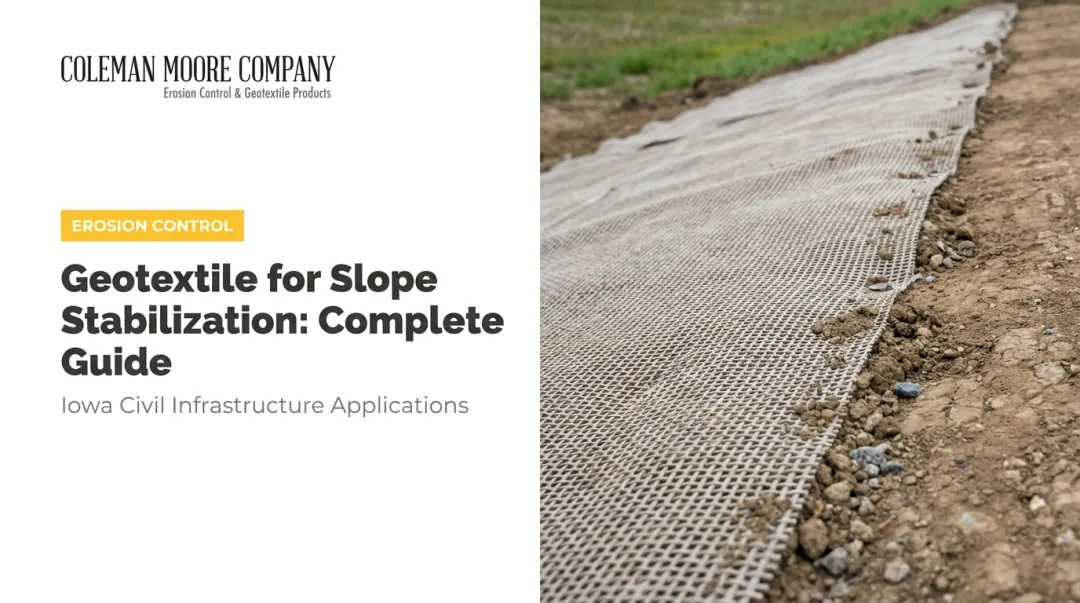
On sites with highly unstable soils or severe slope conditions, geotextiles and geogrids provide subgrade reinforcement beneath vegetated surfaces. Coleman Moore supplies nonwoven and woven geotextiles (Mirafi, Huesker) and biaxial/triaxial geogrids (Tensar InterAx, Huesker Fortrac) suited to highway embankments, slope stabilization, and streambank protection projects across Iowa.
Implementation Best Practices
Seedbed Preparation
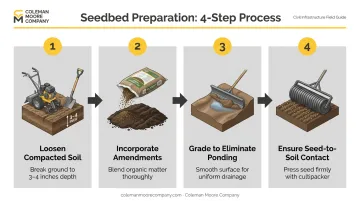
Seedbed quality determines establishment success more than almost any other factor. Before seeding:
- Loosen compacted soil — at least 3–4 inches of tillage depth for root penetration
- Incorporate amendments where organic matter is depleted or soil structure is poor
- Grade to eliminate water concentration points — avoid low spots that will pond and scour
- Ensure seed-to-soil contact — firming or cultipacking after seeding improves germination
Establishment Timing in Iowa
Iowa DOT defines permanent seeding windows as March 1 to May 31 and August 10 to September 30. The right window depends on your grass type:
- Late summer (August–September): Preferred for cool-season grasses — soil temperatures favor germination and warm-season weed competition is declining
- Dormant seeding (late fall): Works for some warm-season native species; seed overwinters and germinates in early spring, ahead of the active erosion season
Monitoring and Maintenance
Establishment doesn't end at seeding. During the first growing season:
- Monitor coverage and reseed bare patches promptly — gaps are where erosion concentrates
- Control invasive weeds that compete aggressively with establishing species (reed canary grass is a particular concern near Iowa waterways)
- Inspect and maintain ECBs, silt fences, and sediment logs after rain events; repair displaced or damaged materials before the next storm
- Document vegetative coverage against the permit's final stabilization threshold (typically 70% cover)
Frequently Asked Questions
What are vegetative methods of erosion control?
Vegetative erosion control methods include seeding and hydroseeding, sod installation, vegetative barriers and buffer strips, and bioengineering techniques such as live staking and brush mattresses. Each method uses plant roots, stems, and foliage to anchor soil and reduce the velocity and volume of surface runoff.
What is the best plant to stop soil erosion?
There's no single best plant; selection depends on slope, soil type, moisture, and climate. That said, deep-rooted native grasses like switchgrass, suckering shrubs like redosier dogwood, and dense mat-forming ground covers are consistently strong performers across a range of Iowa site conditions.
How long does it take for vegetation to control erosion?
Grasses typically emerge within 4 to 28 days after seeding, but full vegetative cover and effective erosion control develops over one to two growing seasons. Sod provides near-immediate stabilization, while bioengineering plantings like live stakes and brush mattresses reach peak effectiveness over multiple years.
Can vegetation alone stop erosion on steep slopes?
On slopes steeper than 2:1, vegetation alone is generally insufficient during the establishment period. Erosion control blankets, geotextiles, or structural bioengineering practices should be combined with plantings until root systems are fully developed and vegetative cover meets permit thresholds.
What is the difference between seeding and hydroseeding?
Conventional seeding involves mechanical or broadcast application of dry seed. Hydroseeding sprays a slurry combining seed, mulch, fertilizer, and tackifier in a single pass. It offers more uniform coverage on slopes and large disturbed areas, with the mulch component providing immediate surface protection during germination.
When should vegetative erosion control be combined with structural methods?
Structural support (erosion control blankets, silt fences, sediment logs, riprap, or geosynthetics) is needed when slopes are steep, soils are highly erodible, or stabilization windows are short. Sites adjacent to waterways require it whenever sediment runoff poses immediate compliance or environmental risk.