Introduction
Erosion doesn't wait for a convenient time. On highway embankments, streambanks, construction sites, and culvert outfalls, unprotected soil moves fast — and the cost of choosing the wrong protection method can be just as damaging as the erosion itself.
Erosion control blankets (ECBs) and rip rap are both widely specified solutions, but they work in very different ways. One supports vegetation and integrates into the landscape; the other physically armors the soil surface against hydraulic forces.
Specifying the wrong one means cost overruns, regulatory headaches, long-term maintenance burdens, or outright failure.
This guide gives contractors, engineers, municipalities, and developers a clear framework for comparing both methods — covering performance thresholds, cost, environmental impact, and the hybrid scenarios where both belong on the same project.
Key Takeaways
- ECBs are rolled products made from organic or synthetic materials that protect disturbed soil while supporting vegetation growth
- Rip rap physically armors soil against hydraulic forces, delivering immediate protection where flow velocities are too high for vegetation
- ECBs typically cost less to install and carry a lower environmental footprint; rip rap excels where flow velocities are extreme
- Key decision variables: flow velocity, slope gradient, vegetation potential, budget, and applicable DOT or NPDES regulations
- Both methods are often combined on complex sites where hydraulic conditions shift across zones
Erosion Control Blankets vs. Rip Rap: Quick Comparison
| Factor | Erosion Control Blankets | Rip Rap |
|---|---|---|
| Cost | ~$1–$16/SY installed depending on type (ECBs to TRMs) | Priced by CY or ton; significant variation by stone size, quarry distance, site access |
| Installation | Manual labor crews; no heavy equipment required | Requires excavators, dump trucks, graders |
| Environmental impact | Supports vegetation; integrates into riparian zones | Can disrupt riparian systems, elevate water temps, prevent vegetation |
| Longevity | 3 months (biodegradable) to permanent (TRMs) | Permanent; requires periodic inspection and stone repositioning after storms |
| Best-fit application | Slopes, revegetation goals, LID projects, moderate flow | High-velocity channels, culvert aprons, bridge scour, hard-armor requirements |
Cost note: Wisconsin DOT's 2025 average unit price list shows erosion mat items at $0.96–$1.04/SY, while riprap runs $67–$134/CY depending on grade. These are material bid prices, not full installed costs. Riprap's logistics burden — filter fabric, mechanical placement, and greater layer thickness — typically adds 30–50% or more to the final installed figure.
What Are Erosion Control Blankets?
Erosion control blankets are Rolled Erosion Control Products (RECPs) — manufactured from organic materials, synthetic fibers, or combinations of both. Their core function: hold seed and soil in place during the critical window between grading and vegetation establishment.
The Three ECB Categories
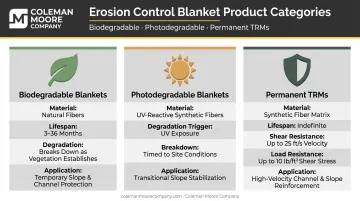
Biodegradable blankets use natural fibers (straw, wood excelsior, coconut coir) and break down after vegetation establishes. The Erosion Control Technology Council classifies functional longevity from ultra short-term (3 months) through long-term (36 months), depending on fiber composition and netting type.
Photodegradable blankets degrade via UV exposure on a timed basis, useful where degradation needs to track sun exposure rather than biological breakdown.
Permanent Turf Reinforcement Mats (TRMs) are non-degradable synthetic mats providing indefinite protection. According to the EPA, TRMs can protect against velocities up to 25 ft/s and shear stresses of 10 lb/ft², performance that approaches or matches many rip rap applications.
How ECBs Actually Work
ECBs anchor the seedbed against rainfall impact and surface runoff, retain soil moisture to accelerate germination, and provide measurable shear resistance during the bare-soil window. Once vegetation takes root, the plant root system becomes the primary erosion-resistance mechanism — making ECBs regenerative rather than just a shield. Unlike rip rap, which holds its position against flow but does nothing more, a properly vegetated ECB or TRM installation improves over time as root density increases.
Operational Advantages
- No heavy equipment required for installation — significant on remote or access-limited sites
- Lower installed cost than rip rap in most moderate-hydraulic applications
- Compatible with LID (Low Impact Development) design requirements
- Better visual integration near residential, commercial, or recreational areas
- NPDES-compliant when properly specified and installed
For Iowa contractors and engineers working toward Iowa DOT compliance, Coleman Moore Company stocks American Excelsior Company's Curlex® line (single- and double-netted straw and wood excelsior configurations) and Recyclex® TRMs made from 100% post-consumer recycled materials. The product range also includes TRMs from Propex (Landlok® and Pyramat® lines) and Huesker (Fortrac 3D) for higher-performance applications.
ECB Use Cases and Performance Limits
Primary applications where ECBs are specified:
- Highway and DOT embankment slopes
- Post-grading construction site stabilization
- Stormwater channels with moderate flow velocities
- Levee slopes and streambank protection
- Mine reclamation sites
- LID projects requiring riparian zone preservation
Performance boundaries matter. Standard biodegradable ECBs are suited for moderate shear conditions. ECTC permanent TRM specifications define minimum permissible shear values at 6.0–10.0 lb/ft² depending on type. For applications exceeding those thresholds — steep concentrated flow channels, culvert aprons, high-velocity streams — TRMs with higher ratings or rip rap become necessary.
FHWA's HEC-15 guidance notes flexible linings are generally suitable for channel gradients up to 10%. Above that, a steep-slope design procedure applies.
What Is Rip Rap?
Rip rap is a hard-armor erosion control method: angular, durable rock (typically limestone, granite, or quarry stone) placed in an interlocking formation over a filter fabric or gravel base layer. It dissipates hydraulic energy and protects underlying soil from scour. You'll also see it called rock armor, riprap revetment, or rubble slope protection.
Stone vs. Concrete Rip Rap
| Type | Strengths | Limitations |
|---|---|---|
| Stone rip rap | Flexes with minor soil movement; graded (mixed-size) stone fills voids more effectively | Heavier logistics; periodic stone repositioning after storms |
| Concrete rip rap | Rigid, impact-resistant surface | Susceptible to undermining and cracking when soil shifts — a significant drawback in Iowa's freeze-thaw environment |
Material selection and sizing go hand in hand. FHWA's HEC-11 designs riprap using the median particle size (D50) relative to flow velocity, depth, and a stability factor. Iowa DOT Section 4130 (revised April 2026) specifies revetment stone by class; Class A revetment carries a nominal top size of 400 pounds.
Installation Requirements
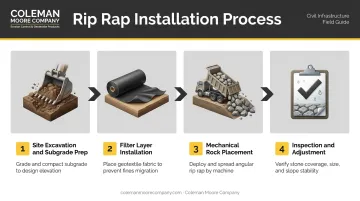
Rip rap installation isn't simply dropping rock on a slope. The full sequence:
- Site excavation to proper grade and subgrade preparation
- Filter layer installation — geotextile fabric or graded gravel to prevent base-soil migration
- Mechanical rock placement using excavators and dump trucks
- Inspection and adjustment post-placement
EPA's riprap BMP guidance notes that rip rap is generally not recommended on slopes steeper than 2:1 (horizontal to vertical). Stones on steeper grades can shift, slide, and create new failure points.
For remote or access-constrained Iowa sites, the equipment logistics for rip rap (excavators, dump trucks, graders) represent a significant cost and schedule factor that ECBs simply don't carry.
Documented Limitations
Rip rap's ecological effects are documented in the research:
- A USACE Engineering Research and Development Center report found that continuous rip rap armor can increase stream temperatures through solar radiation and create barriers between aquatic and terrestrial ecosystems
- Hard-armored banks prevent natural bank processes — vegetation cannot take root, riparian buffers are eliminated
- Weed intrusion into rip rap voids requires periodic herbicide treatment on maintained sites
- Post-storm inspection and stone repositioning add recurring maintenance costs
Rip Rap Use Cases
Rip rap remains the right call in specific conditions:
- High-velocity stream channels and floodways exceeding TRM shear thresholds
- Culvert inlet and outlet aprons
- Bridge scour protection
- Coastal and pond shorelines subject to wave action
- Areas where vegetation cannot establish (under bridges, deep shade)
- Projects requiring immediate hard armor with a known, predictable performance standard
DOTs and drainage engineers frequently specify rip rap where the post-installation vegetation establishment timeline creates an unacceptable risk window — situations where you simply can't wait for grass to grow.
Which Should You Choose?
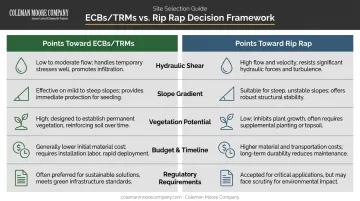
The decision framework isn't complicated, but it requires honest assessment of site conditions before specifying either method.
Primary Decision Factors
| Factor | Points Toward ECBs/TRMs | Points Toward Rip Rap |
|---|---|---|
| Hydraulic shear stress | Below permissible TRM threshold | Exceeds TRM capacity |
| Slope gradient | Any slope within spec | Limited to 2:1 or shallower |
| Vegetation potential | Feasible long-term | Not feasible |
| Budget and timeline | Faster install, lower cost | Higher cost, longer logistics |
| Regulatory requirements | LID mandate, habitat sensitivity | Hard armor required by design spec |
Clear Situational Guidance
Choose ECBs or TRMs when:
- Revegetation is a project goal
- Hydraulic conditions fall within permissible shear thresholds
- LID or NPDES requirements apply
- Site is near pedestrian, wildlife, or recreational areas
- Budget and schedule favor lighter installation
Choose rip rap when:
- Flow velocities exceed even high-performance TRM ratings
- Vegetation cannot establish permanently
- Culvert or bridge scour protection is required
- The design specification requires immediate permanent hard armor
The Hybrid Approach
On complex sites, the best answer often involves both. A channel with a high-velocity toe and gentler upper bank slopes is a common example: rip rap handles the base where hydraulic forces are most intense, while ECBs or TRMs cover the upper slope where vegetation can establish. The result is a channel that meets hydraulic performance requirements at the toe without over-engineering the upper slopes where biology can do the work.
The Cost-Savings Case for TRMs
That hybrid logic has direct cost implications worth quantifying at the design stage. Iowa DOT's EC-104 guidance specifically describes TRMs for applications where vegetation alone cannot withstand expected flow velocities — positioning them as a legitimate alternative to hard armor in many channels. When a TRM with documented shear resistance replaces rip rap on upper slopes or moderate-flow channels, the savings in material, equipment, and installation are easy to justify.
For Iowa contractors and engineers evaluating specific site conditions, Coleman Moore Company provides technical product support and access to manufacturer performance data — helping match the right ECB, TRM, or combined approach to project hydraulics and regulatory requirements.
Conclusion
There's no universal winner between erosion control blankets and rip rap. The right choice depends entirely on site-specific hydraulic conditions, vegetation potential, regulatory requirements, and project budget.
What is clear: many projects default to rip rap out of habit or perceived reliability, when TRMs or ECBs would perform equally well at lower cost and with better ecological outcomes. The inverse is also true. Undersizing protection on a high-velocity application because a biodegradable blanket seemed sufficient is a failure mode that plays out on real projects.
The most defensible specifications come from running the hydraulic numbers, checking shear stress against product ratings, and making an honest assessment of vegetation potential. On complex sites, that analysis often points to both methods in different zones — which is a legitimate design outcome, not a compromise.
Coleman Moore Company works with contractors, engineers, and municipalities across Iowa on exactly this kind of product selection — matching TRMs, ECBs, and rip rap applications to site hydraulics using manufacturer performance data and two decades of field experience. Reach out before finalizing your specification.
Frequently Asked Questions
What are the most cost-effective alternatives to rip rap for preventing soil erosion?
Rolled Erosion Control Products — particularly Turf Reinforcement Mats and erosion control blankets — offer installed costs typically a fraction of rip rap on comparable slopes. The right choice depends on expected flow velocities and whether long-term vegetation establishment is feasible at the site.
Can erosion control blankets and rip rap be used together on the same project?
Yes. Engineers frequently specify both on complex sites — for example, rip rap at a channel toe where hydraulic forces are highest, and ECBs or TRMs on upper bank slopes where vegetation can establish. This hybrid approach balances cost, protection, and ecological benefit across zones with different flow conditions.
How long do erosion control blankets last compared to rip rap?
Biodegradable ECBs are designed to break down as vegetation establishes, with functional lifespans ranging from 3 months to 36 months depending on ECTC category. Permanent TRMs have an indefinite functional life. Rip rap is a permanent installation that can last decades, but requires periodic inspection and stone repositioning after storm events.
What slope gradient is rip rap not recommended for?
EPA's rip rap BMP guidance recommends against placement on slopes steeper than 2:1 (horizontal to vertical) because stones can shift and slide. On steeper slopes, alternative armoring methods or soil bioengineering approaches are typically specified instead.
Are erosion control blankets compliant with DOT and regulatory requirements?
Many ECB and TRM products carry DOT approvals and are tested to ASTM D6459 and D6460 standards. Iowa DOT maintains its MAPLE database as the searchable approved product list for Iowa highway projects. Products on NPDES-regulated sites must also meet applicable SWPPP requirements — verify your state's approval list before finalizing selection.
Which erosion control method is better for streambank protection?
It depends on flow velocity. ECBs and TRMs are preferred for moderate-flow streambanks where vegetation can establish over time. Rip rap or combined bio-engineering approaches are necessary for high-velocity streams or areas subject to wave action, scour, or conditions where plants cannot take permanent root.