Geosynthetic soil stabilizers have become standard practice in civil infrastructure because they solve these problems in ways aggregate alone cannot. For Iowa contractors, engineers, and developers, understanding which type to use — and when — is what separates a well-designed project from a maintenance headache.
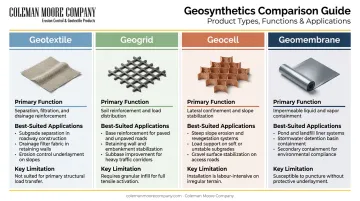
This guide covers the four primary types: geotextiles, geogrids, geocells, and geomembranes. Each one solves a different problem. Each one fails when applied to the wrong job.
Key Takeaways
- Geosynthetic stabilizers are engineered polymer materials — each type designed to reinforce, filter, separate, confine, or contain in a specific application
- Geogrids excel at road base reinforcement and reducing aggregate thickness through mechanical interlock
- Geotextiles handle separation, filtration, and drainage — often used alongside geogrids
- Geocells provide 3D confinement for slopes, erosion control, and unpaved surfaces
- Geomembranes create impermeable barriers for landfill liners, containment ponds, and moisture barriers
- Start with soil strength data (CBR) before selecting any geosynthetic type or grade
What Are Geosynthetic Soil Stabilizers?
Geosynthetics are engineered, polymer-based materials installed within or around soil to perform specific mechanical, hydraulic, or barrier functions. The category includes several distinct product families — not a single material — and each is designed for a different engineering task.
Applications span roadways, embankments, retaining walls, drainage systems, and erosion control — each context defined by a specific failure mechanism: tensile weakness in subgrade, migration of soil into aggregate, unmanaged water movement, or lateral spreading under load.
Understanding them as a category matters because:
- They address root causes of infrastructure failure, not just symptoms
- They reduce material volumes (particularly aggregate) when specified correctly
- They extend service life by stabilizing the conditions that cause premature deterioration
- They're proven across DOT, municipal, and heavy industrial applications
Specification matters more than most engineers expect. A geotextile chosen for a job that needs structural reinforcement will underperform. A geogrid in a drainage-only application adds cost without benefit. Knowing the difference starts with understanding what each type actually does.
Why Geosynthetics Matter in Civil Infrastructure
Subgrade failure isn't a minor inconvenience. FHWA's Long Term Pavement Performance analysis found that environmental factors, including subgrade and climate variables, accounted for 36% of total damage in flexible pavements after 15 years under normal traffic. That's a substantial share of infrastructure deterioration tied directly to what's happening beneath the surface.
When subgrade goes wrong, the consequences compound: excessive rutting, unexpected settlement, premature cracking, over-excavation, and aggregate overuse all pile onto the original problem. On large projects, those costs scale fast.
A project in Sergeant Bluff, Iowa puts those stakes in dollar terms. Soil testing revealed a CBR of just 1.0% — a subgrade so weak it threatened to derail the entire construction program. By developing an optimized geogrid-based design, the team reduced aggregate requirements to the point where every inch removed from the aggregate layer represented approximately $1 million in construction cost savings.
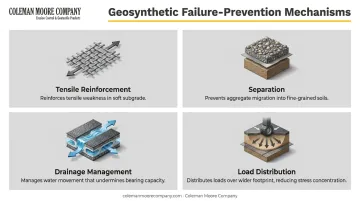
Geosynthetics counter these failure scenarios by:
- Reinforcing tensile weakness in soft or variable subgrade
- Preventing aggregate from migrating into fine-grained soils
- Managing water movement that undermines bearing capacity
- Distributing loads over a wider footprint, reducing stress concentration
The result is longer-lasting infrastructure, less aggregate, and lower total project cost — provided the right type is matched to the actual failure mode on the ground. Selecting incorrectly still leaves the underlying problem unsolved.
Types of Geosynthetic Soil Stabilizers
Geosynthetics address different failure mechanisms. Matching type to problem is the core selection task.
Geotextiles
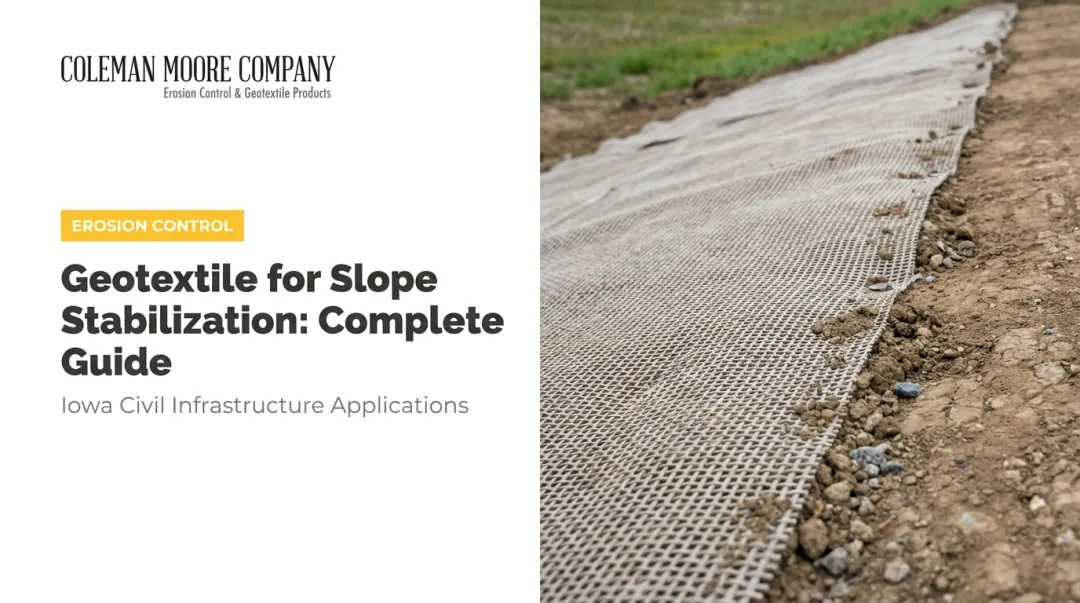
Geotextiles are permeable, fabric-like geosynthetics made from woven, nonwoven, or knitted polymer fibers — typically polypropylene or polyester. Placed between soil layers or beneath aggregate, they allow water to pass through while holding soil particles in place and preventing layer mixing.
Woven vs. nonwoven — the functional difference:
- Woven geotextiles offer higher tensile strength, making them better suited for stabilization, separation under load, and applications where structural performance matters
- Nonwoven geotextiles provide superior filtration and drainage flow, with better performance in applications where water management and particle retention are the priority
Coleman Moore distributes both types from Mirafi and Huesker, covering applications from subsurface drainage and French drains to railroad ballast separation and geomembrane cushioning.
Best suited for: Separation of subgrade from aggregate base on roads and parking areas; drainage blankets beneath pavement; erosion control on slopes; pipe wrapping; filter layers in retaining walls and drainage systems; asphalt overlay applications.
Strengths and limitations:
| Strengths | Limitations |
|---|---|
| Cost-effective and widely available | Can tear during installation with heavy equipment |
| Versatile across application types | Reduced effectiveness in expansive clays that clog pores |
| Straightforward to install | Limited standalone reinforcement under heavy loads |
Geogrids
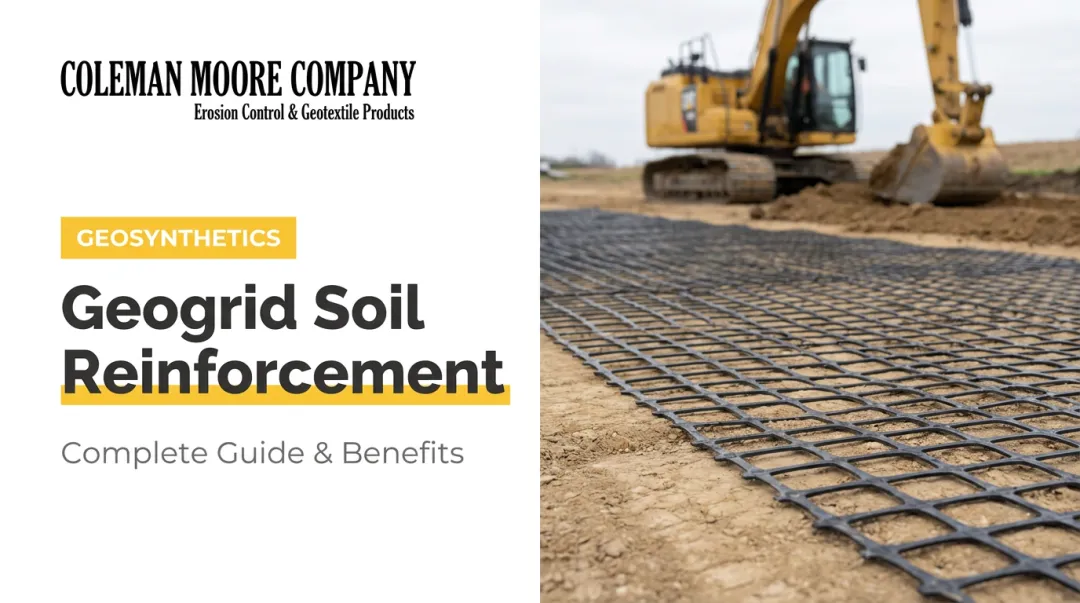
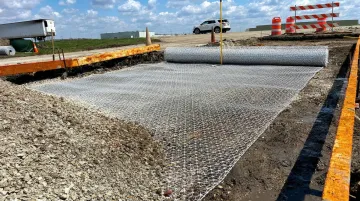
Geogrids are rigid or semi-rigid grid structures with open apertures, manufactured from polyester, polypropylene, or polyethylene. When placed within aggregate or base course, aggregate particles lock into the apertures — a mechanism called mechanical interlock — which prevents lateral movement, distributes load over a larger area, and stiffens the combined soil-aggregate system.
This is fundamentally different from geotextile function. Geogrids don't primarily filter or drain. They reinforce through confinement and load distribution.
Grid geometry and directionality matter:
- Biaxial geogrids resist force in two directions — suited for road bases and parking areas
- Triaxial geogrids provide multidirectional confinement using a triangular rib geometry — better for heavy haul roads and high-load applications
- InterAx® geogrids (Tensar's current generation) are designed for both paved and unpaved roadway applications and are stocked by Coleman Moore
Per Tensar's technical data, TriAx geogrid can reduce aggregate thickness by 25% to 50% and asphalt thickness by 15% to 30% in optimized pavement designs — though savings are design-dependent and require project-specific verification.
Best suited for: Road and pavement base reinforcement over weak or variable subgrades; unpaved haul roads and access roads; retaining wall and slope stabilization; reducing aggregate thickness to lower material cost.
Coleman Moore uses Tensar Plus design software to calculate optimized aggregate and pavement thickness from CBR inputs — giving contractors and engineers a data-driven design output rather than a rule-of-thumb estimate.
| Strengths | Limitations |
|---|---|
| Measurable aggregate reduction and pavement life extension | Higher upfront material cost than geotextiles |
| Data-driven design optimization with CBR inputs | Requires correct installation orientation to achieve designed performance |
Geocells
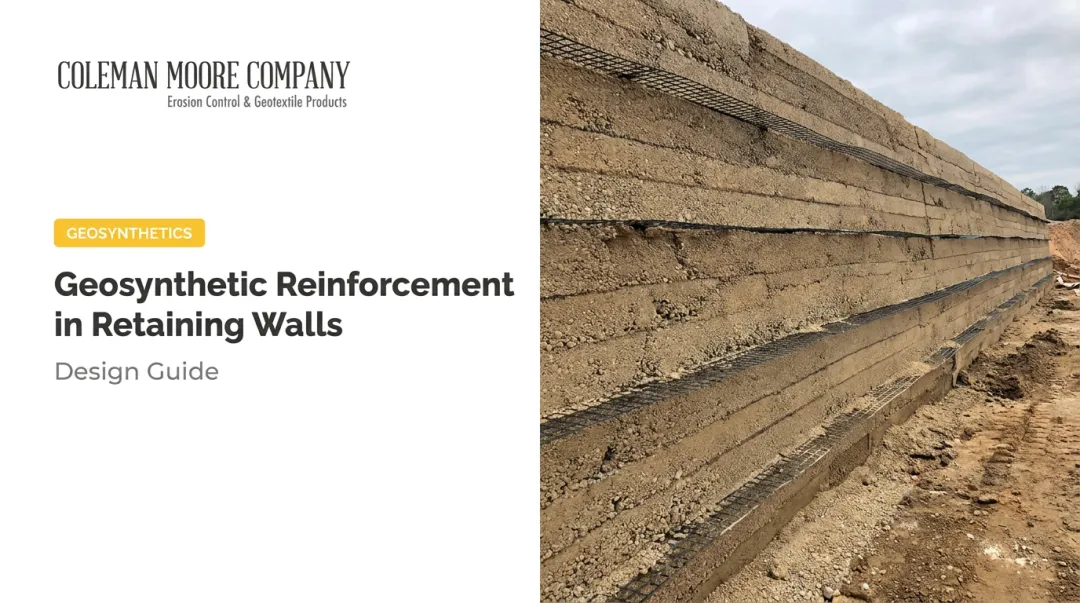
Geocells are three-dimensional, honeycomb-like cellular confinement systems made from HDPE strips connected at intervals. When unfolded and staked in place, they create a lattice of interconnected cells filled with soil, aggregate, or concrete.
The 3D confinement mechanism is what sets geocells apart. Infill material is physically constrained within each cell, preventing lateral spreading, distributing vertical loads over a wider footprint, and reducing surface erosion.
Where geogrids provide flat reinforcement, geocells provide depth and surface containment simultaneously.
Caltrans specifies cellular confinement as a slope treatment with cells 4 to 8 inches deep — a recognized DOT application for erosion control in roadway environments.
Best suited for: Slope stabilization and erosion control on embankments; channel linings and riverbanks; unpaved roads and parking areas with poor base conditions; load support platforms in remote or off-road environments; flat and sloped soil stabilization where vegetative integration is required.
Coleman Moore supplies cellular confinement products made from welded HDPE or Novel Polymeric Alloy, covering applications from nature trails and emergency vehicle access to structural load support and earth retention.
| Strengths | Limitations |
|---|---|
| Strong erosion resistance and slope performance | More labor-intensive to install than geogrids or geotextiles |
| Accepts vegetative infill for environmental applications | Less suited as a standalone solution for high-speed paved roadways |
Geomembranes
Geomembranes are continuous, impermeable synthetic sheets — typically HDPE, LLDPE, or PVC — whose primary function is containment, not reinforcement. They prevent liquids, gases, or contaminants from moving through soil. This puts them in a separate category from the other three types.
Where geogrids and geocells improve bearing capacity and geotextiles manage drainage, geomembranes are barrier products. They don't strengthen soil mechanically — they seal it.
Regulatory context matters here. 40 CFR Part 258 requires MSW landfill composite liners to include a flexible membrane liner of at least 30 mil — or 60 mil if HDPE — over a minimum of 2 feet of compacted soil with hydraulic conductivity no greater than 1 × 10⁻⁷ cm/sec. For regulatory-facing projects, these specifications are not optional.
Best suited for: Landfill liners and caps; stormwater detention and retention ponds; hazardous or agricultural waste containment; moisture barriers beneath sensitive pavement sections in high water table areas.
| Strengths | Limitations |
|---|---|
| Complete liquid and gas containment | No mechanical reinforcement of soil |
| Meets federal regulatory requirements (40 CFR Part 258) | Installation requires care to avoid puncture or seam failure |
| Available in multiple materials for chemical compatibility | Not a substitute for bearing capacity improvements |
How to Choose the Right Geosynthetic for Your Project
The right choice comes from identifying the project's primary failure mode first and then matching type to function. Choosing by familiarity or lowest unit price consistently leads to either underperformance or unnecessary cost.
Start with Soil Assessment
Before selecting any geosynthetic, establish in-situ soil strength. CBR (California Bearing Ratio) is the key metric — it quantifies subgrade load-bearing capacity and directly informs what type and grade of geosynthetic is required.
FHWA's DCP protocol uses an 8-kg hammer dropped on a penetrating cone to rapidly assess in-situ strength. Each blow's depth correlates to CBR without laboratory wait times. Coleman Moore provides on-site DCP testing with direct CBR conversion for Iowa contractors and engineers, delivering actionable design inputs the same day.
Note: for CBR values below 1, FHWA's geosynthetic reinforcement guidance identifies conditions outside standard AASHTO M288 coverage. These projects require engineered reinforcement design, not standard product selection.
Match Type to Primary Function
| Primary Need | Recommended Type |
|---|---|
| Separation + drainage | Geotextile (nonwoven) |
| Tensile separation under load | Geotextile (woven) |
| Load distribution + aggregate reduction | Geogrid (biaxial or triaxial) |
| 3D surface confinement + erosion control | Geocell |
| Liquid or gas containment | Geomembrane |
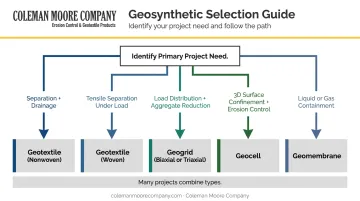
Many projects benefit from combining types. A nonwoven geotextile beneath a biaxial geogrid handles both separation/drainage and structural reinforcement — addressing two distinct failure modes in a single installation pass.
Factor in Long-Term Cost
Once you've matched product to function, run the full cost picture before finalizing your selection. Higher upfront material cost doesn't mean higher total project cost. On aggregate-heavy projects, the right geogrid or geocell often reduces total spend by cutting material volume, trucking, and long-term maintenance. On a large road project, that math compounds quickly — as the CF Industries example shows, aggregate reduction at scale delivers seven-figure savings.
Common Mistakes to Avoid When Selecting Geosynthetics
Three mistakes consistently drive poor geosynthetic selections — and all three are avoidable with proper site evaluation upfront.
Specifying from habit, not data. The most consistent error is matching a product to past project experience rather than actual site conditions. Without a CBR value or soil classification, there's no basis for selecting the right type or grade. What performed well on last month's job may be entirely wrong for this one.
Mismatched product grade. Specifying a triaxial geogrid where biaxial would perform adequately inflates cost with no performance benefit. Going the other direction — using a lightweight nonwoven geotextile as a structural separator under heavy traffic — leads to premature failure. The fix is the same in both cases: site-specific design support before specifying.
Evaluating cost per unit instead of cost per project. Geogrids, geocells, and engineered geomembranes cost more per unit than simpler alternatives. They frequently reduce total project cost through lower aggregate volumes, reduced hauling, fewer maintenance cycles, and longer asset life. Running a cost-benefit comparison between a geosynthetic-inclusive design and an aggregate-only approach usually reveals significant savings — often enough to change which option gets specified.
Frequently Asked Questions
What is the difference between a geotextile and a geogrid?
Geotextiles are permeable fabrics that separate soil layers, filter water, and manage drainage. Geogrids are rigid grid structures that reinforce through mechanical interlock with aggregate, distributing loads and resisting lateral movement. They serve different primary functions and are often installed together on the same project.
Which geosynthetic is best for road base stabilization?
Geogrids are generally preferred for road base reinforcement — they interlock with aggregate to distribute loads, reduce rutting, and allow for thinner base sections. A nonwoven geotextile beneath the geogrid is often added to handle separation and drainage simultaneously.
Can different types of geosynthetics be used together on the same project?
Yes, and it's often the optimal approach. A nonwoven geotextile beneath a biaxial geogrid provides both separation/drainage and structural reinforcement in a single combined installation — no need to choose one function over the other.
How long do geosynthetic soil stabilizers last in the field?
Most geosynthetics are engineered for decades of in-ground service. Solmax reports that properly installed, buried nonwoven polypropylene geotextiles are expected to last up to 200 years; GSI estimates covered HDPE geomembranes have a half-life of roughly 449 years at 20°C. Natural fiber geotextiles biodegrade within a few years and are suited to temporary applications only.
What soil conditions indicate a need for geosynthetic stabilization?
CBR values below 3, visually soft or saturated subgrade, high clay content, frost-susceptible soils, and sites with recurring rutting or settlement under load all signal a need for geosynthetic stabilization before breaking ground.
Are geosynthetics more cost-effective than adding more aggregate?
On weak subgrade projects, geogrids typically allow measurable aggregate thickness reductions, lowering total material and hauling costs. On large or long-distance projects, those per-inch savings compound quickly. The CF Industries project in Sergeant Bluff quantified this at roughly $1 million per inch of aggregate removed.