Geogrid soil reinforcement addresses these problems at the source. But the product's value often gets buried in spec sheets rather than explained through the outcomes that actually matter to project teams: how much aggregate can be eliminated, how much longer the pavement lasts, and whether you can build at all on marginal ground without blowing the budget.
This guide covers all of that — what geogrid is, what it does in practice, where it pays off most, and what happens when it's skipped.
Key Takeaways
- Geogrid reduces required aggregate base thickness by 25–50%, directly cutting material and haul costs
- Geogrid-reinforced base sections can carry up to 3x more load cycles before reaching deformation failure thresholds
- MSE retaining walls reinforced with geogrid reach heights of 25–30 feet at significantly lower cost than cast-in-place concrete alternatives
- Soft subgrades (CBR below 3–3.5%) are where geogrid delivers the highest return — and where skipping it causes the most damage
- This guide covers product selection, soil assessment, and installation practices so reinforcement performs as engineered
What Is Geogrid Soil Reinforcement?
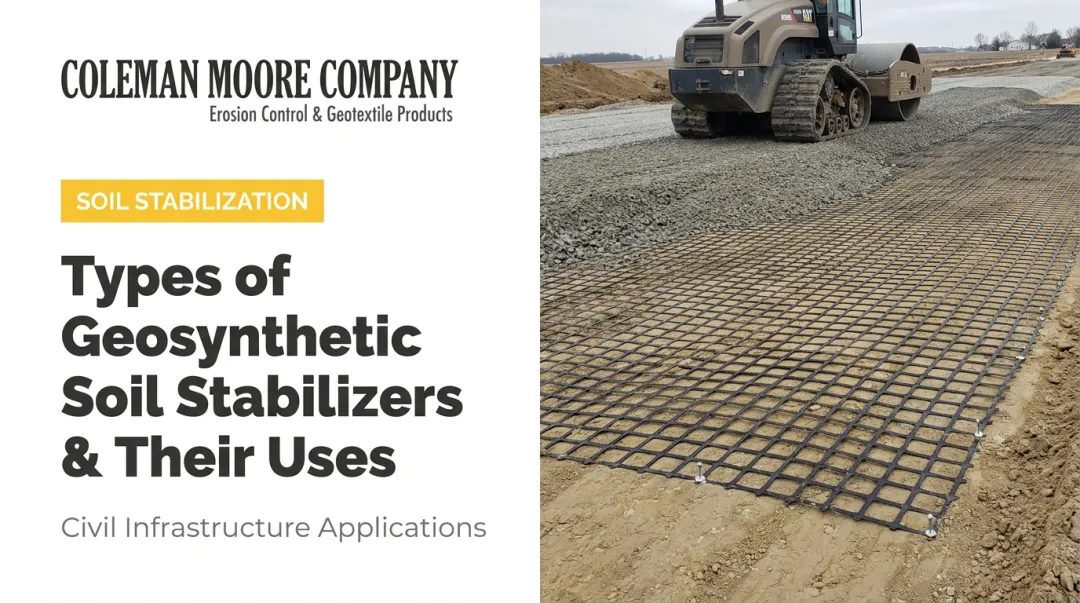
Geogrid is a flat, polymer-based mesh (typically polypropylene, HDPE, or polyester) engineered with open apertures that allow soil and aggregate particles to interlock.
When compacted fill is placed over and around the grid, particles lock into those apertures and the composite layer distributes loads over a broader subgrade area — increasing bearing capacity and reducing deformation under traffic.
The core mechanisms are mechanical interlock and lateral restraint. Without geogrid, aggregate under repeated loading tends to punch down into soft subgrade or shove laterally — exactly what leads to rutting and loss of structural support. Geogrid stops both.
The Three Primary Types
| Type | Aperture Shape | Primary Application |
|---|---|---|
| Uniaxial | Rectangular (elongated) | Retaining walls, steep slopes — resists load in one direction |
| Biaxial | Rectangular | Subgrade stabilization under pavements and foundations |
| Triaxial | Triangular | Mechanical stabilization in trafficked pavement sections, working platforms |
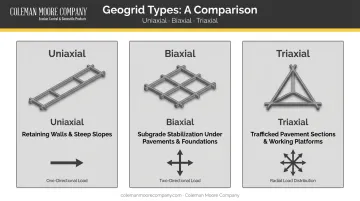
Selecting the right type comes down to four key factors:
- Application type (retaining wall, pavement subgrade, working platform)
- Subgrade strength (CBR value or DCP test results)
- Available aggregate gradation and thickness
- Anticipated traffic loading and frequency
Coleman Moore supplies geogrid products from Tensar, including the Tensar InterAx® Geogrid for paved and unpaved road applications, and Huesker® Fortrac® geogrids for retaining wall and slope reinforcement.
Key Advantages of Geogrid Soil Reinforcement
The advantages below aren't theoretical. They show up in material invoices, maintenance budgets, and project schedules.
Reduced Aggregate Use and Lower Material Costs
Geogrid placed between the subgrade and aggregate base stiffens the composite layer, reducing lateral spreading and permanent deformation under load. The result: less aggregate is required to achieve the same structural performance.
TRB repeated-load testing on flexible pavements found that geogrid inclusion can allow 25–50% granular base thickness reduction under tested conditions. On large-footprint projects — commercial sites, industrial yards, rural road corridors — that reduction compounds significantly across aggregate tonnage, hauling costs, and truck traffic over soft access roads.
Iowa State/InTrans workshop material cites biaxial geogrid at $2–$3 per square yard and triaxial at $3–$5 per square yard. Against those material costs, the aggregate savings on a single soft-subgrade project typically far exceed the geogrid investment.
Where this matters most:
- Subgrades with CBR below 3–3.5%
- Projects with long aggregate haul distances
- Large paved areas (commercial pads, industrial yards, roadway corridors)
- Any site where reducing truck passes over soft access roads is a priority
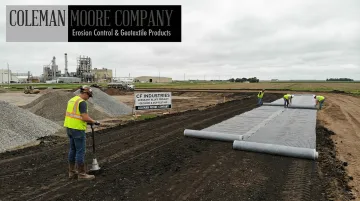
A documented Iowa example: at the CF Industries Plant Expansion in Sergeant Bluff, Coleman Moore performed DCP testing on soils with a CBR of just 1.0% and used Tensar Plus design software to optimize the aggregate section. Every inch reduced from the required aggregate layer translated to approximately $1 million in construction cost savings — a result that illustrates how dramatically geogrid optimization pays off at scale.
Extended Pavement and Road Life
Unreinforced pavements over weak subgrades lose structural support as aggregate migrates laterally under repeated loading. The base course loses its interlock, deformation accumulates, and what was designed as a 20-year road becomes a recurring maintenance problem within a few years.
Geogrid reinforcement maintains aggregate confinement over time, preserving load distribution and delaying deterioration. The same TRB study found that reinforced base sections carried up to 3 times the load cycles of comparable unreinforced sections before reaching a 0.8-inch permanent deformation threshold. At scale, that difference reshapes both maintenance schedules and long-term ownership costs.
Freeze-thaw cycling is a chronic stressor on Iowa subgrades. Fines migration into the base course reduces resilient modulus and increases susceptibility to freeze-thaw damage. Field research from the Mountain-Plains Consortium confirms this mechanism directly. Geogrid-reinforced sections maintain base course integrity across repeated freeze-thaw cycles because the aggregate stays where it was placed.
KPIs affected:
- Pavement service life
- Maintenance frequency and repair cost per lane-mile
- Lifecycle cost per project
Ability to Build Safely on Challenging Ground
Geogrid reinforcement opens up construction options that are otherwise cost-prohibitive or physically impractical on soft ground.
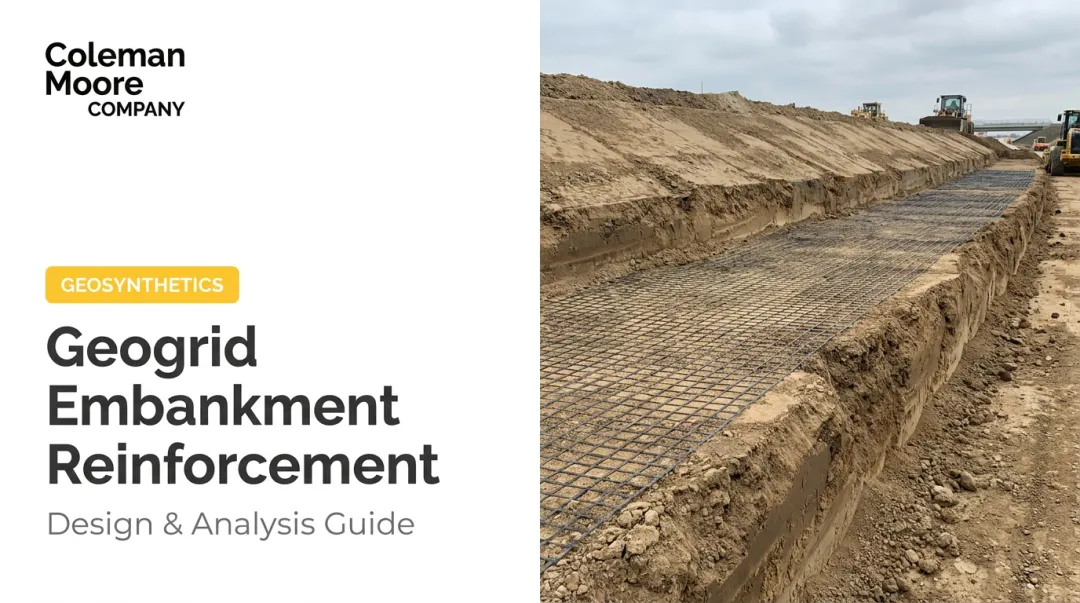
1. MSE Retaining Walls Mechanically Stabilized Earth walls reinforced with uniaxial geogrid (Coleman Moore supplies Huesker® Fortrac® geogrids for this application) can reach 25–30 feet in height, with documented cases up to 45 feet. FHWA MSE guidance specifies a 75–100 year design life for permanent reinforced soil systems. Compared to cast-in-place cantilever concrete walls, MSE walls with geogrid reinforcement typically cost significantly less per square foot of wall face, a meaningful advantage on tight-budget bids.
2. Reinforced Steep Slopes and Working Platforms Reinforced slopes can be built at 1H:1V ratios, recovering usable site area compared to conventional 2H:1V unreinforced slopes — a direct benefit on constrained urban or suburban sites where every square foot of buildable pad counts. On soft clay sites, geogrid-reinforced working platforms allow heavy tracked equipment to operate without miring, eliminating the costly delays and equipment damage that can push a project's first weeks off schedule.
What Happens When Geogrid Reinforcement Is Skipped
Skipping geogrid to reduce upfront material costs typically produces the opposite result: higher total project spend.
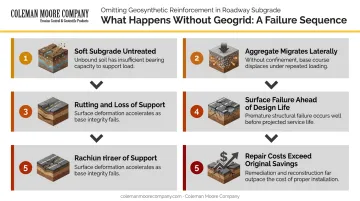
The sequence on roadway projects:
- Soft subgrade goes untreated
- Aggregate base migrates laterally under load
- Rutting and loss of pavement support develop quickly
- Surface failure occurs years ahead of design life
- Repair costs — overlays, base replacement, traffic control — dwarf the original geogrid savings
Schedule risk compounds the cost problem. Soft subgrade that isn't stabilized before construction starts can mire heavy equipment mid-project. Emergency stone bridging, subgrade removal, and replacement push timelines by weeks — reactive costs that far exceed what a proper geogrid specification would have cost at the design stage.
Iowa's freeze-thaw cycles add another layer of damage on untreated sections. Fines migrating upward from clay subgrades contaminate the aggregate base, reducing its resilient modulus and leaving it more vulnerable to each winter's cycles. Treated sections hold their performance; untreated sections degrade on a predictable downward curve.
The math is straightforward: geogrid specified at the design stage costs a fraction of what emergency remediation, base replacement, and shortened infrastructure life will cost over time. Getting the specification right early is where the savings are found.
How to Get the Most Value from Geogrid Reinforcement
Geogrid works best when soil conditions are properly assessed before product selection. Vague subgrade assumptions lead to either over-engineering (wasted budget) or under-engineering (early failure). Both outcomes cost money.
Step 1: Assess Soil Strength Before Specifying
Coleman Moore conducts on-site Dynamic Cone Penetrometer (DCP) testing — standardized under ASTM D6951 — to measure in-situ subgrade strength rapidly. Readings convert to CBR values, giving the design team quantified soil strength data rather than field estimates. For large sites, Coleman Moore establishes grid patterns to map variability across the area; for road alignments, a straight-line series of tests along the proposed route captures the key weak spots.
CBR is the number that drives geogrid specification. A CBR of 1.0% (as encountered at the CF Industries Sergeant Bluff project) demands a fundamentally different design than a CBR of 4% or 6%.
Step 2: Match the Product to the Application
- Uniaxial geogrid (Huesker® Fortrac®): retaining walls and steep slopes requiring tensile strength in a defined direction
- Biaxial geogrid: subgrade stabilization under foundations and pavements, spreading load in two directions
- Triaxial geogrid (Tensar InterAx®): trafficked pavement sections and working platforms requiring radial load distribution
The selection also depends on available aggregate, required section depth, and traffic loading — evaluated alongside soil CBR. Coleman Moore assesses all four factors before specifying a product.
Step 3: Use Design Software to Optimize the Section
Once CBR values are in hand, Coleman Moore inputs them into Tensar Plus — a cloud-based geotechnical design tool — to calculate optimum aggregate thickness and geogrid specification. Available modules cover the most common project types:
- Unpaved Road & Subgrade Stabilization
- Heavy Haul Road
- Asphalt Pavement
- Pass the Proof Roll
The output is a fully optimized section design — calculated for cost efficiency without over-specifying materials.
Step 4: Execute Installation Correctly
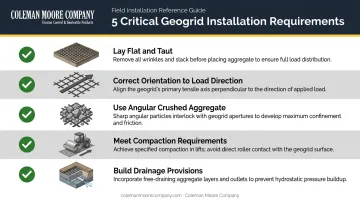
Incorrect installation eliminates all design value. Critical installation requirements:
- Lay flat and taut — no wrinkles or folds
- Orient correctly relative to primary load direction (especially for uniaxial)
- Use angular crushed aggregate (not rounded river stone) sized appropriately for the geogrid aperture
- Meet compaction requirements for the fill placed over the grid
- Build drainage provisions behind walls and slopes as designed
Coleman Moore supports projects from design through construction — advising on aggregate specifications, installation sequencing, and product compatibility at each stage.
Conclusion
Geogrid soil reinforcement delivers compounding value: lower aggregate costs upfront, extended infrastructure service life over time, and the ability to build on ground conditions that would otherwise delay or derail projects. For Iowa contractors and engineers dealing with soft clay subgrades, freeze-thaw cycling, and tight project budgets, it's a foundational practice — not an optional add-on.
The results depend on control: the right geogrid type, matched to properly assessed soil conditions, installed correctly. Guesswork on subgrade strength or shortcuts during installation undermine every advantage the product offers. That's where early supplier involvement pays off — getting the right expertise into the design phase before decisions get locked in.
Coleman Moore has supported Iowa civil infrastructure projects since 2004. The team works with contractors, engineers, and municipalities from design through installation, offering:
- On-site DCP testing with CBR conversion for rapid, accurate soil strength assessment
- Tensar Plus design optimization to calculate correct aggregate thickness and geogrid selection
- Geogrid supply from Tensar and Huesker, matched to your specific application and site conditions
Contact the team at 515-309-5577 or info@colemanmoorecompany.com.
Frequently Asked Questions
At what retaining wall height is geogrid soil reinforcement required?
Geogrid reinforcement is generally warranted for retaining walls taller than 4 feet, though the actual threshold depends on wall type, surcharge loads, and site-specific soil conditions. MSE walls using uniaxial geogrid are the standard engineering approach above this height, and a geotechnical engineer should specify the design.
How long does geogrid soil reinforcement typically last?
Quality geogrids made from HDPE or polyester are designed for a 75–100 year service life in permanent reinforced soil structures when properly installed. Once buried, they resist UV degradation, chemical attack, and biological breakdown, which is why FHWA specifies this design life for MSE walls and reinforced slopes.
How much does geogrid soil reinforcement cost?
Biaxial geogrid runs approximately $2–$3 per square yard and triaxial around $3–$5 per square yard based on Iowa State/InTrans workshop data. The material cost is a fraction of what it saves in aggregate reduction and long-term maintenance. On soft subgrade projects, total project cost is almost always lower with geogrid than without.
What is the difference between a geogrid and a geotextile?
Geogrids are open-mesh structures designed for tensile reinforcement and mechanical stabilization through particle interlock. Geotextiles are permeable fabrics used primarily for separation, filtration, and drainage. Many projects use both together — geotextile to prevent clay migration into the base, geogrid to reinforce it.
What types of geogrids are best for road and pavement projects?
Biaxial and triaxial geogrids are the standard choice for subgrade stabilization and base course reinforcement under roads and pavements, providing strength in multiple directions to resist load spreading. Uniaxial geogrids are reserved for walls and slopes where primary tensile strength in one direction is the design requirement.
Can geogrid reinforcement be used on soft clay subgrades?
Geogrid is one of the most effective solutions for soft clay conditions and is often paired with a geotextile separator to prevent clay migration into the aggregate base. Proper soil assessment (DCP testing to establish CBR values) is essential to select the correct geogrid type and design an aggregate section that performs under the actual loading conditions.