Introduction
Weak subgrade costs more than most project owners expect. FHWA's AASHO Road Test data attributes 11% of surface rutting to the subgrade itself and 39% to granular subbase — meaning foundation layers can drive roughly half of all pavement distress. Once that distress surfaces, you're looking at reconstruction, not maintenance.
Subgrade stabilization is the process of improving the engineering properties of the native soil layer beneath formation level so it can adequately support the structure above it. Done right, it prevents pumping, rutting, and differential settlement before the first load of aggregate is placed.
This article covers what project teams need to know: how to recognize a problematic subgrade, which stabilization methods apply to which conditions, how to compare chemical and geosynthetic materials, and what field testing should happen before any design decisions are made.
Key Takeaways
- Foundation layers drive roughly half of pavement rutting; subgrade assessment belongs at the front of every project plan
- Soil modification improves workability; soil stabilization achieves measurable structural strength gain — these are not the same thing
- CBR below 3 requires aggressive intervention; CBR 3–8 is the sweet spot for geosynthetic stabilization
- On-site DCP testing delivers initial soil strength data without weeks of lab wait time
- Chemical and geosynthetic methods suit different soil types; the wrong choice wastes money
What Is Subgrade Stabilization?
The subgrade is the natural soil layer immediately below formation level — the platform on which the entire pavement structure sits. FHWA defines it as the top surface of the roadbed that supports the pavement structure without excessive deflection. It may be undisturbed in-situ soil in cut sections or compacted fill in embankments.
Modification vs. Stabilization
These terms are often used interchangeably on jobsites, but they describe different outcomes:
- Soil modification uses lower additive doses to reduce plasticity, dry the soil, and improve workability for compaction — sometimes called "mud drying." Per USACE, modification improves certain soil properties but isn't intended to deliver a significant strength increase.
- Soil stabilization applies higher additive doses or engineered reinforcement to achieve a measurable, designed increase in bearing strength sufficient to structurally support pavements or foundations.
The distinction matters for design. Specifying modification treatment when structural support is needed will produce a subgrade that looks improved but fails under load.
Two Broad Categories
All stabilization approaches fall into one of two categories:
- Chemical stabilization — alters the soil's composition by introducing a binding agent (lime, cement) that reacts with soil particles to reduce plasticity and increase strength
- Mechanical stabilization — reinforces the soil-aggregate system with geosynthetics that distribute load and confine aggregate without changing the soil's chemistry
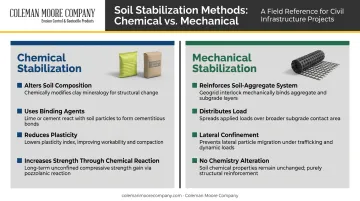
The right choice depends on soil type, moisture conditions, weather, project schedule, and budget. Both approaches are covered in detail below — along with the materials and methods used to execute each one.
Signs Your Subgrade Needs Stabilization
Most subgrade problems reveal themselves during grading — often after mobilization is complete and the schedule is already at risk. Knowing what to look for before earthwork begins changes the outcome.
Common Field Indicators
- Pumping or rutting under equipment loads, where tire tracks don't spring back
- "Trampoline" effect — visible flexing or wave motion when walking on wet soil
- High plasticity index (PI) in lab results, indicating clay-heavy soil that swells and shrinks with moisture changes
- Inability to achieve compaction despite multiple passes, usually because moisture content exceeds the soil's optimum
Any one of these should trigger a formal stabilization assessment. All four together mean the subgrade needs treatment before aggregate placement begins.
Freeze-Thaw and Expansive Clay Risks in Iowa
Iowa State's InTrans research confirms that granular-surfaced roads in seasonally cold regions suffer severe damage during thaw periods. A subgrade that tests adequately in summer may lose significant bearing capacity by spring.
Frost isn't the only concern. Iowa SUDAS notes that shrinkage, swelling, and frost heave deform and crack pavement constructed over susceptible soils. Expansive clays — common across the state — can degrade a pavement structure from below even when the surface layer looks intact.
Subgrade evaluation in Iowa should account for seasonal moisture variation and frost depth, not just summer-condition density tests.
Subgrade Stabilization Methods Explained
Four primary methods are used in practice, and they're often combined based on what the site conditions actually require.
Over-Excavation and Replacement
This method involves removing unsuitable soil to sufficient depth, then backfilling with engineered material (typically compacted gravel or crushed aggregate) placed in controlled lifts.
It's reliable and well-understood, but costs scale quickly with depth and haul distance — disposal of unsuitable material adds expense, and importing engineered fill adds more. FHWA notes that where poor subgrade conditions are extensive in area or depth, surface stabilization may be more practical than removal.
Over-excavation works best when:
- The problem zone is shallow and laterally defined
- Haul distances to disposal and borrow sites are short
- Imported fill costs remain competitive with in-place treatment options
Chemical Stabilization
A stabilizing agent (lime, cement, or a combination) is mixed in-place with native soil using specialized equipment, then compacted and allowed to cure.
The process improves both strength and workability: lime reduces plasticity through cation exchange and pozzolanic reactions; cement hydrates and binds soil particles to increase stiffness. Both require:
- Dry mixing conditions
- Moisture control to within specification range
- Curing periods before trafficking (typically 2–14 days)
- Temperatures above the additive's minimum threshold during placement and cure
Chemical stabilization is also sensitive to soil chemistry. Soils with sulfate content between 3,000 and 7,000 ppm can heave when treated with calcium-based stabilizers, a risk that applies to both lime and cement. Testing for sulfates before treatment is not optional on sites where this is a possibility.
Where soil chemistry rules out calcium-based treatment, or where curing time isn't available, geosynthetic stabilization offers a practical alternative.
Mechanical Stabilization with Geosynthetics
Contractors place geogrids or geotextiles between the weak subgrade and aggregate fill to form a mechanically stabilized layer (MSL). The geogrid's apertures lock with aggregate particles, creating lateral confinement that increases the stiffness and load-bearing capacity of the combined layer without altering the subgrade soil itself.
Key advantages over chemical methods:
- Works on virtually all soil types, including those unsuitable for lime or cement
- No curing time — the layer is trafficable immediately after compaction
- Installable in adverse weather conditions
- No chemical runoff or dust management required
Coleman Moore supplies Tensar InterAx® geogrids, a current-generation product that distributes loads radially through a triangular multi-directional rib structure. On the CF Industries plant expansion in Sergeant Bluff, Iowa (subgrade CBR measured just 1.0%), this approach allowed the project team to optimize aggregate thickness so efficiently that each inch of reduction translated to approximately $1 million in construction cost savings.
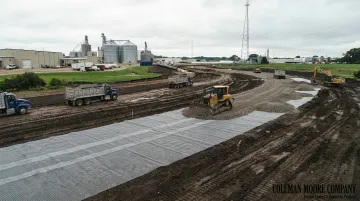
FHWA identifies geosynthetic stabilization as appropriate for subgrades with CBR below 3, and mechanical stabilization with geogrids as applicable for CBR values up to 8.
Compaction
Proof-rolling and compaction with appropriate equipment can improve subgrade density where moisture conditions permit. It's typically a preliminary step, used to identify soft spots and improve borderline soils rather than as a standalone solution for significantly weak subgrades.
When proof-rolling reveals deflection or pumping, one of the three methods above is needed before paving proceeds. Compaction alone won't resolve a subgrade that fails under load.
Stabilization Materials: Chemical vs. Geosynthetic
Lime and Cement
| Lime | Cement | |
|---|---|---|
| Best soil fit | High-plasticity clay (PI > 12) | Broader range, PI < 20 |
| Mechanism | Cation exchange + pozzolanic reaction | Hydration, binding |
| Strength target | 50 psi minimum gain (FHWA) | 150 psi UCS at 7 days (Iowa SUDAS) |
| Typical dose | 3–8% by dry soil weight | Varies by soil and target strength |
| Sulfate risk | High (heave > 3,000 ppm sulfates) | High (same risk) |
| Organic soil | Ineffective | Sensitive to high organic content |
Both materials carry manufacturing CO2 footprints and introduce dust and chemical runoff risks during application. iSWM construction controls address these risks with three core requirements:
- Limit treated area to what can be fully mixed and compacted in a single workday
- Avoid application when rain is likely to produce runoff
- Provide secondary containment for onsite stabilizer storage
Critical limitations to communicate to project teams:
- Lab mix design testing takes 2–3 weeks before field work can begin
- Temperature minimums apply — both during placement and through the curing period
- Freeze-thaw cycles over time can degrade chemically stabilized layers in cold climates
Those lead-time and weather constraints push many project teams toward geosynthetics — particularly when schedules are tight or subgrade conditions are variable.
Geogrids
Tensar InterAx® geogrids work by mechanically interlocking with compacted aggregate. Stiff ribs and integral junctions confine aggregate particles within the grid openings, creating a stabilized zone with higher strength and stiffness than aggregate alone. The result: a thinner aggregate layer achieves the same bearing capacity as a thicker unreinforced section.
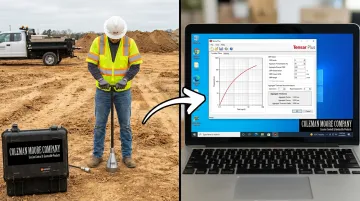
Getting the grade right starts with knowing actual subgrade strength. Coleman Moore conducts on-site DCP testing to establish CBR values, then runs those inputs through Tensar Plus design software. The modules cover unpaved road stabilization, heavy haul roads, proof-roll scenarios, and asphalt pavement optimization — each producing an aggregate thickness recommendation based on actual subgrade strength and expected loads.
Geotextiles
Woven and non-woven geotextiles serve different functions and are not interchangeable:
- Woven geotextiles (Mirafi, Huesker) provide separation and tensile reinforcement, preventing aggregate from migrating into soft subgrade fines over time
- Non-woven geotextiles handle filtration and drainage, managing water movement through the pavement section
Geotextiles improve long-term subgrade performance by maintaining base thickness, but they do not provide the same degree of lateral confinement as geogrids. When geotextiles are used alone, aggregate layer requirements are typically higher to achieve equivalent bearing performance.
Quick decision guide:
- Chemical stabilization: large areas of cohesive clay, conditions permitting proper curing, sufficient lead time for lab testing
- Geosynthetics: variable or chemically unsuitable soil types, fast-track schedules, adverse weather, or sites with environmental runoff concerns
How to Evaluate Subgrade Conditions Before You Build
Selecting the wrong stabilization method for a given soil costs more than doing nothing at all. Lime on a low-clay or high-sulfate soil can cause heave. An undersized geogrid on a CBR 1 subgrade won't perform to design. Testing first is the only way to make an informed decision.
Key Parameters to Assess
- Moisture content (ASTM D2216) — compare field moisture to compaction optimum and stabilization requirements
- Plasticity index (ASTM D4318) — determines lime vs. cement fit and flags expansive clay risk
- Gradation (ASTM D6913/D7928) — identifies fines content, frost susceptibility, and aggregate compatibility
- Bearing strength — CBR from lab (ASTM D1883) or field DCP testing (ASTM D6951)
DCP Testing: Fast Field Strength Assessment
The Dynamic Cone Penetrometer drops an 8-kg hammer onto a cone driven into the soil. Each blow's penetration depth is recorded and converted to a CBR estimate using FHWA-published DCPI correlations. FHWA's LTPP research confirms CBR is the most commonly used parameter for DCP correlation.
Coleman Moore supports on-site DCP testing as part of their subgrade evaluation process — covering grid patterns across large areas or linear alignments along road corridors. Results are converted to CBR and fed into Tensar Plus software, producing aggregate thickness and geogrid specifications in hours rather than days.
Reading CBR Values for Design
| CBR Range | Typical Soil | Design Implication |
|---|---|---|
| < 1 | Very weak (saturated clay) | Excavation or aggressive stabilization likely required |
| 1–3 | Weak (high-plasticity clay, CH) | Geosynthetic stabilization — primary candidate range |
| 3–8 | Moderate | Mechanical stabilization often delivers best cost-benefit |
| > 8 | Competent | Compaction or separation geotextile may be sufficient |
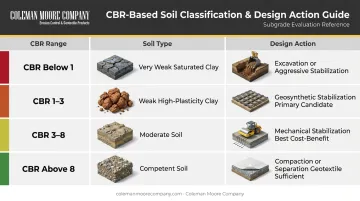
CBR values can shift significantly across a project footprint, particularly on sites with mixed fill history or variable clay content. Testing at isolated points and extrapolating across the site is a common source of differential settlement problems. Grid-based testing maps that variability so the stabilization design reflects actual conditions, not assumed uniformity.
Best Practices for Successful Subgrade Stabilization
Weather and Timing Controls
Chemical stabilization is highly sensitive to conditions at the time of application:
- Do not apply when rain is forecast and runoff is likely
- Observe temperature minimums for the specific additive through both placement and curing
- Limit each day's work to what can be fully mixed and compacted before day's end — iSWM explicitly requires this to prevent uncontrolled chemical runoff
- Roughen adjacent soil areas to intercept any stabilizer migration off the treatment zone
Geosynthetic installation carries fewer weather constraints. That said, soft subgrades should be graded and prepared before grid placement to prevent puncture and allow the aggregate-interlock mechanism to engage uniformly.
Quality Control During Installation
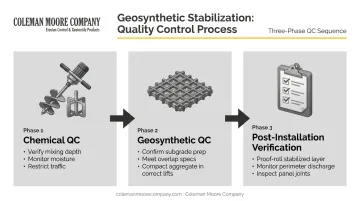
For chemical methods:
- Verify mixing depth matches specification — shallow mixing leaves untreated soil beneath a crust
- Monitor moisture content during mixing; too dry or too wet both compromise cure strength
- Restrict traffic to mixing equipment and water trucks until mixing is complete
For geosynthetic installation:
- Confirm subgrade surface is prepared and graded before grid placement
- Meet overlap specifications at panel joints: undersized overlaps compromise continuity of the stabilized layer
- Compact aggregate in lifts sized for the geogrid's aperture geometry, following Tensar's recommended gradation for InterAx® grids to maximize interlock
Post-Installation Verification
Key verification steps before paving begins:
- Proof-roll the stabilized layer to catch localized weak zones missed during initial testing
- For chemical stabilization, monitor down-slope perimeters for discharge evidence during and after application
- For geosynthetic layers, inspect panel joints and aggregate coverage before opening to construction traffic
Geosynthetic-stabilized layers require minimal ongoing maintenance, but track pavement surface condition over time to confirm the subgrade is performing as designed. In Iowa, spring thaw cycles are the most likely trigger for surface distress — any cracking or rutting that appears in March or April warrants a closer look at subgrade moisture and bearing capacity.
Frequently Asked Questions
What are the methods of subgrade stabilization?
The four primary methods are over-excavation and replacement, chemical stabilization (lime or cement), mechanical stabilization with geogrids or geotextiles, and compaction. Most projects combine methods — compaction as a preliminary step, followed by chemical or geosynthetic treatment where soils remain inadequate.
Is lime or cement better for subgrade stabilization?
Lime works best on high-plasticity clay soils (PI above 12), where it reduces plasticity through chemical reaction. Cement applies to a broader range of soil types but shares lime's sensitivity to organic content and sulfate-bearing soils. The right choice depends on lab-tested soil characteristics, not general preference.
Does subgrade stabilization work?
Yes. Chemical methods have decades of documented use — the PCA has monitored cement-modified subgrade test sections in Oklahoma since 1938. Full-scale load testing and field performance data confirm geosynthetic stabilization works when the method is matched to actual site soil conditions.
What is the difference between soil modification and soil stabilization?
Soil modification uses lower additive doses to reduce plasticity and improve workability, sometimes called "mud drying." Soil stabilization uses higher doses to achieve a significant, measurable increase in load-bearing strength sufficient to structurally support pavements or foundations. The distinction determines whether the treated subgrade can carry structural load.
How do you assess subgrade conditions before stabilization?
The Dynamic Cone Penetrometer (DCP) test provides rapid in-situ CBR estimates without lab wait times — the standard field screening tool for subgrade strength. Lab testing for plasticity index, moisture content, gradation, and sulfate content completes the picture and determines which stabilization method is chemically appropriate.
How long does subgrade stabilization last?
Durability depends on the material and site conditions. FHWA research confirms that polypropylene and polyester geosynthetics resist biological degradation in highway applications, and freeze-thaw cycling does not degrade the mechanical interlock mechanism. Chemical stabilization longevity depends on curing quality, sulfate exposure, and freeze-thaw effects across the pavement's service life.