These polymer-based engineered materials are now a standard component in road construction, landfill design, and drainage systems across the country. The U.S. geosynthetics market was projected to grow from $2.37B in 2021 to $3.59B by 2028, reflecting how widely the industry has adopted them as a core construction tool — not a specialty add-on.
This article covers what geosynthetics are, the eight functions they perform, the main types used in civil construction, and how to match the right product to your project.
Key Takeaways
- Geosynthetics are synthetic polymer materials placed in or on soil to improve ground performance across roads, embankments, drainage systems, and containment applications
- They perform eight core functions: reinforcement, stabilization, separation, filtration, drainage, erosion control, containment, and protection
- The main types — geotextiles, geogrids, geomembranes, and geocells — each address distinct engineering challenges and are not interchangeable
- Choosing based on familiarity or cost rather than function leads to premature failure and expensive rework
- Soft subgrade conditions (CBR below 3%) frequently trigger geosynthetic specification on Iowa infrastructure projects
What Are Geosynthetics?
The International Geosynthetics Society defines geosynthetics as synthetic polymeric materials specially fabricated for geotechnical, environmental, hydraulic, and transportation engineering applications. They're always used in direct contact with soil, rock, or other geotechnical material — combining engineered performance with natural ground conditions.
Most geosynthetics are made from polypropylene, polyethylene, or polyester. These three polymers accounted for 93.51% of the geosynthetics market by material in 2025, according to Mordor Intelligence. Polypropylene dominates geotextile production; polyethylene is the primary polymer in geomembranes.
Where They're Used
Geosynthetics are placed at or near the soil surface in a wide range of civil engineering applications:
- Roadway subbase and pavement construction
- Embankment stabilization over soft soils
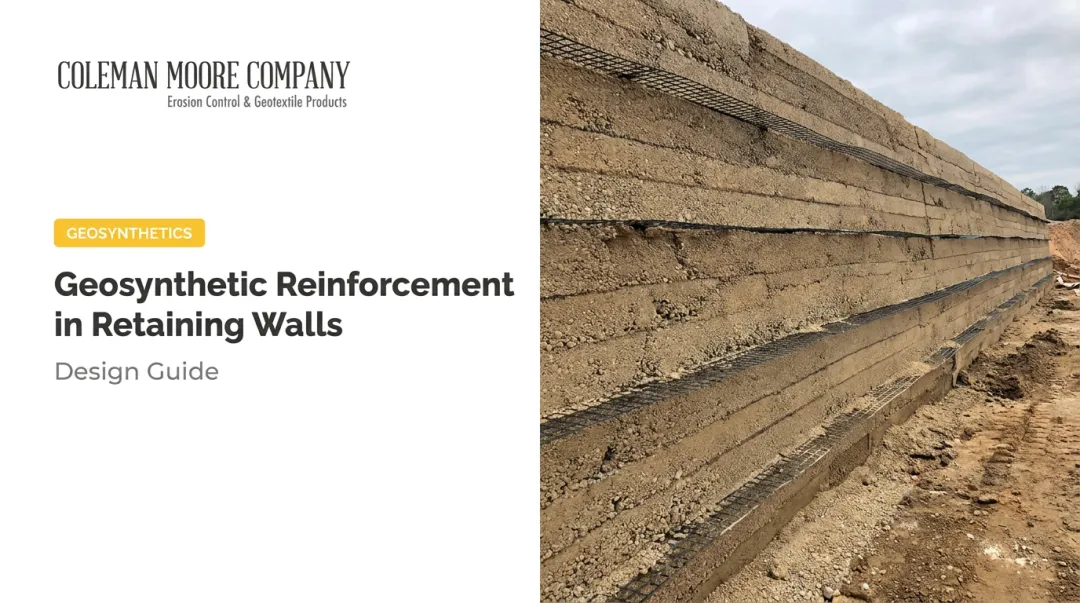
- Retaining wall and slope reinforcement
- Erosion control on disturbed ground and waterways
- Subsurface drainage systems
- Landfill liners and caps
- Stormwater containment and detention
They're specified by contractors, engineers, municipalities, and DOTs on projects ranging from county road repairs to large-scale plant expansions. Coleman Moore Company has been supplying geosynthetics for Iowa civil infrastructure projects since 2004, providing DOT-compliant materials and design assistance across all of these application categories.
What Functions Do Geosynthetics Serve?
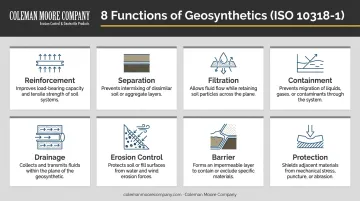
The ISO 10318-1 standard defines eight recognized functions for geosynthetics. The intended function — or combination of functions — should drive product selection before any product type is named.
| Function | What It Does |
|---|---|
| Reinforcement | Adds tensile strength to resist stress and contain deformation in soil structures |
| Stabilization | Improves the mechanical behavior of weak or unstable ground |
| Separation | Prevents two dissimilar materials (e.g., aggregate and subgrade) from intermixing |
| Filtration | Allows water to pass while retaining soil particles |
| Drainage | Collects and transports fluids within or through the geosynthetic |
| Erosion Control | Prevents soil and particles from being displaced by water or wind |
| Barrier/Containment | Limits liquid or gas migration through or beneath a structure |
| Protection | Prevents or reduces localized damage to an adjacent surface or material |
Most Common Functions in Road and Site Construction
Three functions dominate road and site construction decisions:
- Separation keeps aggregate layers from mixing into soft subgrade — without it, aggregate pumps downward under load and the road deteriorates rapidly
- Reinforcement adds tensile capacity that soil alone can't provide, enabling construction over poor ground without full excavation
- Filtration allows groundwater to move freely while preventing fine soil particles from migrating into drainage layers or pipes
Drainage and Containment in Specific Applications
Drainage geosynthetics manage pore pressure and groundwater movement in embankments and road sections where moisture buildup causes instability. Containment applications — landfills, impoundments, stormwater ponds — rely on barrier geosynthetics to prevent liquids or gases from migrating where they shouldn't.
These distinctions matter at the specification stage. A geotextile selected for filtration performance may lack the tensile properties required for reinforcement — and substituting one for the other is a common source of premature failure in the field.
Types of Geosynthetics
Geosynthetics span a wide range of engineered products, each designed for specific functions and site conditions. The four types most common in civil infrastructure are geotextiles, geogrids, geomembranes, and geocells. Specialized products — geonets, geopipes, geofoam, geosynthetic clay liners, and geocomposites — address more targeted needs.
Geotextiles
Geotextiles are permeable woven or non-woven fabrics made from polypropylene or polyester fibers. Both types allow water to pass through while interacting with surrounding soil, but they work differently:
- Woven geotextiles — made from interlaced yarns, offering higher tensile strength and load distribution capacity; well-suited for separation and reinforcement
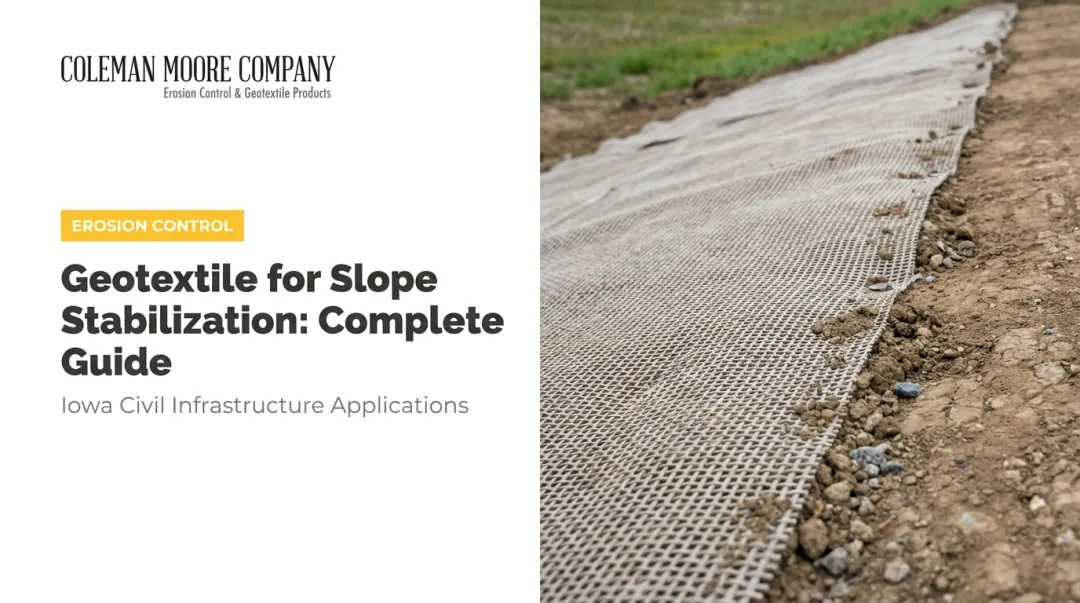
- Non-woven geotextiles — needlepunched or heat-bonded fibers providing superior filtration and drainage; higher permittivity, better for drainage wraps and erosion control
Coleman Moore supplies Mirafi® non-woven and woven geotextiles, as well as woven products from Huesker. These materials are used across separation, filtration, drainage, and erosion control applications on Iowa DOT and civil infrastructure projects.
Common applications include:
- Separation between subgrade and aggregate base in road construction
- Filtration around drainage pipes and French drains
- Erosion control on slopes and disturbed areas
- Subsurface drainage (trench drains, underdrains, pipe wrap)
- Cushion layers protecting geomembranes from puncture
Key limitation: Non-woven types lack the structural load distribution capacity of geogrids. Selecting the wrong fabric weight or apparent opening size for the soil type can lead to clogging or inadequate separation — most geotextile system failures trace back to improper fabric selection or installation, according to Wisconsin LTAP.
Geogrids
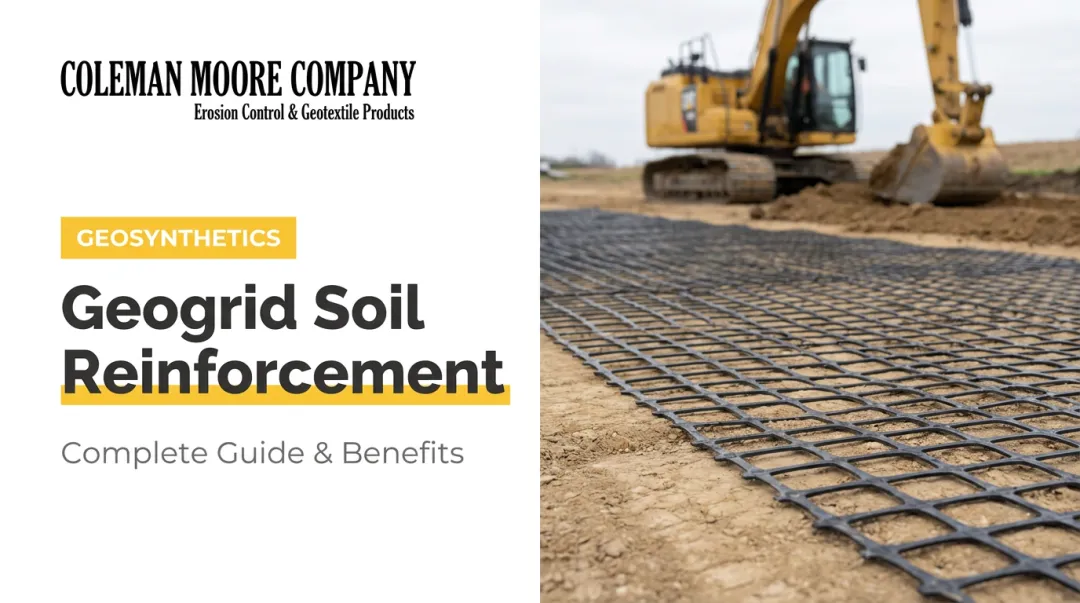
Geogrids are open-grid structures with rigid polymer ribs and apertures large enough for aggregate particles to penetrate and interlock. That mechanical interlock between grid and aggregate delivers stabilization and load distribution — a mechanism distinct from how geotextiles function.
Three configurations:
- Uniaxial — tensile strength in one direction; used for retaining walls and slopes
- Biaxial — strength in two directions; road and railway base stabilization
- Multiaxial — triangular or hexagonal pattern providing stiffness in multiple directions; optimized for moving wheel loads
CBR thresholds guide specification:
- CBR below 3% — subgrade stabilization is the primary need
- CBR 3% to 8% — base reinforcement and stabilization for thin HMA roads
Coleman Moore stocks Tensar InterAx® Geogrids as their primary geogrid product. InterAx® creates a mechanically stabilized layer (MSL) that distributes loads evenly and reduces stress on weak subgrade. Coleman Moore uses Tensar Plus design software to calculate optimized aggregate thickness from site-specific CBR values gathered through on-site DCP testing.
At the CF Industries Plant Expansion in Sergeant Bluff, Iowa, subgrade conditions measured a CBR of just 1.0%. Coleman Moore's design optimization reduced aggregate requirements substantially. On that project, every inch of aggregate eliminated translated to roughly $1 million in construction cost savings.
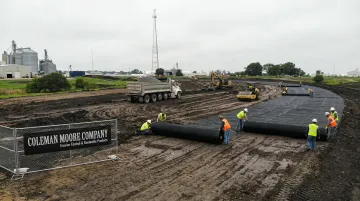
Road base stabilization over weak subgrades, unpaved haul roads, pavement reinforcement, retaining walls, and steep slope reinforcement are the primary applications for geogrids.
Geomembranes
Geomembranes are impermeable or very low-permeability synthetic sheets — most commonly HDPE, LLDPE, or PVC — designed to act as a barrier against liquid or gas movement. Unlike geotextiles and geogrids, which manage water movement, geomembranes stop it.
EPA regulations under RCRA Subtitle D require composite liners for municipal solid waste landfill units, with a minimum 30-mil flexible membrane liner — or 60-mil minimum if HDPE is used. These aren't guidelines; they're federal thresholds with direct compliance implications.
Material comparison:
| Material | Key Properties | Primary Use |
|---|---|---|
| HDPE | High chemical resistance, low permeability, long service life | Landfills, hazardous waste, reservoirs |
| LLDPE | Better puncture resistance, more flexible | Mining, waste landfills |
| PVC | Flexible, cost-effective | Buried barrier applications |
Buried HDPE liners are designed to exceed 50 years of service life under proper conditions. Non-woven geotextiles are typically placed above and below geomembranes as protective cushion layers — a role Coleman Moore's geotextile products are routinely specified to fill.
Landfill liners and caps, containment ponds, mining tailings impoundments, and regulatory-compliance fluid containment are the core use cases for geomembranes.
Geocells
Geocells are three-dimensional honeycomb-like structures made from HDPE strips welded together. Expanded on-site and filled with soil, gravel, or aggregate, they create a confined matrix that distributes load and prevents lateral movement of fill material.
The confinement works in three dimensions — surrounding cell walls stabilize fill both vertically and laterally. Flat geogrids, by contrast, rely on planar interlock with aggregate particles rather than physical enclosure.
Coleman Moore's cellular confinement products are most commonly specified for:
- Driveways, parking lots, and access areas
- Bike trails and nature paths
- Emergency vehicle access
- Slope stabilization on embankments
- Sports fields and turf reinforcement
A practical advantage: geocells can be filled with locally available materials, reducing aggregate import costs. When paired with a non-woven geotextile separation layer beneath, the system reduces both the quantity and quality of aggregate needed for effective subgrade performance.
Geocells are well-suited for slope and channel protection, load support surfaces, and vegetation reinforcement — wherever lateral spreading of fill is the primary concern. For primary road base stabilization, geogrids typically provide more efficient load distribution.
Common Applications in Civil Infrastructure
Roads and Site Access
Geotextiles and geogrids are routine components in road construction over variable or soft subgrades. Geotextiles provide the separation layer that prevents aggregate from pumping into subgrade under traffic loading. Geogrids — particularly multiaxial types like Tensar InterAx® — create a mechanically stabilized layer that reduces required aggregate depth while improving long-term performance.
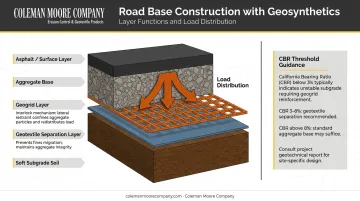
FHWA confirms that geotextiles and geogrids reduce stress on subgrade and prevent base aggregate from penetrating into subgrade. On projects with poor CBR values, eliminating even a few inches of aggregate depth produces significant material cost savings at scale.
Erosion Control and Drainage
Beyond roadways, geosynthetics play a critical role in protecting exposed slopes, stream banks, and disturbed construction sites from rainfall and runoff. Products commonly used in these applications include:
- Curlex® erosion control blankets from American Excelsior for slope and channel stabilization
- Recyclex® Turf Reinforcement Mats (TRMs) for long-term erosion protection on high-velocity channels
- Coir fiber logs from Nedia Enterprises for shoreline and stream bank applications
Turf reinforcement mats can reduce sheet, rill, and channel erosion by 90% or more when properly installed. Drainage geocomposites address a related problem — managing groundwater behind retaining walls, beneath embankments, and along roadway shoulders to prevent moisture-related failures.
Containment and Environmental Protection
Containment applications demand the highest level of material integrity. Geomembranes and geosynthetic clay liners (GCLs) form the impermeable barrier in landfill cells, stormwater detention basins, and industrial containment facilities — preventing contaminants from reaching soil and groundwater. These systems are designed to meet regulatory requirements set by state DNRs and the EPA.
How to Choose the Right Geosynthetic for Your Project
Start with the function, not the product. Misidentifying the required function — specifying a separator when reinforcement is needed, for example — leads to premature failure and expensive remediation that costs far more than the original product.
Key Factors to Evaluate
- Primary function: reinforcement, separation, filtration, drainage, containment, or erosion control — many projects require more than one
- Soil conditions: CBR or bearing capacity; on-site DCP testing provides rapid, reliable data
- Load type and intensity: static vs. dynamic, light passenger vs. heavy haul
- Drainage requirements: high water table, poor drainage soils, or proximity to waterways
- Regulatory requirements: landfill liner minimums, stormwater permits, DOT specifications
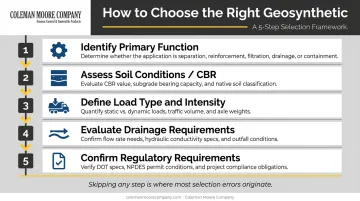
Skipping any of these steps is where most selection errors originate.
Common Selection Mistakes
- Choosing a more complex product when a simpler one meets the engineering need
- Selecting by material availability rather than soil compatibility
- Ignoring manufacturer specifications for apparent opening size or survivability class
- Skipping site testing on projects with variable or unknown ground conditions
For projects with soft subgrade or uncertain soil conditions, run on-site testing before committing to a product. Coleman Moore Company performs DCP testing with CBR conversion directly on-site and uses Tensar Plus design software to determine aggregate thickness and confirm geosynthetic selection — so engineers and contractors have soil-specific numbers before work begins.
Frequently Asked Questions
What are geosynthetics for construction projects?
Geosynthetics are synthetic polymer materials installed in or on soil to improve ground performance. They address stabilization, separation, drainage, reinforcement, and containment challenges across roads, embankments, drainage systems, and landfills — replacing or supplementing methods like excavation and aggregate replacement that cost significantly more.
What is the difference between geotextiles and geomembranes?
Geotextiles are permeable fabrics that allow water to move through them while performing separation, filtration, drainage, and reinforcement functions. Geomembranes are impermeable sheets designed to stop liquid or gas movement entirely. They're built for opposite hydraulic behaviors and are rarely interchangeable.
What is the cost of geosynthetics for construction projects?
Costs vary widely by product type, project scale, and site conditions — no single number applies across types. Geosynthetics carry an upfront material cost but typically reduce total project costs by cutting aggregate usage, shortening construction timelines, and lowering long-term maintenance. Site-specific evaluation is required to size the cost-benefit accurately.
What are the main functions of geosynthetics?
ISO 10318-1 defines eight functions: reinforcement, stabilization, separation, filtration, drainage, erosion control, barrier/containment, and protection. Many products are engineered to perform more than one function simultaneously, which is why function identification must precede product selection.
How long do geosynthetics last in the ground?
Properly specified and installed geosynthetics are designed for the service life of the structure they support — typically decades. Buried HDPE geomembranes are designed to exceed 50 years under appropriate conditions. The polymers used resist biological degradation, chemical attack, and UV exposure, with product selection and installation quality being the primary variables affecting longevity.
Can geosynthetics be used on soft or weak soils?
Addressing soft or weak subgrade is one of the primary use cases. Geogrids are routinely specified for CBR values below 8%, with subgrade stabilization applications starting below CBR 3%. Geotextiles contribute separation and reinforcement functions on soft soils as well.