
Introduction
Municipalities, contractors, and industrial operators face a recurring tradeoff with wastewater treatment: conventional chemicals like alum and ferric chloride work, but they generate toxic sludge, elevate salinity, and create chemical handling liabilities that add cost and compliance pressure at every stage.
Chitosan — a biopolymer derived from crustacean shell waste — has emerged as a well-documented natural alternative with a broad removal profile. It targets heavy metals, synthetic dyes, suspended solids, and pathogens through multiple mechanisms, and it carries the EPA's highest safety rating for chemical ingredients.
This guide walks through what you need to evaluate chitosan-based adsorbents for your application: how they work, what forms are available, which pollutants they target, what governs performance, and where the practical limitations lie.
Key Takeaways
- Chitosan is derived from seafood industry byproduct, biodegradable, non-toxic, and EPA Green Circle-rated
- It removes pollutants via electrostatic attraction, chelation, and ion exchange — each mechanism targeting a different class of contaminant
- Modified forms (crosslinked, magnetic, composite) substantially outperform raw chitosan in stability and reusability
- pH is the single most critical operational variable — raw chitosan dissolves below approximately pH 6
- Lab results are strong; scaling to full municipal systems remains the primary barrier
What Is Chitosan? Source, Structure, and Key Properties
Chitosan is produced by deacetylating chitin — the second most abundant natural polymer on Earth after cellulose. Commercial production relies primarily on shrimp and crab shells, making it an upcycled byproduct of the seafood processing industry rather than a synthesized chemical.
Chemical Structure
Chitosan is a linear polysaccharide with two functional groups that drive its treatment performance:
- Free amino groups (-NH₂) act as the primary adsorption sites, enabling heavy metal chelation and electrostatic attraction of anionic pollutants
- Hydroxyl groups (-OH) provide secondary binding sites that support chelation and physical adsorption
Commercial chitosan is defined by a degree of deacetylation (DD) above 50–60%, with most water-treatment grades exceeding 55% DD. The higher the DD, the more free amino groups are available — which directly affects adsorption capacity.
Key Properties for Water Treatment
| Property | Relevance |
|---|---|
| Biodegradable | No persistent residue in spent sludge |
| Non-toxic | EPA Safer Chemical Ingredients List, Green Circle rating |
| Hydrophilic | Readily contacts aqueous contaminants |
| Low production cost | Sourced from seafood waste |
| Surface area | Raw: ~2–30 m²/g; modified forms: up to 152 m²/g |
The EPA's Safer Chemical Ingredients List assigns chitosan its Green Circle rating, confirming low concern based on experimental and modeled data — a useful reference point for procurement decisions and regulatory conversations.
How Chitosan-Based Adsorbents Work: Adsorption Mechanisms
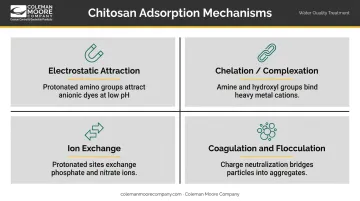
Chitosan removes contaminants through four distinct mechanisms. Understanding which mechanism applies to your target pollutant determines whether chitosan is the right fit.
Electrostatic Attraction
At low pH, chitosan's amino groups become protonated and positively charged. This attracts negatively charged (anionic) pollutants (sulfonate dye groups, nitrates, and certain metal complexes). One ACS Langmuir study reported 93% Reactive Black 5 removal at pH 2.0, confirming this as the dominant mechanism for anionic dye removal.
The practical implication: anionic dye streams at acidic pH are an excellent match. pH adjustment to achieve those conditions adds operating cost, so influent pH must be factored into any feasibility analysis.
Chelation (Complexation)
The amine and hydroxyl groups form coordinate bonds with heavy metal cations by donating electron pairs. This makes chitosan a chelating agent — capable of binding Cu²⁺, Pb²⁺, Cd²⁺, Hg²⁺, and Cr(VI) from solution. Chelation is the primary mechanism for heavy metal removal and is what drives the high adsorption capacities reported for modified chitosan forms.
Ion Exchange
Protonated amino groups can exchange with metal ions and oxyanions in solution. This is especially useful for removing phosphate and nitrate from agricultural runoff or municipal effluent — applications where conventional adsorbents often fall short.
Coagulation and Flocculation
Chitosan functions as both a coagulant and a flocculant:
- As a coagulant: Destabilizes colloidal particles through charge neutralization
- As a flocculant: Bridges destabilized particles into larger aggregates that settle or filter more readily
It is commonly used alongside metal coagulants, where alum or ferric chloride initiates coagulation and chitosan enhances floc formation. One study found an optimum chitosan dose of 30 mg/L achieved final turbidity of 2.7 NTU, compared to alum at 0.7 NTU and ferric chloride at 0.5 NTU at equivalent doses. Chitosan approaches but doesn't consistently match conventional coagulant performance on turbidity alone.
Physical adsorption via van der Waals forces and pore filling also contributes, particularly in modified composites with expanded surface areas — though this mechanism is secondary to the four above in most treatment scenarios.
Which mechanism dominates in practice depends on your contaminant type, solution pH, and how the chitosan has been modified. The next section breaks down performance by pollutant class.
Types of Chitosan-Based Adsorbents for Wastewater Treatment
Raw chitosan has three core limitations: low surface area, poor acid stability, and dissolution below pH 6. These constraints have driven the development of several modified forms, each addressing a specific engineering problem. The main formats in use today range from crosslinked beads to magnetic composites.
Raw/Native Chitosan
Available as powder, flakes, or liquid solution. Functional for coagulation and flocculation applications, but limited by:
- Dissolution in acidic media (below ~pH 5.5–6)
- Low surface area (~2–30 m²/g)
- Poor mechanical strength in packed-bed systems
These constraints push most wastewater applications toward modified formats.
Crosslinked Chitosan
Chemical crosslinking with glutaraldehyde or epichlorohydrin creates a more stable three-dimensional network. Epichlorohydrin-crosslinked beads, for example, maintained >95% Cr(VI) removal across at least 5 regeneration cycles under acidic conditions — a clear advantage over raw chitosan's single-use limitations. Crosslinked forms are the standard choice for continuous treatment systems.
Chitosan Beads and Hydrogels
Forming chitosan into spherical beads or hydrogel matrices increases surface area and allows controlled porosity. These formats are well-suited to packed-bed column reactors, where hydraulics require a mechanically stable, consistently shaped adsorbent. Chitosan/PVA hydrogel beads in fixed-bed columns achieved Cr(VI) removal capacity of 15.53 mg/g with only ~2.5% desorption efficiency loss over 3 regeneration cycles.
Magnetic Chitosan Composites
Embedding Fe₃O₄ nanoparticles into chitosan allows post-treatment magnetic separation of the adsorbent. Recovery exceeded 95% within 210 seconds in heavy-metal adsorption systems — addressing one of the most persistent recovery challenges with fine adsorbent particles.
Membranes and Nanofibers
These formats are used in membrane filtration systems for selective contaminant removal — particularly for emerging micropollutants and dyes where bead-based systems underperform. Both remain at research and pilot scale; commercial deployment is still limited to specialized applications.
Pollutants Removed by Chitosan Adsorbents
Heavy Metal Ions
Heavy metals are chitosan's most documented application, driven by the chelation mechanism. Modified chitosan forms show particularly strong performance:
| Metal | Chitosan Form | Langmuir qmax |
|---|---|---|
| Pb(II) | Chitosan-functionalized adsorbent | 294.12 mg/g |
| Cu(II) | TPP-modified chitosan-coated Fe₃O₄ | 141.034 mg/g |
| Cd(II) | TPP-modified chitosan-coated Fe₃O₄ | 104.384 mg/g |
| Cr(VI) | Magnetic carbon nanotube composite | 119 mg/g |
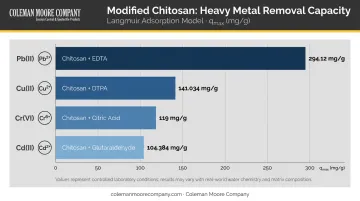
These values come from controlled lab conditions. Real wastewater matrices with competing ions will produce lower effective capacities — matrix-specific testing is essential before specifying chitosan for any industrial application.
Industrial sources generating heavy metal wastewater include mining operations, electroplating facilities, battery manufacturers, and tanneries — all regulated under EPA effluent guidelines.
Synthetic Dyes and Organic Pollutants
A 2021 critical review found that inefficient textile dyeing releases 15–50% of unbound azo dyes into wastewater — representing a substantial removal challenge. Chitosan addresses this through electrostatic adsorption:
- Anionic dyes: Best removed at low pH (protonated surface attracts sulfonate groups); Langmuir Qm of 239 mg/g for Reactive Black 5
- Cationic dyes: Require separate pH optimization; Langmuir Qm of 158 mg/g for methylene blue
Beyond dyes, chitosan also adsorbs oils, surfactants, and pharmaceutical compounds (emerging contaminants), broadening the range of treatable contaminants beyond metal-focused applications.
Pathogens and Suspended Solids
Chitosan's positively charged surface disrupts negatively charged bacterial cell membranes — an antimicrobial action that complements its physical removal role. Published results include:
- 74.3–98.2% turbidity removal at pH 7.0–7.5
- 2–4 log bacterial reduction (99–99.99%) within the first 1–2 hours
- Turbidity consistently below 1 NTU when combined with filtration
These results support chitosan's use in turbidity and microbial control, but they do not substitute for disinfection compliance or plant-specific validation.
Factors That Influence Chitosan Adsorption Performance
pH: The Dominant Variable
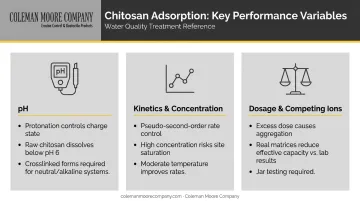
pH controls both chitosan's solubility and the charge state of the adsorbent and target pollutant simultaneously. Native chitosan dissolves in dilute acidic solutions, typically at pH below 6 (commonly in dilute acetic or hydrochloric acid). Below approximately pH 5.5, raw chitosan faces stability issues that can compromise performance entirely.
This is why crosslinked or modified forms are specified for neutral-to-alkaline wastewaters — they maintain structural integrity where raw chitosan would dissolve.
Kinetics, Concentration, and Temperature
- Most chitosan-based adsorption follows pseudo-second-order kinetics, suggesting chemisorption-like rate control
- Higher initial pollutant concentration increases the driving force but can saturate active sites — pushing equilibrium toward earlier breakthrough in column systems
- Moderate temperature increases improve adsorption rates, though the practical temperature range for most wastewater is narrow
Adsorbent Dosage and Competing Ions
Two factors that lab studies frequently overlook:
- Excess dosage does not always improve efficiency. Particle aggregation at high doses reduces available surface area, creating a point of diminishing returns
- Competing ions in real wastewater matrices occupy the same amine and hydroxyl binding sites, reducing selectivity and effective capacity compared to single-ion lab results
Site-specific jar testing before full-scale application is essential — it's the only reliable way to validate performance against your actual wastewater matrix.
Benefits, Limitations, and Practical Considerations
Advantages Over Conventional Adsorbents
Chitosan's practical case rests on several well-documented advantages:
- Biodegradable — no persistent toxic residue accumulates in treatment sludge
- EPA Green Circle rating — lower-hazard chemistry for worker safety and regulatory positioning
- Renewable sourcing — produced from seafood processing waste, aligning with circular economy procurement criteria
- Denser, more dewaterable sludge — natural coagulant reviews report sludge generation up to 5 times lower than chemical alternatives
- No salinity increase — unlike metal salt coagulants, chitosan does not add dissolved solids to treated water
For construction site stormwater management, chitosan fits naturally into a layered treatment approach. Coleman Moore Company's Biostar-CH products are bio-polymer liquid flocculants formulated for stormwater treatment. They target fine sediment particles that physical barriers alone cannot capture.
When combined with geotextile-based systems like dewatering bags, inlet protection filters, or turbidity curtains (available from Coleman Moore's Enviro-USA line), chitosan flocculants address dissolved and colloidal contaminants that physical filtration passes through. On Iowa construction and civil infrastructure sites, that pairing — physical separation for coarse solids, chitosan flocculation for fines — consistently handles what either method misses alone.
Limitations and Challenges
Chitosan's key limitations:
- pH sensitivity — raw chitosan dissolves in acidic conditions, restricting use without modification in low-pH wastewaters
- Cost relative to alum and ferric chloride — on a per-unit-volume basis at municipal scale, chitosan typically costs more; reduced sludge handling, lower chemical hazard, and dose reduction potential often offset that premium, though the net difference depends on project scale and disposal costs
- Municipal regulatory approvals — NSF/ANSI/CAN 60 certification exists (Tidal Vision holds listed products at use levels up to 4,000 mg/L), but adoption in full-scale municipal drinking water treatment remains limited
- Regeneration and disposal — saturated adsorbent requires regeneration or disposal planning, and regeneration efficiency degrades with cycles
- Scale-up gap — a 2025 review flags weak transfer from laboratory studies to dynamic columns and complex industrial matrices as a persistent barrier to commercialization
Frequently Asked Questions
Is chitosan used as a coagulant or flocculant in wastewater treatment?
Both. As a coagulant, it neutralizes colloidal particle charge to destabilize them; as a flocculant, it bridges those particles into larger, settleable aggregates. In practice, it is paired with alum or ferric chloride, where the metal salt initiates coagulation and chitosan boosts floc formation.
At what pH does chitosan dissolve for wastewater treatment applications?
Native chitosan dissolves in dilute acidic solutions, typically at pH below 6 — commonly in dilute acetic or hydrochloric acid. Crosslinked or modified chitosan forms are used when wastewater pH is neutral to alkaline, preventing dissolution and maintaining structural integrity throughout treatment.
Is chitosan a chelating agent in wastewater treatment?
Yes. The free amino (-NH₂) and hydroxyl (-OH) groups on chitosan's polymer chain form stable coordinate bonds with heavy metal cations. This chelation mechanism makes it effective for removing lead, copper, mercury, cadmium, and chromium from industrial effluents.
What pollutants can chitosan-based adsorbents remove from wastewater?
Chitosan-based adsorbents target a broad range of pollutants, including:
- Heavy metal ions (Pb, Cu, Cd, Hg, Cr, As)
- Synthetic dyes — both anionic and cationic
- Suspended solids, bacteria, and pathogens
- Oils, greases, ammonia, phosphate, and nitrate
- Emerging contaminants such as pharmaceuticals
What are the main limitations of using chitosan in wastewater treatment?
The primary limitations fall into four areas:
- pH sensitivity: Raw chitosan dissolves in acidic conditions without chemical modification
- Cost: Higher per-unit cost than conventional coagulants at municipal scale
- Regulatory gaps: Limited approvals for municipal drinking water applications
- Operational challenges: Adsorbent recovery, regeneration efficiency, and lab-to-plant scale-up remain difficult
How does modified chitosan differ from raw chitosan for wastewater use?
Modifications — crosslinking, magnetic particle incorporation, composite formation — improve chemical stability, surface area, reusability, and ease of post-treatment separation. These changes address the core performance limitations of raw chitosan while preserving its biodegradability and low-hazard character.