When most people hear the word concrete, they picture ready-mix trucks, forms, crews finishing wet concrete, and days of curing before the finished surface can be put into service.
Concrete Canvas changes that picture considerably.
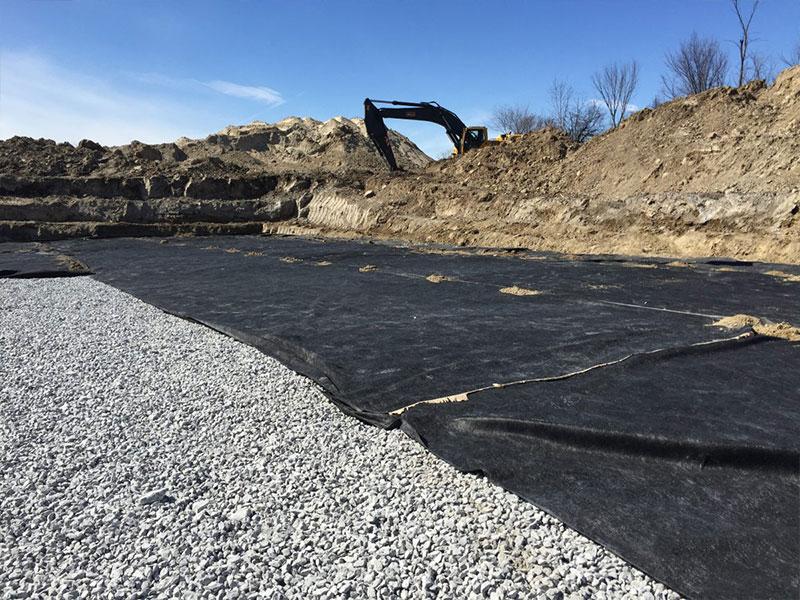
Concrete Canvas is a flexible, concrete-filled geosynthetic material supplied in rolls. It can be transported to the jobsite in its flexible form, positioned to conform to the existing surface, secured in place, and then hydrated. Once cured, it creates a thin, durable concrete layer that follows the shape of the underlying ground.
That combination of flexibility during installation and rigidity after curing opens the door to an unusually wide range of applications.
More Than Just a Ditch Liner
One of the most common uses for Concrete Canvas is lining drainage ditches and channels.
Flowing water can quickly erode exposed soil, particularly on steep grades or where concentrated runoff creates high velocities. Traditional solutions may include riprap, poured concrete, articulated concrete block, turf reinforcement mats, or other erosion-control systems.
Concrete Canvas provides another option.
Because the material is flexible before hydration, it can follow the contours of an existing channel without requiring the extensive forming normally associated with cast-in-place concrete.
Potential applications include:
- Roadside drainage ditches
- Industrial drainage channels
- Stormwater conveyance systems
- Railroad drainage
- Mine drainage
- Agricultural drainage
- Steep-gradient channels
- Areas subject to concentrated runoff
But drainage is only part of the story.
Culvert and Outlet Protection
Culvert entrances and outlets are frequent trouble spots.
Water exiting a pipe can create concentrated velocity and turbulence, leading to scour around the outlet and erosion downstream.
Concrete Canvas can be used around culverts and drainage structures to provide a hardened erosion-resistant surface.
Depending on the project, it may be used for:
- Culvert inlet protection
- Culvert outlet protection
- Headwall areas
- Downstream scour protection
- Transition areas between pipes and channels
Its ability to conform around irregular shapes can be particularly useful in retrofit situations where an existing drainage structure is already in place.
Slope Protection
Not every erosion problem occurs in the bottom of a channel.
Steep slopes can be difficult to protect because conventional concrete may require substantial forming and access for equipment. Loose aggregate or riprap may also be difficult to keep in place depending on the slope and site conditions.
Concrete Canvas can be installed directly over properly prepared slopes to create a hard-armored surface.
Applications can include:
- Embankments
- Cut slopes
- Drainage slopes
- Industrial sites
- Infrastructure corridors
- Areas exposed to runoff
- Locations where vegetation is difficult to establish
The rolls can be positioned while flexible, allowing the material to follow changes in grade before being secured and hydrated.
Protecting Difficult-to-Reach Areas
One of Concrete Canvas’ biggest advantages becomes apparent when the jobsite is difficult to access.
Traditional concrete requires getting several things to the installation area: concrete trucks or mixing equipment, labor, forms, tools, and sometimes pumping equipment.
That may be relatively simple alongside an open roadway. It becomes much more complicated on a steep slope, beside railroad tracks, inside an industrial facility, along a remote drainage channel, or in locations where equipment access is limited.
Because Concrete Canvas is delivered as a roll, material can often be moved into locations where traditional concrete construction would be considerably more complicated.
That makes it worth considering for remote infrastructure and repair projects where access may be as important as the actual material cost.
Industrial and Containment Applications
Concrete Canvas is also used in industrial environments where a durable protective layer is needed over soil or other underlying materials.
Depending on project requirements, applications may include protection around:
- Industrial drainage systems
- Berms
- Secondary containment areas
- Lagoons
- Mine sites
- Tank facilities
- Utility infrastructure
These are situations where erosion resistance, durability, installation speed, and reduced dependence on conventional concrete equipment can become important considerations.
A Useful Material for Repairs
Not every application has to be a large new construction project.
Concrete Canvas can also be useful when repairing damaged erosion-control systems or drainage infrastructure.
For example, a site may have:
- A washed-out section of ditch
- Erosion developing around a culvert
- A failing drainage swale
- Localized slope erosion
- Difficult areas around existing structures
Because the material can conform to existing surfaces and structures, it may provide an alternative to removing and completely rebuilding the original system.
That can be particularly valuable when keeping an operation, roadway, facility, or drainage system functioning is a priority.
Installation Can Be Fast
Another reason Concrete Canvas fits so many applications is that the installation process is relatively straightforward.
The basic concept can be summarized as:
Unroll it. Secure it. Hydrate it.
The details of anchoring, overlaps, joints, surface preparation, and hydration are important and will vary depending on the application, but the system eliminates several steps commonly associated with poured concrete.
There is generally no need for traditional concrete forming, mixing, pumping, or finishing.
For the right project, reducing those operations can significantly simplify construction.
Less Material Does Not Necessarily Mean Less Performance
Concrete Canvas creates a relatively thin concrete layer compared with a conventionally poured concrete slab.
But the two materials are not always being asked to perform the same job.
A drainage channel liner, erosion-control surface, or slope-protection system does not necessarily need to function like a structural concrete pavement.
The question should therefore be:
What does the application actually require?
If the primary goal is erosion protection, hydraulic conveyance, surface armoring, or protection of an underlying surface, constructing a thick conventional concrete section may not always be necessary.
Where Does Concrete Canvas Make the Most Sense?
Concrete Canvas will not replace poured concrete, riprap, geotextiles, turf reinforcement mats, articulated concrete blocks, or other erosion-control systems in every application.
Nor should it.
Every site has different hydraulic conditions, soils, access restrictions, design requirements, and budgets.
Its real advantage is that it gives engineers and contractors another tool.
Concrete Canvas becomes especially interesting when a project involves some combination of:
- Difficult access
- Steep terrain
- Concentrated water flow
- Erosion problems
- Limited room for equipment
- A need for rapid installation
- Irregular surfaces
- Remote construction
- Expensive conventional concrete placement
In those situations, comparing only the cost of materials may miss the larger opportunity.
The savings may come from reducing excavation, forming, trucking, equipment, crew size, installation time, or disruption to the site.
One Product, A Lot of Possibilities
Perhaps the easiest way to understand Concrete Canvas is to stop thinking of it simply as concrete in a roll.
Think of it as a way to put a durable concrete surface in places where installing conventional concrete would otherwise be difficult, slow, or expensive.
A roadside ditch and an industrial containment area may appear to have very little in common. A steep embankment and a culvert outlet may appear to be completely different applications.
But they can share the same fundamental problem:
They need a durable protective surface, and getting conventional concrete to that location isn’t necessarily easy.
That is where the versatility of Concrete Canvas becomes apparent.
From drainage channels and culverts to slopes, industrial facilities, erosion repairs, and remote infrastructure, one roll-based product can solve a surprisingly wide variety of problems.