The challenge for contractors, engineers, and municipalities is that erosion doesn't wait. A 2023 study assessing Iowa streambanks found average bank recession of 12.4 cm per year across 385 bank-years, with roughly 41% of third- to sixth-order streambanks in the state classified as severely eroding. That's not a fringe problem — it's a widespread one.
The good news: natural and geosynthetic protection methods work, and they work best when matched to actual site conditions. This guide covers the causes, warning signs, and proven methods — from vegetation planting to geotextile-reinforced riprap — so you can select the right approach before a bad situation becomes an emergency repair.
Key Takeaways
- River bank erosion accelerates due to flooding, vegetation removal, saturated soils, and channelization — not just natural water flow.
- Warning signs like exposed roots, undercutting, and fresh vertical scarps signal that intervention is overdue.
- Natural protection methods work best when matched to site-specific conditions: slope, flow velocity, and erosion severity.
- Geotextile filter fabric beneath riprap is not optional — skipping it causes soil migration and early riprap failure.
- Long-term stability requires routine inspection, livestock exclusion, and post-flood monitoring.
What Causes River Bank Erosion?
Some degree of bank erosion is part of how rivers naturally shape their channels. The problem is when human activity or altered hydrology pushes that process into overdrive.
High Water Velocity and Flooding
Floodwaters increase both current speed and hydraulic shear force against bank faces. Large chunks of soil break away, deepening the erosion cycle as the river redirects force onto newly exposed surfaces. Upstream channel modifications — straightening, culvert installations, impervious surface expansion — deliver faster, higher-volume flows to downstream reaches, compounding the damage.
EPA's channelization research confirms that channelization creates shorter, steeper streams, which directly increases flow velocity and erosion rates at the bank.
Removal of Riparian Vegetation
Vegetation does more than hold soil — it dissipates flow energy and creates resistance to scour. When banks are cleared for farming, livestock grazing, or development, that protection disappears. Research on unrestricted grazing found it can produce a sixfold increase in bank erosion in some cases. Once roots are gone, even moderate flows can remove significant soil volume.
Saturated or Weak Soil Conditions
When external water sources — heavy rain, poor drainage, or high groundwater — push pore pressure up, the bank's load-bearing capacity drops sharply. USGS research confirms that cohesive banks most commonly fail during storm-flow recessions: banks are saturated, but channel water levels have already dropped, removing the lateral support the water was providing.
Human Land Use and River Management
Adjacent construction and river engineering introduce additional risk. Levees redirect flow energy onto unprotected banks, while new impervious surfaces increase runoff volume and speed — concentrating erosive force on banks that were previously stable.
What Happens When River Bank Erosion Goes Unchecked
Once bank erosion starts, it compounds. In Iowa, streambanks contribute an estimated 31% of riverine total phosphorus exports, and USDA ARS data shows bank material can account for up to 80% of total sediment eroded from incised channels in Midwestern loess landscapes. That sediment load degrades water quality, fills channels, and impairs aquatic habitat downstream.
The damage doesn't stop at the waterline. Bridges, culverts, roads, and trails adjacent to eroding banks face progressive undermining — often without visible warning until failure is already underway.
Warning Signs You're Losing Your River Bank
Early detection is far cheaper than emergency remediation. Watch for:
- Exposed tree roots along the bank edge, indicating significant soil loss has already occurred below the surface
- Undercutting or overhangs at the waterline, where water has hollowed out the soil beneath an otherwise intact-looking bank face
- Fresh vertical scarps where bank sections have already sheared off and dropped into the channel
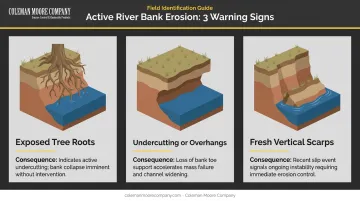
Any one of these signs warrants a site assessment by a qualified engineer or erosion control specialist before conditions worsen.
Natural Methods to Stop River Bank Erosion
Natural and nature-based methods are often more economical than hard engineering alone, and they deliver environmental co-benefits that structural methods can't match. The best approach is almost always a combination of methods calibrated to site conditions.
Native Vegetation Planting
Plant roots bind soil particles, increase shear resistance, and add surface roughness that slows near-bank flow. The US Army Corps of Engineers' bioengineering guidelines state directly that vegetation is often less expensive than most structural methods and improves fisheries, wildlife, and water quality.
For Iowa conditions, deep-rooted native riparian species perform best:
- Willows and native shrubs (establish quickly from cuttings, provide rapid root reinforcement)
- Native grasses and sedges (bind shallow soils, tolerate periodic inundation)
- Ferns and forbs suited to riparian zones (gap-filling species that protect bank faces)
Iowa State University Extension and the Iowa DNR can advise on regionally appropriate species selection. One important note: root reinforcement varies significantly with bank material, groundwater, and hydraulic stress. Vegetation alone may not be sufficient on steep or high-velocity banks.
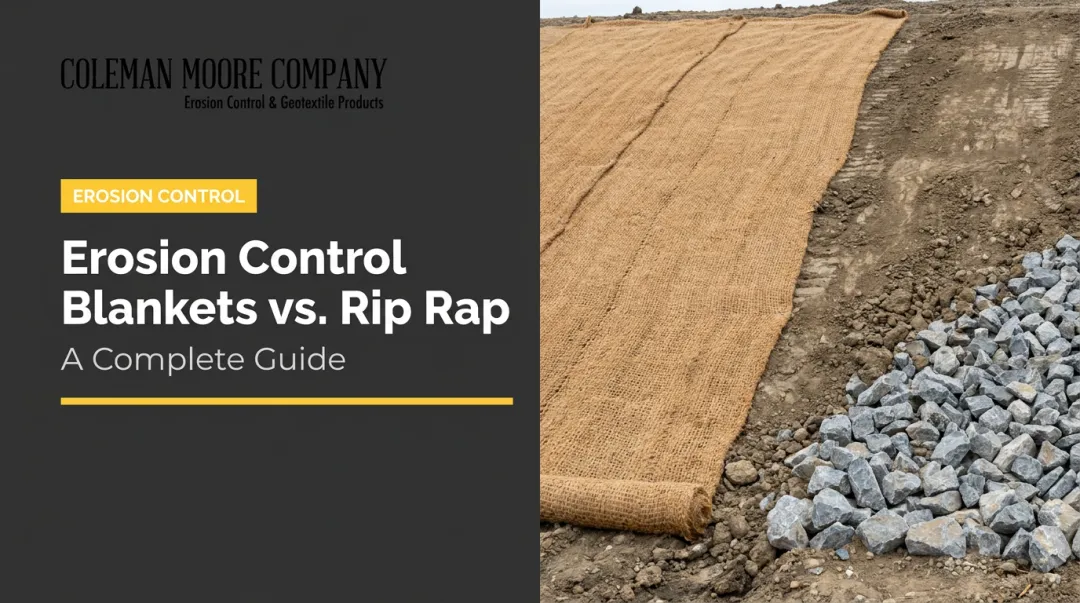
Riprap (Rock Armoring)
Riprap (angular, water-resistant rock typically ranging from 4 inches to 2 feet in granite or limestone) physically absorbs hydraulic force and prevents scour. Iowa DNR guidance specifies a maximum bank slope of 1.5H:1V for riprap applications.
Riprap works, but it comes with real limitations:
- Accelerates current velocity in adjacent unprotected areas
- Can disrupt aquatic and riparian habitat
- Fails over time if the filter layer beneath it is wrong or absent
The filter layer is non-negotiable. A nonwoven geotextile placed beneath riprap prevents fine soil particles from migrating through the rock layer, a failure mechanism called piping. Coleman Moore Company supplies Mirafi nonwoven geotextiles for this application: polypropylene-fiber fabric with UV and chemical resistance suited to long-term soil contact.
Bioengineering: Live Stakes, Fascines, and Brush Mattress
Soil bioengineering uses living plant material to create a root-anchored bank structure that grows stronger over time. Methods listed under NRCS Conservation Practice Standard 580 include:
- Live stakes — hardwood cuttings driven into the bank face, typically willow species, that root and provide structural reinforcement
- Fascines — bundled willow rods staked horizontally along the bank to capture sediment and establish root networks
- Brush mattresses — layered live branch material pinned to the bank surface, protecting against surface scour while root systems develop
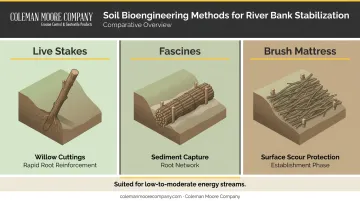
These methods are best suited to low-to-moderate energy streams. Dormant-season installation, careful species-to-site matching, and livestock exclusion during establishment all directly affect whether the planting takes hold.
Tree Revetments and Engineered Log Jams
Anchored fallen trees or engineered log structures placed along the bank slow near-bank current, dissipate flow energy, and trap sediment — building a natural soil bed where new vegetation can take hold. Missouri Department of Conservation documentation confirms this mechanism: tree revetments decrease erosion by slowing current and allowing silt and sand to deposit within the branch structure.
NRCS Technical Supplement 14J covers large woody material design specifically. Any log jam installation requires hydraulic review for buoyancy, anchoring, and debris risk, since wood structures interact directly with flood flows.
Coir Fiber Rolls and Erosion Control Blankets
Biodegradable coir (coconut fiber) rolls and erosion control blankets protect freshly reprofiled or revegetated banks from surface scour during the vegetation establishment window, typically one to two growing seasons.
Coleman Moore supplies two specific product lines for this application:
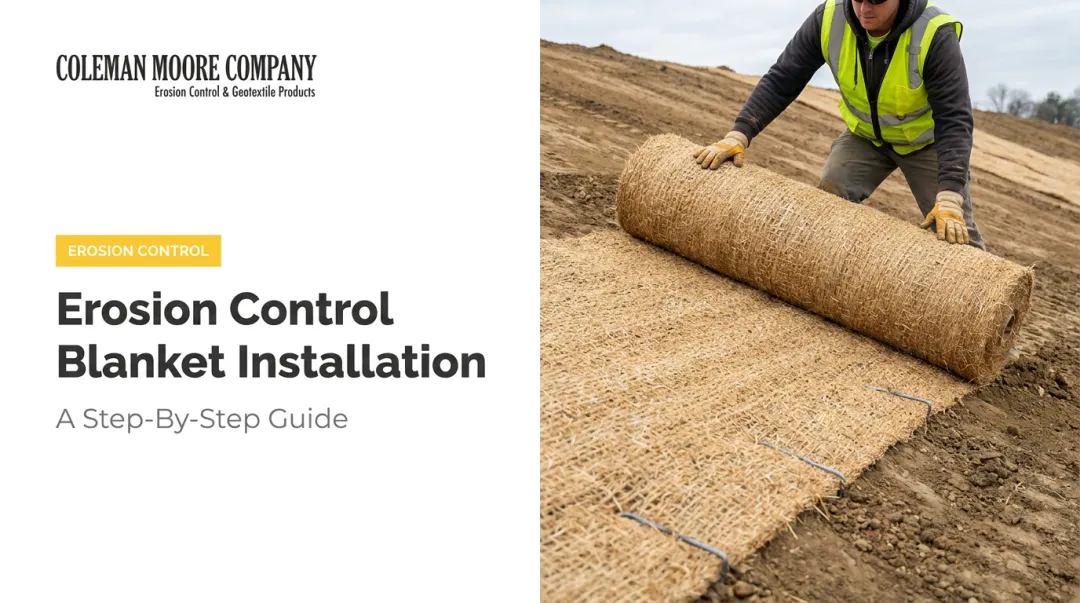
- Nedia Enterprises Coir Fiber Logs — designed for stream shore restoration and stabilization, these can be installed pre-vegetated or plugged with plants after placement, and biodegrade naturally once vegetation is established
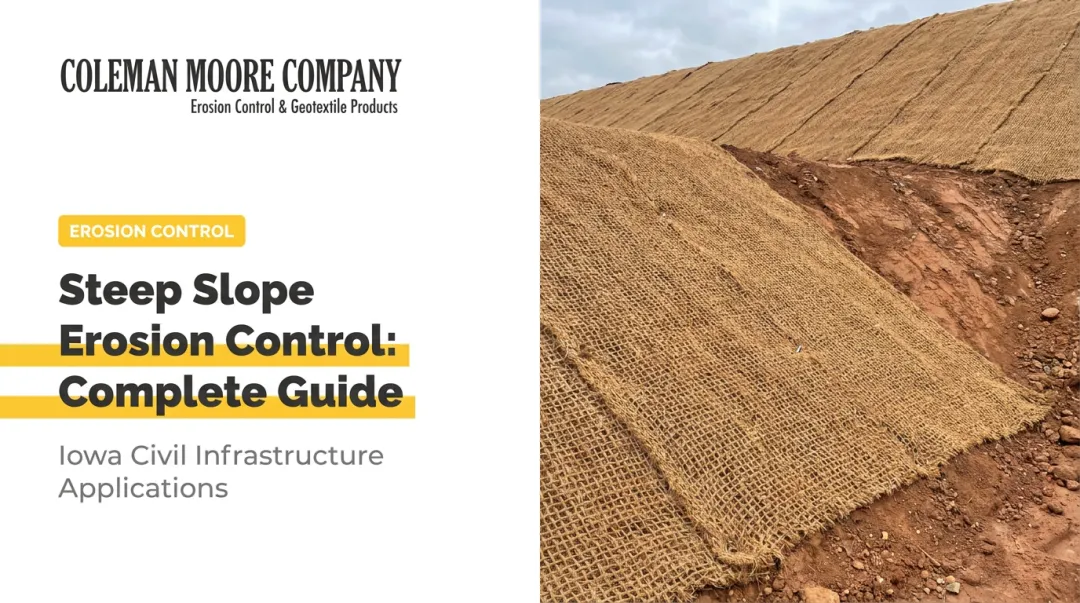
- American Excelsior Curlex® erosion control blankets — available in straw, wood excelsior, and coconut fiber configurations, with the double-netted coconut fiber variant offering 2–3 year longevity on slopes up to 1:1
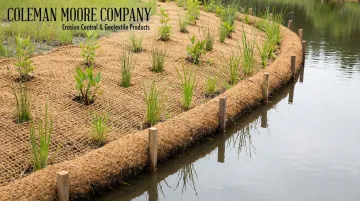
Indiana DOT/Purdue field research found an 88% minor problem rate and 25% major problem rate for coir roll installations. These are temporary protection measures, not permanent stabilization systems, and perform best as part of a broader revegetation plan.
How Geotextiles Support and Strengthen Natural River Bank Protection
Geotextiles serve as the foundation layer that allows other bank protection methods to perform as designed.
The most critical application is under riprap. Without a properly designed filter layer, fine soil particles migrate through the rock layer over time, causing settlement and premature failure. FHWA's riprap design guidelines (HEC-11) include filter design as a core component of any riprap revetment, and NRCS Technical Supplement 14K confirms that bedding or geotextile provides filtration and prevents soil migration from behind or beneath stone armor.
Beyond riprap, geotextiles contribute to several other bank protection applications:
- Woven geotextiles applied in shoreline and bulkhead projects where both load distribution and filtration are required
- Geogrids used in vegetated geogrid systems, an NRCS-listed bioengineering method where the grid reinforces the bank while vegetation grows through it, creating a permanently stable, living structure
- Kyowa Filter Units (geotextile bags filled with aggregate) deployed for high-energy bank and riverbed protection where conventional riprap isn't practical
For contractors and engineers working on Iowa bank stabilization projects, selecting the right geotextile means matching the fabric's hydraulic and filter properties to the site's soil type, flow conditions, and slope. Coleman Moore Company's team provides product selection assistance and technical guidance from design through installation, drawing on over 20 years supplying civil infrastructure projects across Iowa.
Choosing the Right River Bank Protection Method for Your Site
No single method fits every bank — three site factors drive the selection decision.
Slope and Bank Geometry
Iowa DNR guidance sets the benchmarks:
- 3H:1V or flatter — suitable for vegetation and most bioengineering methods
- 1.5H:1V — maximum slope for riprap
Steeper banks or those experiencing mass failure typically require structural support — riprap with geotextile underlayment, Flexamat (concrete block erosion control mat on geogrid backing), or geotextile bag systems — before softer methods can establish.
Water Energy and Current Speed
FHWA and Indiana DOT/Purdue research establishes these velocity thresholds:
| Velocity Range | Suitable Methods |
|---|---|
| Under 3 ft/s | Herbaceous vegetation alone |
| 3–5 ft/s | Woody species, bioengineering methods |
| 6–8 ft/s | Bioengineering approaching limits; riprap or reinforced systems preferred |
| Over 8 ft/s | Riprap with geotextile, engineered log jams, geotextile bags |
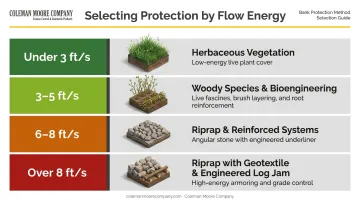
High-energy rivers leave little margin for soft methods. Where current speed or shear stress exceeds what plant roots can resist, structural or hybrid systems are the right call.
Regulatory and Permitting Requirements
Work on or near Iowa waterways requires early permitting review. Key requirements include:
- Section 404 (Clean Water Act) — regulates discharge of dredged or fill material into waters of the US
- Section 401 certification — state-level review for federal permits that may result in discharges
- Iowa DNR PERMT screening — determines floodplain development permit requirements
- Iowa PE certification — required for Method B installations (material placed in-channel), along with hydrologic and hydraulic modeling
Screen for all applicable permits before finalizing design. Complex bank failures near infrastructure warrant involvement from a qualified engineer. If you're sourcing materials or need guidance on compliant products for your specific site conditions, Coleman Moore Company has supplied Iowa civil projects for over 20 years and can help match the right system to your application.
Long-Term Tips for Sustained River Bank Protection
Installation is only half the work. Riverbanks are dynamic systems — flow volumes shift, vegetation establishes unevenly, and flood events stress any protection measure. Long-term performance depends on consistent monitoring and timely intervention:
- Inspect annually after major flood events — focus on the upstream and downstream ends of any protection measure, where undermining starts first
- Establish a livestock exclusion zone — NRCS guidance recommends fences at least 30 feet from the streambank; livestock concentration areas should be more than 100 feet from surface water
- Monitor vegetation survival — replace failed stakes or plantings within the first growing season; invasive species can colonize bare areas quickly
- Document baseline conditions — photograph and measure the bank at installation, then track changes annually; dated records support permit renewals, funding requests, and future repair decisions
- Build in a review cycle — if one method underperforms after a full growing season, adding riprap, a structural toe, or adjusting the planting strategy may be the right call
Conclusion
River bank erosion has identifiable causes and effective solutions. The problem accelerates when flooding increases hydraulic force, when vegetation is removed and roots no longer bind soil, and when land use changes direct erosive energy onto unprepared banks. Left unchecked, the consequences escalate quickly: lost farmland, damaged infrastructure, and degraded water quality.
Proactive assessment and early intervention cost far less than emergency repair once a bank fails. The most effective bank protection programs combine natural methods with appropriate geosynthetic support, match treatment to actual site conditions, and build in a maintenance plan before construction begins.
For contractors, engineers, and municipalities working on Iowa river bank stabilization projects, Coleman Moore Company can help select the right combination of geotextiles, erosion control blankets, coir products, and reinforcement systems for your specific site. Reach the team at 515-309-5577 or info@colemanmoorecompany.com.
Frequently Asked Questions
What are the most common river bank protection methods?
The three main categories are natural vegetation and bioengineering (live stakes, fascines, willow plantings), hard armoring (riprap), and geosynthetic systems (geotextile bags, erosion control blankets, turf reinforcement mats). Combining methods — riprap with geotextile underlayment plus revegetation above the waterline, for example — typically outperforms any single approach.
What kind of fabric do you put under riprap?
A nonwoven geotextile filter fabric is placed beneath riprap to prevent fine soil particles from migrating through the rock layer — a failure mechanism called piping. This filtration layer stabilizes the foundation and is a required component of properly designed riprap revetment, not an optional add-on.
Does planting vegetation alone stop river bank erosion?
Vegetation works well for low-to-moderate energy streams with stable slopes. On steep banks, high-velocity rivers, or sites with active mass failure, it needs to be supplemented with bioengineering structures or hard armoring before plants can establish and hold.
How do you know if a river bank needs erosion control?
Watch for exposed tree roots at the bank edge, undercutting or overhangs at the waterline, fresh near-vertical scarps from recent collapses, and sediment plumes entering the water during normal flow. Any of these signals active erosion that warrants a site assessment.
What is the difference between bioengineering and hard armoring for river banks?
Bioengineering uses living material — live stakes, fascines, brush mattresses — to build a root-anchored bank structure that strengthens over time. Hard armoring uses inert materials like riprap to physically resist hydraulic forces. Bioengineering suits lower-energy streams; hard armoring is needed where flow energy exceeds what plant roots can handle.
How long does it take for natural river bank protection methods to take effect?
Bioengineering and vegetation methods typically require one to two full growing seasons to establish and become fully effective. Structural methods like riprap provide immediate protection. For high-risk sites — especially those near infrastructure or with active mass failure — combining both approaches gives immediate stability while the biological component develops.